How to Automate LinkedIn Connection Requests: 5 Rules for 26% Reply Rates (2026)
Stop losing leads. 5 proven rules to automate LinkedIn connection requests safely and hit 26%+ reply rates with personalized welcome messages.
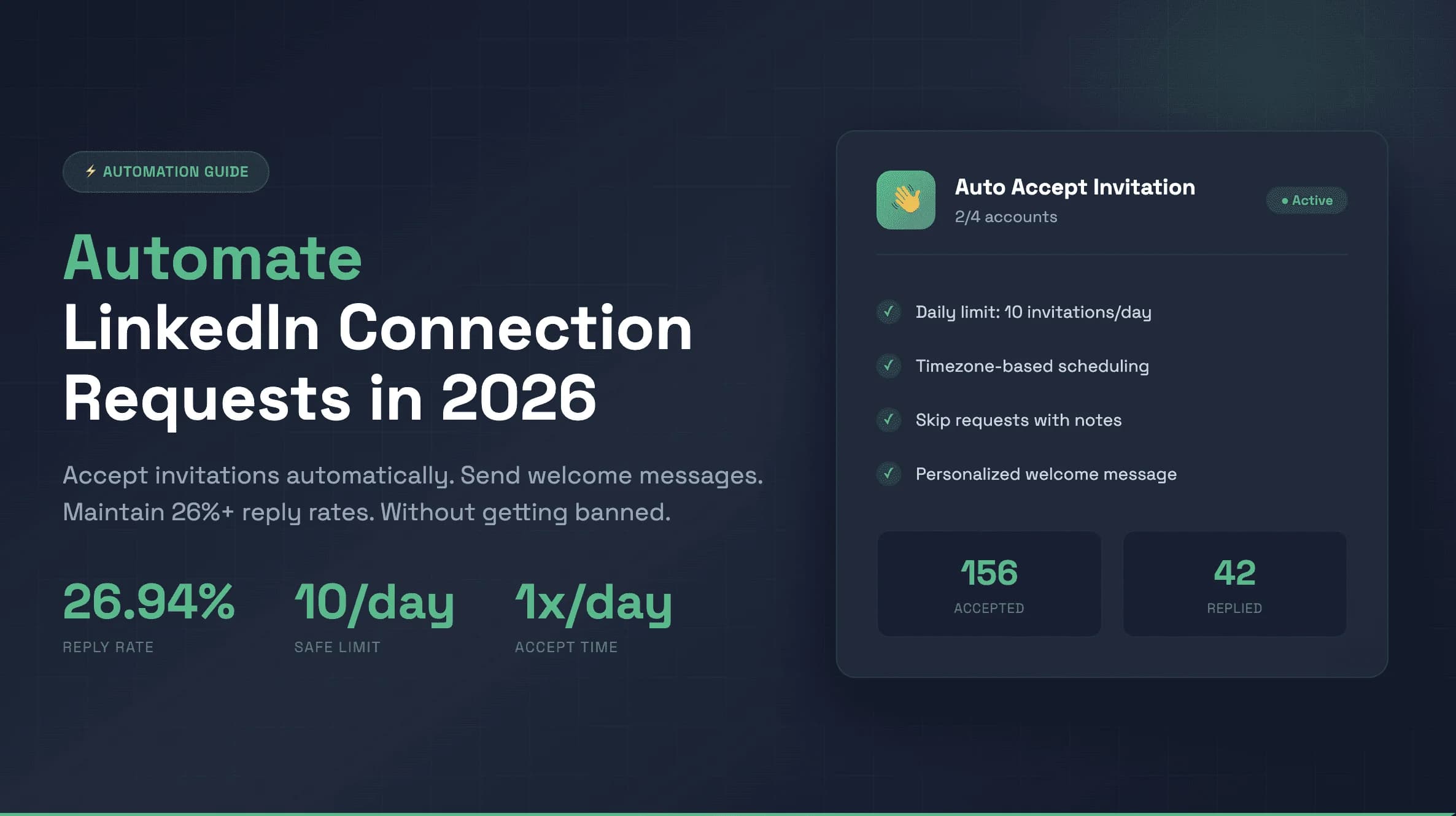
Every hour you delay accepting a LinkedIn connection request, you’re losing warm leads to faster competitors.
Someone sends you a connection request on Monday. You accept it on Friday. By then, they’ve already connected with your competitor, had a conversation, and moved on. Sound familiar?
days: average time to accept a LinkedIn connection request manually
Based on data from 4 LinkedIn accounts over 3 months
The fix? Automate it. But here’s the catch: most automation gets accounts banned. LinkedIn’s algorithm watches for bot-like behavior. Accept 50 requests in 10 minutes? Flagged. Send the same message to everyone? Shadowbanned.
This guide gives you 5 battle-tested rules to automate LinkedIn connection requests safely. You’ll learn the exact connection request limit per day in 2026, the 300-character note character limit, how to use safe linkedin automation tools, and how to maintain a 26%+ reply rate - without risking your account.
Why Automate LinkedIn Connection Requests?
When someone sends you a connection request, they’re showing intent. They found your profile. They’re curious. They clicked “Connect.” That’s a warm lead.
But if you wait 3 days to accept, you’ve lost the moment. They’ve moved on. The context is gone. Your reply rate drops dramatically.
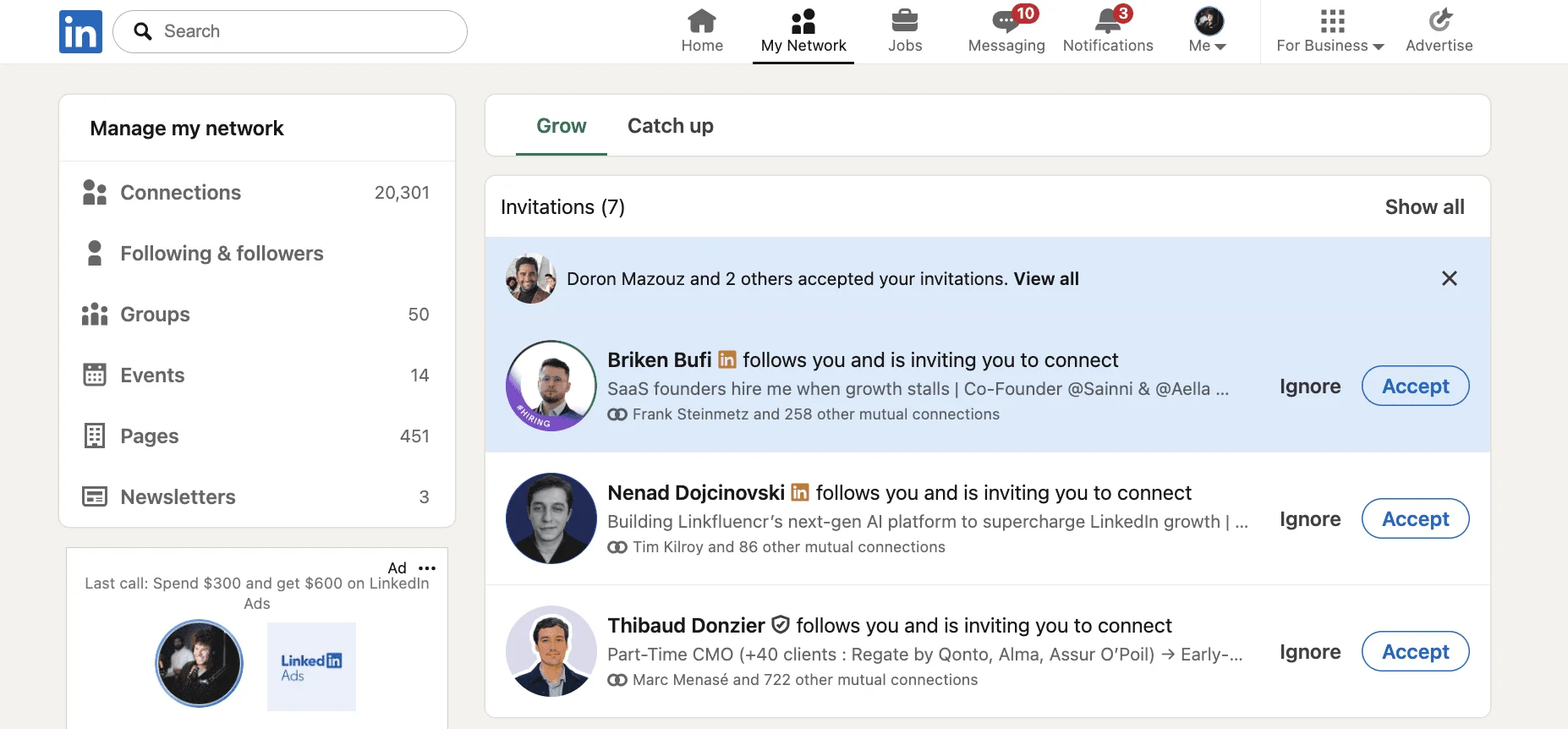
The Data
We ran auto-accept automation on 4 LinkedIn accounts for 3 months. Here’s what changed:
Before automation:
- Average acceptance time: 2-3 days
- Reply rate to welcome messages: 12%
After automation:
- Average acceptance time: same day (during working hours)
- Reply rate to welcome messages: 26.94%
The difference? Accepting within the same day, while the intent is fresh - not 2-3 days later.
reply rate on welcome messages after enabling auto-accept
Measured across 4 LinkedIn accounts over 3 months
The Problem with Most LinkedIn Automation
LinkedIn’s algorithm watches for patterns. Here’s what triggers account restrictions:
Most automation tools ignore these signals. They prioritize speed over safety. The result? Accounts get restricted, shadowbanned, or worse.
The fix: make automation look human.
LinkedIn Connection Request Best Practices: How to Automate Safely in 2026
These are the linkedin connection request best practices for 2026. Here’s the framework we use across 4 accounts with zero restrictions, using safe LinkedIn automation tools:
Rule 1: Respect the LinkedIn Connection Request Limit Per Day (2026)
What’s the LinkedIn connection request limit per day in 2026? LinkedIn allows 100 connection requests per week for free accounts, roughly 15-20 per day. But accepting 100 in one day? That’s suspicious.
Safe approach:
- Set daily limits per account (we use 10/day)
- Spread acceptances across working hours
- Never accept more than your normal pattern
If you typically accept 5-10 requests per day, don’t suddenly jump to 50.

Rule 2: Timezone-Based Automation
Accepting requests at 3 AM looks like a bot.
Smart automation:
- Runs based on each account’s timezone
- Only during working hours (9 AM - 6 PM)
- Adds random delays between acceptances
This mirrors human behavior. You check LinkedIn during the day, not at midnight.
Rule 3: Skip Connection Requests with Notes
When someone sends a connection request with a personalized note, they’re putting in effort. Auto-replying with a generic message feels cold.
Best practice:
- Auto-accept requests without notes
- Manually review requests with notes
- Respond personally to personalized outreach
Rule 4: Personalize Within the LinkedIn Connection Request Character Limit
The LinkedIn connection request note character limit in 2026 is 300 characters. That’s it. Generic messages that waste these 300 characters kill reply rates.
“Thanks for connecting!”
“Hey {{firstName}}, thanks for connecting! I saw you’re in {{industry}} - curious what brought you to my profile?”
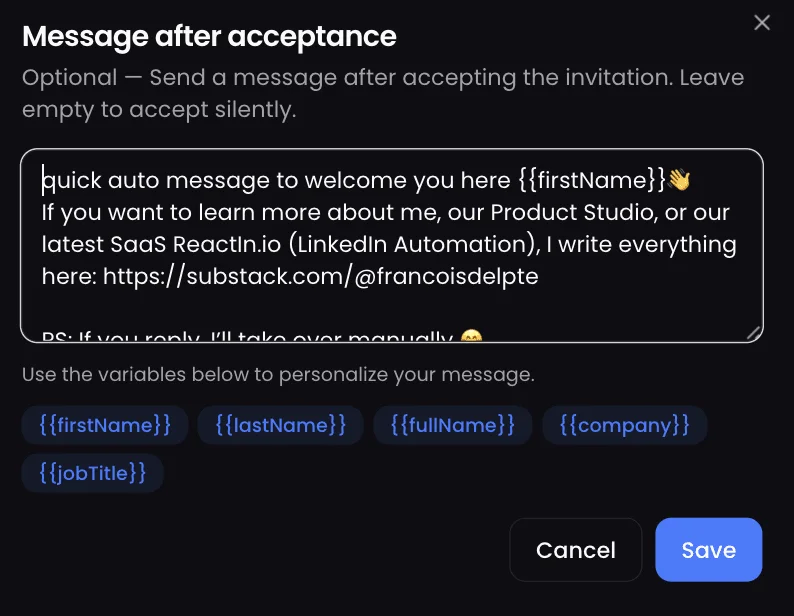
Use variables:
- {{firstName}} - First name
- {{lastName}} - Last name
- {{fullName}} - Full name
- {{company}} - Company name
- {{jobTitle}} - Job title
Personalization increases reply rates from 8% to 26%+.
reply rate increase when switching from generic to personalized welcome messages
Rule 5: Make Replies Opt-Out, Not Automated
The best welcome messages don’t feel automated.
Our template (26.94% reply rate):
“Hey {{firstName}} 👋 If you want to learn more about me, our Product Studio, or our latest SaaS ReactIn.io (LinkedIn Automation), I write everything here: https://substack.com/@francoisdelporte PS: If you reply, I’ll take over manually 😊”
Why this works:
- Casual tone (not corporate)
- Offers value (blog link)
- Sets expectation (manual takeover on reply)
- Single emoji (not excessive)
- Personal sign-off
The “I’ll take over manually” line is key. It tells people there’s a human behind the automation.
LinkedIn Connection Request Limits in 2026: Daily, Weekly & Monthly Breakdown
Understanding the exact LinkedIn connection request limits is critical before you automate anything. These limits changed in late 2025 and apply differently depending on your account type. Here's the complete breakdown for 2026.
Daily and Weekly Limits by Account Type
LinkedIn enforces connection request limits based on your subscription tier. These numbers represent the maximum safe volume - not the amount you should send from day one.
| Account Type | Daily Limit | Weekly Limit | Monthly Limit |
|---|---|---|---|
| Free Account | 15-20/day | ~100/week | ~400/month |
| LinkedIn Premium | 25-30/day | ~200/week | ~800/month |
| Sales Navigator | 50-60/day | ~400/week | ~1,600/month |
Important: These are upper limits for mature accounts. New accounts (under 6 months old) should start at 30-50% of these numbers and ramp up over 2-4 weeks.
Sales Navigator Connection Request Limits in 2026
Sales Navigator users get significantly higher limits, but the rules are different. Here's what you need to know:
- InMail credits (50/month) are separate from connection requests - they don't count toward your daily limit
- Sales Navigator allows up to 400 connection requests per week, but spreading them across 5 business days is safer
- Lead recommendations and saved leads don't affect your connection request quota
How to Warm Up to Full Volume
Never jump straight to your maximum limit. Here's a safe warmup schedule:
- Week 1: 5 connection requests per day (regardless of account type)
- Week 2-3: Increase by 5 per day each week
- Week 4+: Reach your target daily volume (10-15 for free, 25-30 for Premium, 40-50 for Sales Navigator)
The warmup period is non-negotiable. Skipping it is the #1 reason accounts get restricted in the first month of automation.
LinkedIn Connection Request Note Character Limit in 2026: 300 Characters
The LinkedIn connection request note character limit in 2026 is 300 characters. It applies to every account type — free, LinkedIn Premium and Sales Navigator — so upgrading your subscription does not buy you a longer note. Type past character 300 and LinkedIn simply stops accepting input: there is no truncation warning, no "continued" field, nothing. Whatever you wanted to say has to fit in roughly 50 words.
Note, Message, InMail: Three Different Character Limits
Most people searching for the LinkedIn connection request message character limit in 2026 are actually looking at one of three separate fields, and each has its own cap. Mixing them up is why a message that looked fine in your draft gets cut off at send time.
| Field | Character limit | When you use it |
|---|---|---|
| Connection request note | 300 characters | Attached to the invitation, before they accept |
| LinkedIn message (DM) | 8,000 characters | After the invitation is accepted — this is where your welcome message goes |
| InMail (Premium / Sales Navigator) | 200 subject / 1,900 body | To people outside your network, using InMail credits |
The practical consequence: the 300-character cap only constrains the invitation itself. Your welcome message has 26 times more room, which is exactly why Rule 5 above puts the real conversation after the acceptance, not inside the note.
How to Write Inside the 300-Character Limit
The LinkedIn connection note character limit in 2026 is tight enough that every generic sentence costs you a specific one. Four rules that survive the cut:
- Open with why you are reaching out, not with your job title. "I help B2B teams…" burns 40 characters saying nothing about them.
- Name exactly one thing: the post they published, the role they are hiring for, the group you share. One specific detail beats three vague ones.
- Delete any sentence that would work unchanged in an invitation to someone else. That is the test.
- Leave the ask out. The note buys the connection; the pitch belongs in the 8,000-character message that follows.
And count what your variables actually cost. A template that fits in 300 characters for "Jo" can blow past the limit for "Maximilian" — write against your longest prospect name, not your shortest, or your automation will send a note that stops mid-sentence.
Is LinkedIn Automation Safe? How LinkedIn Detects Automation Tools in 2026
The #1 question we hear: are LinkedIn automation tools safe in 2026? The honest answer: it depends entirely on the tool and how you use it. Here's how LinkedIn's detection works and how to stay invisible.
How LinkedIn Detects Automation (4 Methods)
LinkedIn uses multiple detection layers to identify automated behavior:
- Browser fingerprinting - LinkedIn detects Chrome extensions that inject scripts into the page. This is why browser-based automation tools are inherently unsafe in 2026.
- Behavioral analysis - LinkedIn's algorithm tracks action velocity, timing patterns, and session duration. Sending 30 connection requests in 2 minutes is inhuman.
- IP and device monitoring - Multiple accounts running from the same IP address, or a single account accessed from different countries within hours, triggers review.
- Content pattern detection - LinkedIn flags identical messages sent to multiple recipients. Even small variations (like changing just the first name) can be detected if the rest is identical.
What Makes a LinkedIn Automation Tool Safe in 2026
Safe LinkedIn automation tools share these characteristics:
- Cloud-based execution - no browser extension, no injected scripts, no fingerprint to detect
- Dedicated IP addresses - each LinkedIn account gets its own residential IP, matching the account's geographic location
- Human-like delays - random intervals between actions (not fixed 5-second delays, but variable 30-second to 3-minute gaps)
- Timezone-aware scheduling - actions only during the account holder's working hours
- Gradual warmup - adjustable daily limits that you increase progressively from low volume to target volume over 2-4 weeks
Human-Like Behavior Patterns That Keep You Safe
Beyond the tool itself, your automation settings determine safety. Follow these patterns:
- Vary your daily volume - don't send exactly 15 requests every single day. Some days send 12, others 18. Humans aren't consistent.
- Take breaks - pause automation for a day or two each week. No one is on LinkedIn 7 days a week.
- Mix automated and manual activity - log in manually, engage with posts, comment on updates. Pure automation with zero manual activity looks suspicious.
- Rotate message templates monthly - even personalized templates become patterns after hundreds of sends. Refresh your copy regularly.
How to Auto-Accept LinkedIn Connection Requests (Incoming Invitations)
Most automation guides focus on sending connection requests. But auto-accepting incoming invitations is equally powerful - and much safer. When someone sends you a connection request, the intent is already there. Auto-accepting and following up fast converts these warm leads at 26%+ reply rates.
Why Auto-Accept Incoming Requests?
Incoming connection requests are different from outbound prospecting:
- The prospect already knows who you are - they found your profile and chose to connect
- There's zero risk of being marked as spam - they initiated the connection
- Reply rates are 2-3x higher than cold outreach because intent is pre-established
Auto-Accept vs. Manual Accept: When to Use Each
Not every incoming connection request should be auto-accepted. Here's the decision matrix:
| Scenario | Recommendation |
|---|---|
| Request without a note | Auto-accept + send welcome message |
| Request with a personalized note | Accept manually + reply personally |
| Request from obvious spam/bot profile | Ignore or decline manually |
The key insight: auto-accept handles the volume, manual review handles the quality. Most incoming requests (80%+) come without a note and are perfect candidates for automation.
LinkedIn Automation Policy in 2026: What's Allowed and What's Not
LinkedIn's Terms of Service explicitly address automation. Understanding their policy helps you stay compliant while still benefiting from automation tools.
What LinkedIn's Terms of Service Say About Automation
LinkedIn's Professional Community Policies and User Agreement prohibit:
- Using bots, scrapers, or other automated methods to access, search, or collect data from LinkedIn
- Sending unsolicited messages or connection requests in bulk through unauthorized software
- Creating fake profiles or using profiles for automated mass outreach
- Using browser extensions that modify LinkedIn's interface or inject code into the platform
How to Stay Compliant in Practice
The reality is that LinkedIn's enforcement targets disruptive, spammy behavior - not thoughtful automation. Here's how compliant automation looks:
- Respect rate limits - stay within the daily and weekly connection request limits for your account type
- Personalize every interaction - no mass-blast identical messages to hundreds of people
- Provide value - every automated message should offer something useful, not just pitch
- Maintain human oversight - review automation performance regularly, respond personally when prospects reply
The bottom line: LinkedIn targets tools that damage user experience. Automation that respects limits, personalizes messages, and adds value doesn't trigger enforcement. Tools like ReactIn are designed specifically to operate within these boundaries.
Step-by-Step: Setting Up Auto-Accept in ReactIn
Here’s how to set up safe auto-accept automation:
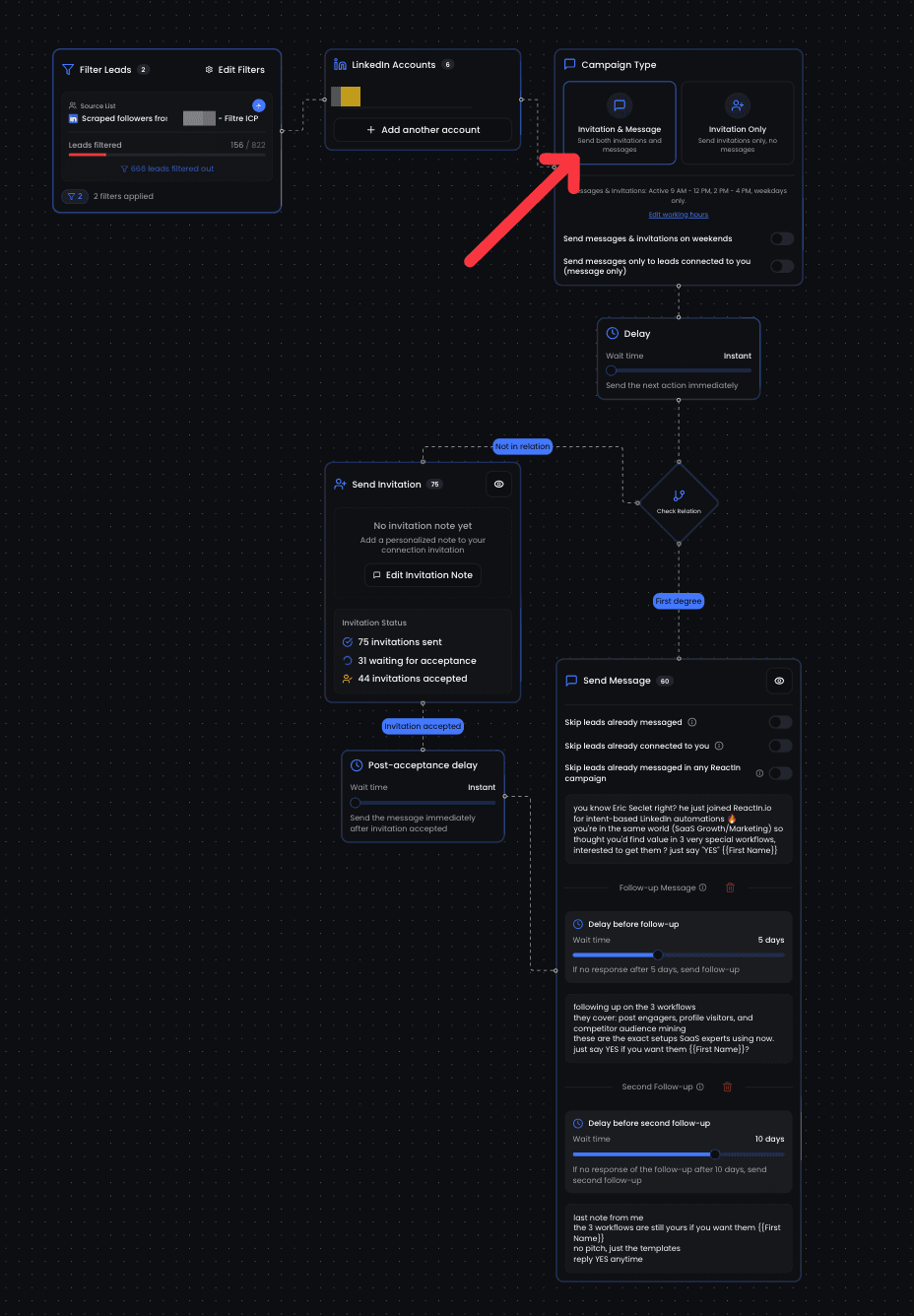
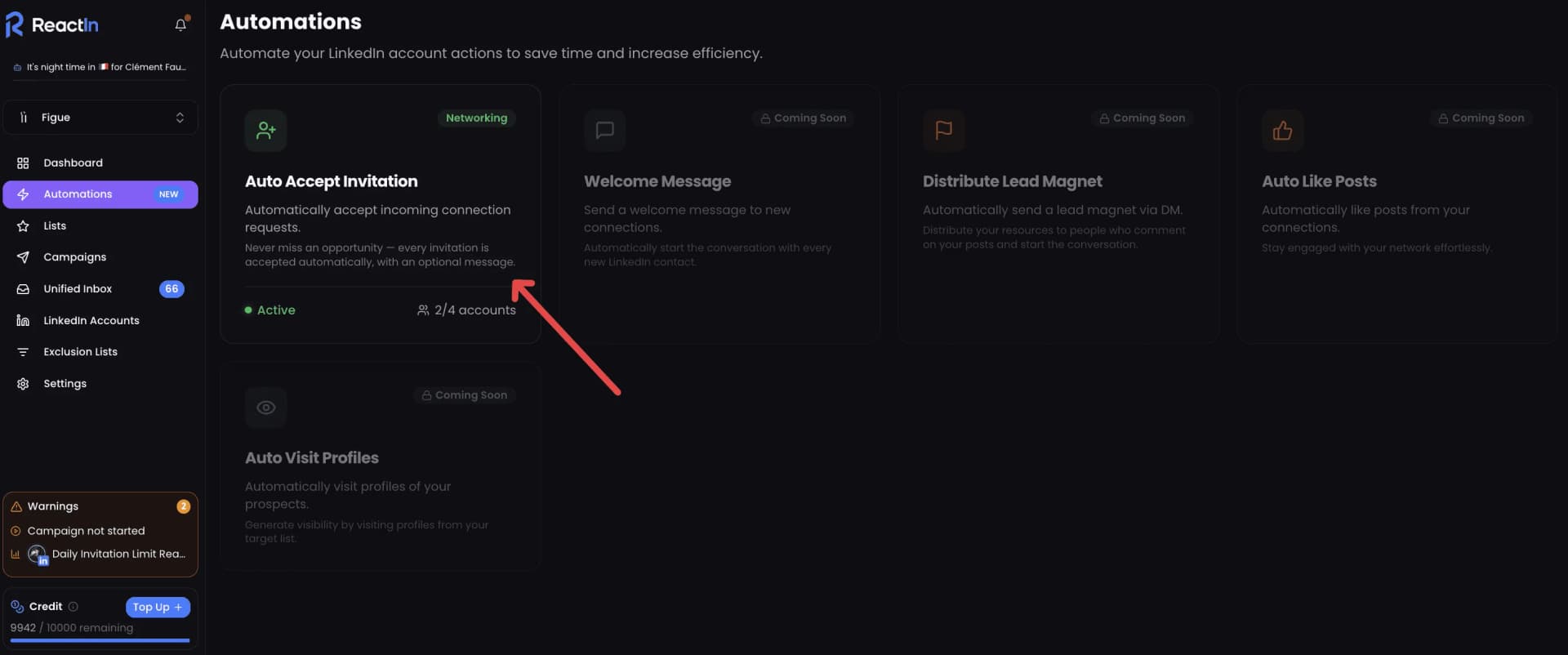
Enable Auto-Accept Automation
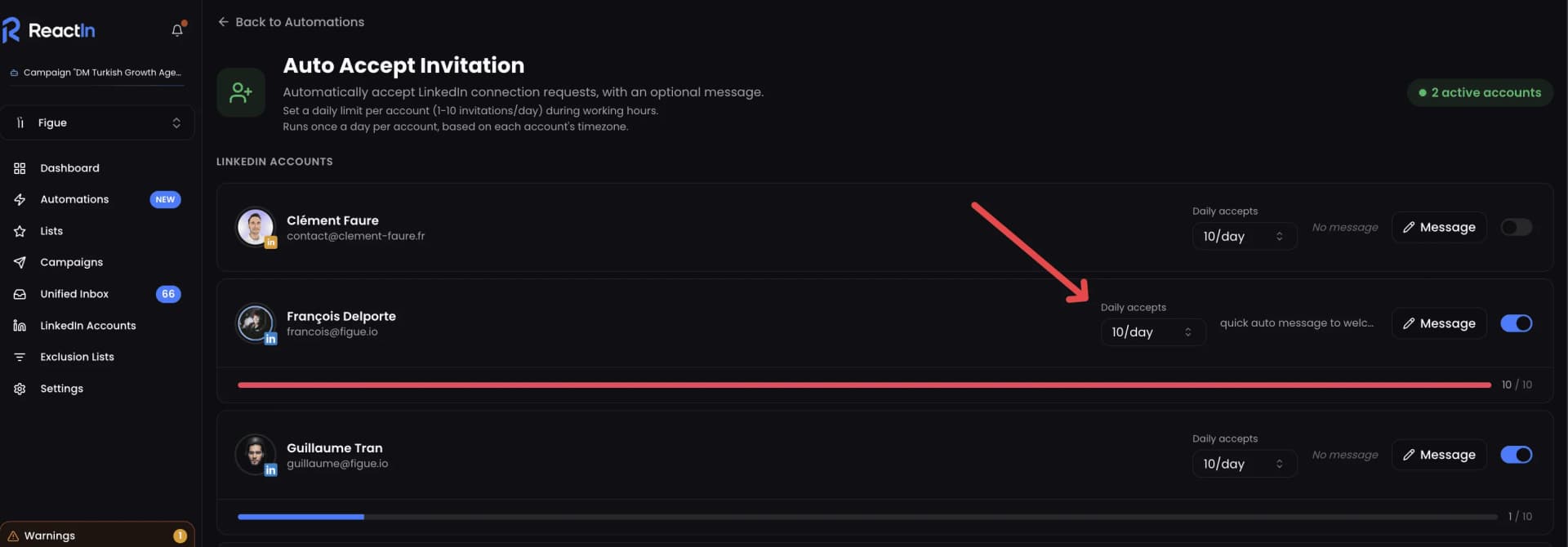
Go to Automations in ReactIn, click Auto Accept Invitation, and select your LinkedIn accounts. You can run this on multiple accounts - each operates independently with its own timezone and limits.
Set Daily Limits
Configure how many requests to accept per day based on your account type.
| Account Type | Daily Limit | Why |
|---|---|---|
| Personal (active) | 10/day | Matches typical human behavior |
| Personal (passive) | 5/day | Lower activity = lower limits |
| New account (<6 months) | 3-5/day | Build reputation slowly |
Never exceed 15/day unless you’re consistently hitting that number manually.
Configure Welcome Message
Toggle on “Message” and write your template. Follow this structure:
- Greeting with {{firstName}}
- Value offer (content, resource, insight)
- Call to action or question
- Personal sign-off
Length: keep it under 300 characters. Long messages feel like sales pitches.
Set Timezone
ReactIn automatically detects your account’s timezone from LinkedIn. Accepts run once per day during working hours. If you’re in Paris (CET), automation runs between 9 AM - 6 PM CET.
What NOT to Do
We’ve tested (and broken) enough automations to know what kills accounts:
Beyond Auto-Accept: 18 Intent Signals You Can Automate
Auto-accept is just one piece of the automation puzzle. The real power comes from stacking multiple intent signals.
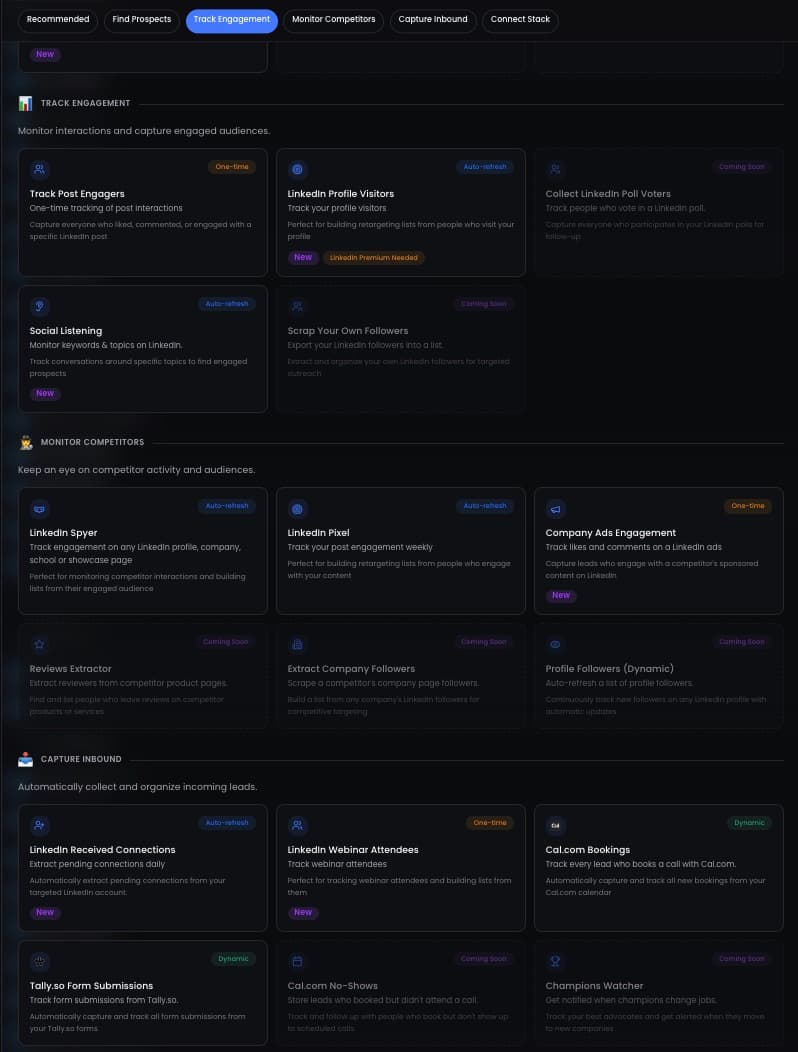
Top Tier Signals (30%+ Meeting Rate)
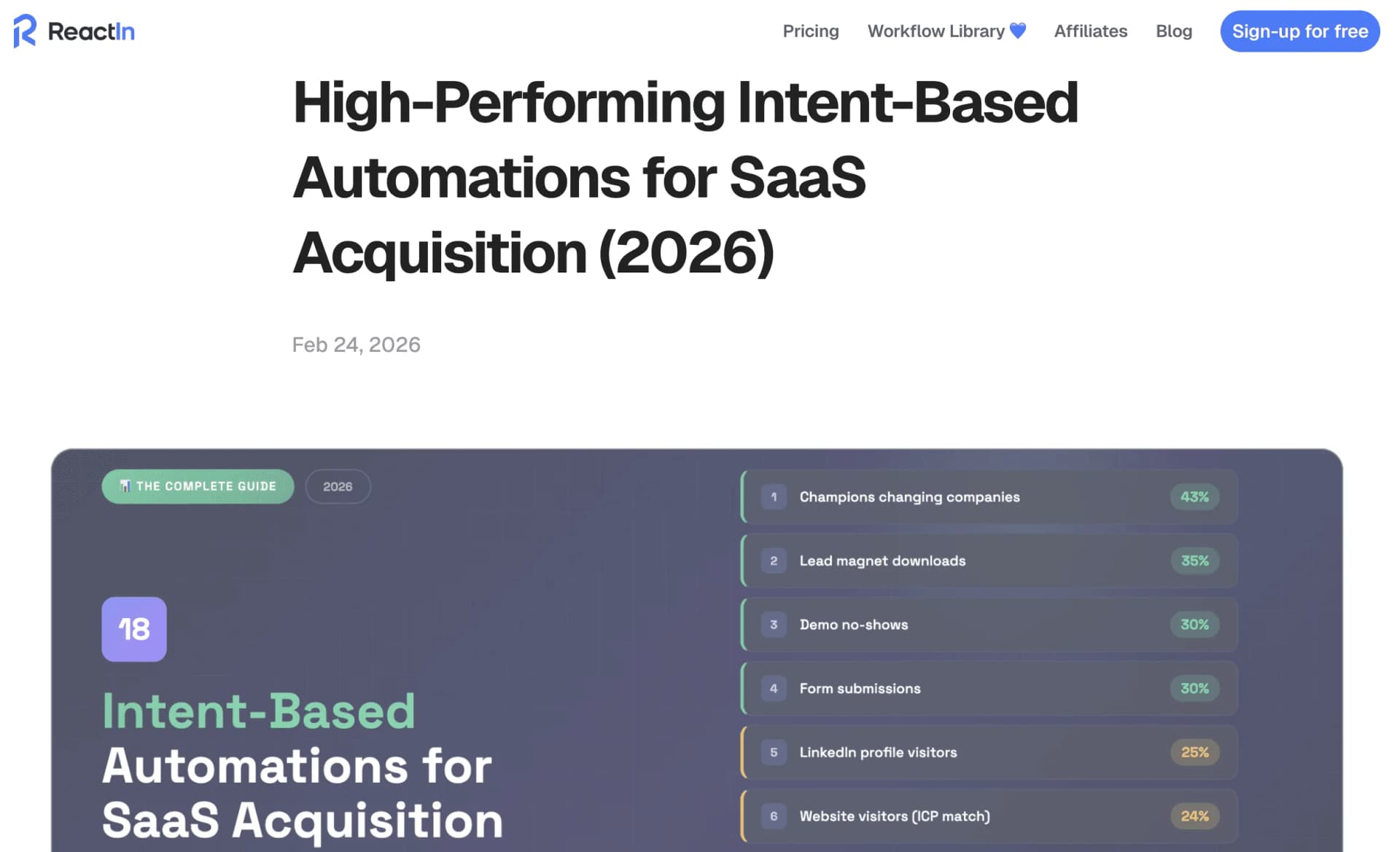
Champions changing companies - 43% meeting rate. Former customers starting new roles.
Lead magnet downloads - ~35% meeting rate. Trigger a LinkedIn DM within 24 hours.
Demo no-shows - ~30% meeting rate. Friendly follow-up 2-4 hours after missed call.
Form submissions - ~30% meeting rate. LinkedIn + email double tap.
High Intent Signals (20-29% Meeting Rate)
LinkedIn profile visitors - ~25% meeting rate. “Noticed we crossed paths” message.
Website visitors (ICP match) - 24% meeting rate. LinkedIn outreach within 24-48 hours.
Engaged with YOUR posts - 22% meeting rate. Follow-up DM referencing the post.
Engaged with competitor posts - 21% meeting rate. Value-first outreach (don’t mention competitor), built from the commenters you pull off their posts.
How to Stack These Signals
The magic happens when you combine multiple signals:
- Auto-accept connection requests (this guide)
- LinkedIn Pixel captures post engagers
- Lead magnet downloads trigger DM
- Profile visitors get follow-up
- Spyer monitors competitor audiences
Result: 5 intent signals running 24/7, feeding qualified leads into your pipeline automatically.
Conclusion
Automating LinkedIn connection requests isn’t about shortcuts. It’s about speed.
When someone connects with you, they’re showing intent. Accept fast, send value, start the conversation.
Done right, automation increases reply rates (26%+ vs 12%) and saves 30+ minutes per day.
“27% average reply rate across 5,000+ user campaigns”
Ready to automate? The signals are everywhere. Now go capture them.
This guide is part of our complete LinkedIn automation playbook for 2026 - covering everything from intent signals to safety limits.
Frequently Asked Questions
Sources & Further Reading
- Weekly invitation limits and what triggers them are documented in the LinkedIn Help Center on account restrictions.
- Automation sits under LinkedIn's terms. Read the LinkedIn User Agreement before you scale volume.
Related Articles
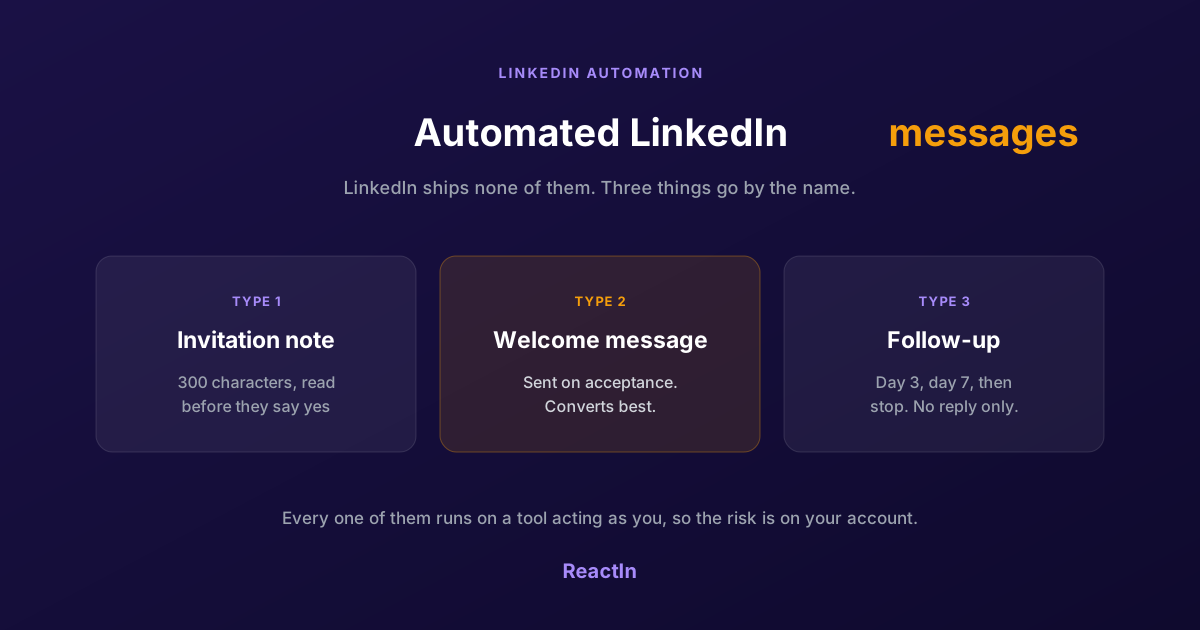
Automated LinkedIn Messages: How to Send Them Without Getting Restricted (2026)
LinkedIn ships no automated messaging at all. Here are the three things people call an automated LinkedIn message, how to set one up, what the terms actually say, and the three cases where writing by hand wins.
How to Automate LinkedIn Connection Requests in 2026 (Safe Method)
The safe method to automate LinkedIn connection requests in 2026. Daily limits by plan (20-50/day), 300-character note limit, best practices, step-by-step ReactIn setup, and safety comparison of top tools.
Best LinkedIn Automation Tool for Agencies in 2026 (Ranked by Total Cost, Not Feature Lists)
The 7 best LinkedIn automation tools for agencies in 2026, ranked by true cost at scale. ReactIn replaces 3-4 tools ($69/mo vs $300+/mo stack) with intent signals, AI enrichment, and unified inbox. Full "True Cost for 10 Accounts" comparison included.
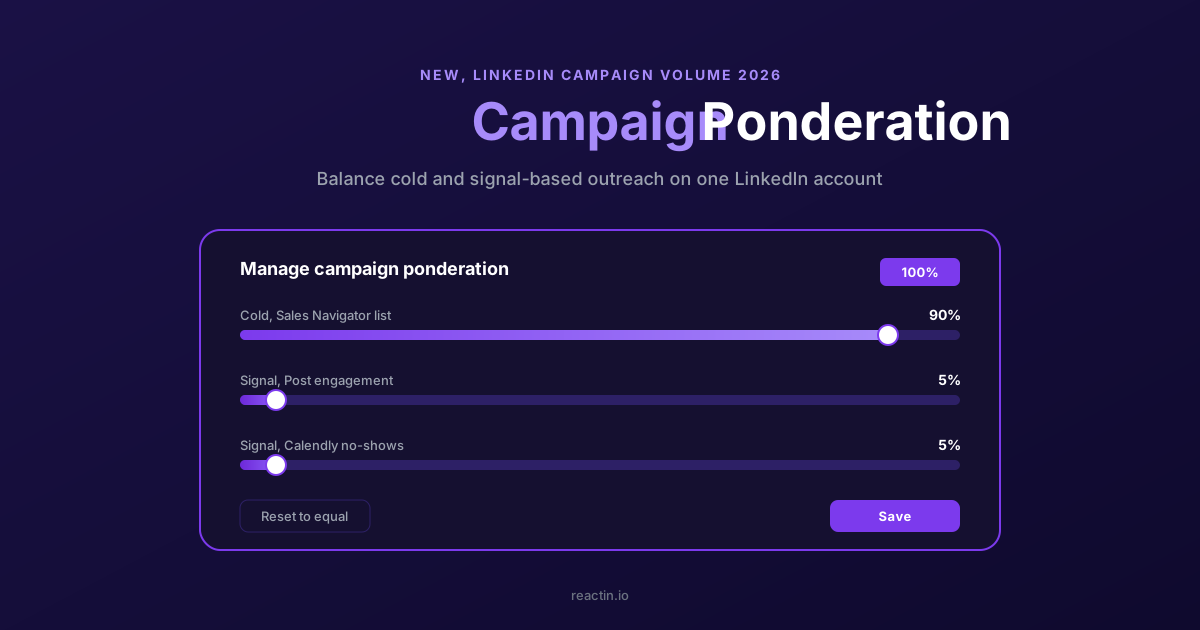
How to Balance LinkedIn Campaign Volume Across Tools (Waalaxy, HeyReach, Expandi, Dripify, LGM, PhantomBuster, Gojiberry vs ReactIn)
Most LinkedIn automation tools force you to pick: one big cold campaign, or none. Here is how Waalaxy, HeyReach, Expandi, Dripify, LGM, PhantomBuster and Gojiberry actually let you split daily volume between campaigns - and how ReactIn’s new Campaign Ponderation finally lets you run a 90/5/5 mix of cold + signal-based outreach.