The B2B SaaS GTM Stack in 2026: What a Series B Team Actually Runs
The best go-to-market tools for B2B SaaS in 2026. A complete 12-tool GTM stack with automation platforms that actually integrate - from prospecting to closing, built for scaling SaaS businesses. ~$500/month total.
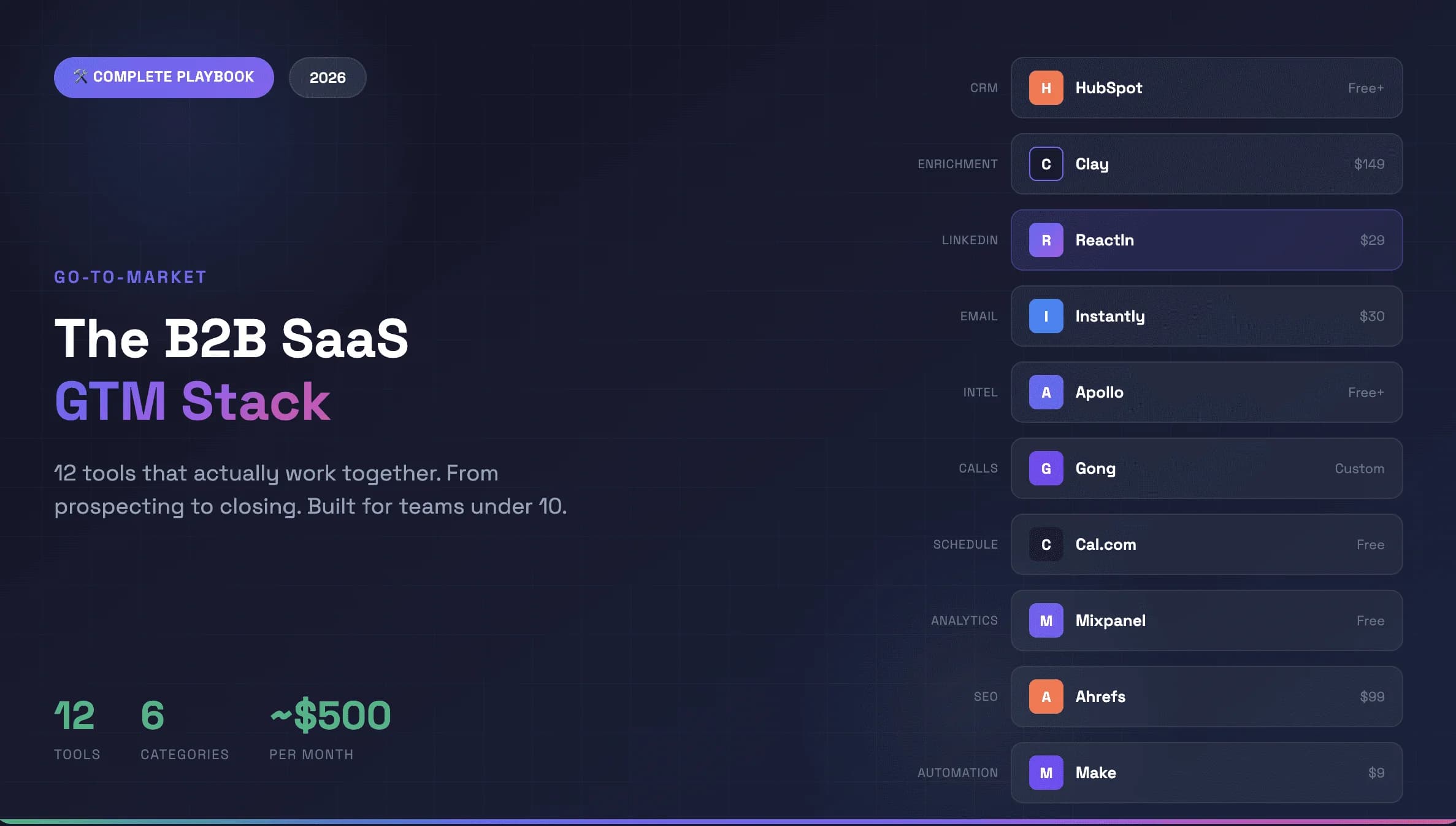
Looking for the best go-to-market tools for B2B SaaS in 2026? Most teams either overspend on enterprise suites they barely use, or cobble together random tools that don't talk to each other. Both approaches waste money and pipeline.
After building and optimizing GTM stacks for multiple SaaS companies, I've landed on a 12-tool sales automation stack that covers every stage from discovery to close - the best GTM stack automation platforms for SaaS, for a fraction of what legacy solutions charge.
Total monthly cost for a complete GTM stack
Based on Growth tier pricing
Best Go-to-Market Tools for B2B SaaS: The 12-Tool Stack
Here are the best go-to-market tools for B2B SaaS in 2026 at a glance. Scroll down for the detailed breakdown of each tool and how they connect into a modern sales automation stack.
| Tool | Category | Price | Key Job |
|---|---|---|---|
| HubSpot | CRM | Free-$800/mo | Single source of truth for pipeline |
| Clay | Data Enrichment | $149-349/mo | Enrich leads from 75+ sources |
| ReactIn | LinkedIn Outreach | $29-69/mo | Intent-based LinkedIn automation |
| Instantly | Cold Email | $30-77/mo | High-volume cold email at scale |
| Apollo | Sales Intelligence | Free-$79/mo | Prospect discovery and contact data |
| Gong | Conversation Intelligence | Custom | Call recording and deal intelligence |
| Cal.com | Scheduling | Free-$12/mo | Meeting booking with CRM sync |
| Make | Automation | $9-16/mo | Workflow glue between all tools |
| Notion | Content & Docs | Free-$10/mo | Content planning and team wiki |
| Loom | Video | Free-$12.50/mo | Async video for sales and onboarding |
| Mixpanel | Analytics | Free-$20/mo | Product and funnel analytics |
| Ahrefs | SEO | $99-199/mo | Organic traffic and keyword tracking |
The Philosophy: Integration Over Features
Enterprise sales suites promise everything in one dashboard. In practice, they do 20 things at 60% quality. A curated GTM stack of specialist automation platforms does 12 things at 95% quality - and costs less.
The key is how well the tools connect, not how many features each one has. Three principles guide this stack:
- One job per tool. Each tool does one thing exceptionally well. No overlap, no redundancy.
- Data flows automatically. Every tool feeds data to the next one in the pipeline. No manual exports, no copy-pasting.
- Replace, don't accumulate. If a tool isn't earning its cost back within 30 days, cut it. No shelf-ware.
With that mindset, here's the stack broken down by category.
CRM: HubSpot
HubSpot (Free-$800/mo)
HubSpot's free CRM is genuinely one of the best products in SaaS. Unlimited contacts, deal pipelines, email tracking, and meeting scheduling - all without paying a cent.
The reason HubSpot wins isn't features. It's ecosystem. Every tool in this stack integrates with HubSpot natively or through Make. That makes it the natural hub for your pipeline data.
- Free tier with unlimited contacts and deal tracking
- Native integrations with most GTM tools on the market
- Built-in email tracking, templates, and sequences
- Scales from solo founder to 200-person sales org without migration
Alternative: Attio - a modern CRM with a cleaner UI and better data modeling. Great for teams that find HubSpot bloated, but the integration ecosystem is smaller.
Data Enrichment: Clay
Clay ($149-349/mo)
Clay is the data enrichment layer that makes every other tool in your stack perform better. It pulls from 75+ data providers in a single query, waterfall-style - if one source doesn't have the data, it tries the next.
The real power is enrichment workflows. Import a list of companies, and Clay returns verified emails, tech stack data, funding info, employee count, LinkedIn URLs, and custom AI-generated research - all in one table.
- 75+ data providers in one platform (no separate subscriptions needed)
- Waterfall enrichment: automatically tries multiple sources per field
- AI-powered research agent that summarizes company news, blog posts, and hiring signals
- Direct integrations with HubSpot, Instantly, and outreach tools
Alternative: Clearbit (now part of HubSpot) - simpler enrichment with fewer sources, but tightly integrated if you're already on HubSpot paid plans.
LinkedIn Outreach: ReactIn
ReactIn ($29-69/mo)
LinkedIn is where B2B deals start. But most LinkedIn automation tools treat it like email - blast generic messages to thousands of strangers and hope for the best. ReactIn takes the opposite approach.
ReactIn's SmartLists capture people who already showed interest in you or your competitors - profile visitors, post engagers, competitor followers - and auto-enrolls them in personalized outreach campaigns.
- Spyer: Monitor any LinkedIn profile's network for new connections and engagements
- Pixel: Track website visitors and match them to LinkedIn profiles
- Profile visitor capture with automatic campaign enrollment
- Native Cal.com and Tally.so integrations for instant lead capture
- Cloud-based execution with human-like delays for account safety
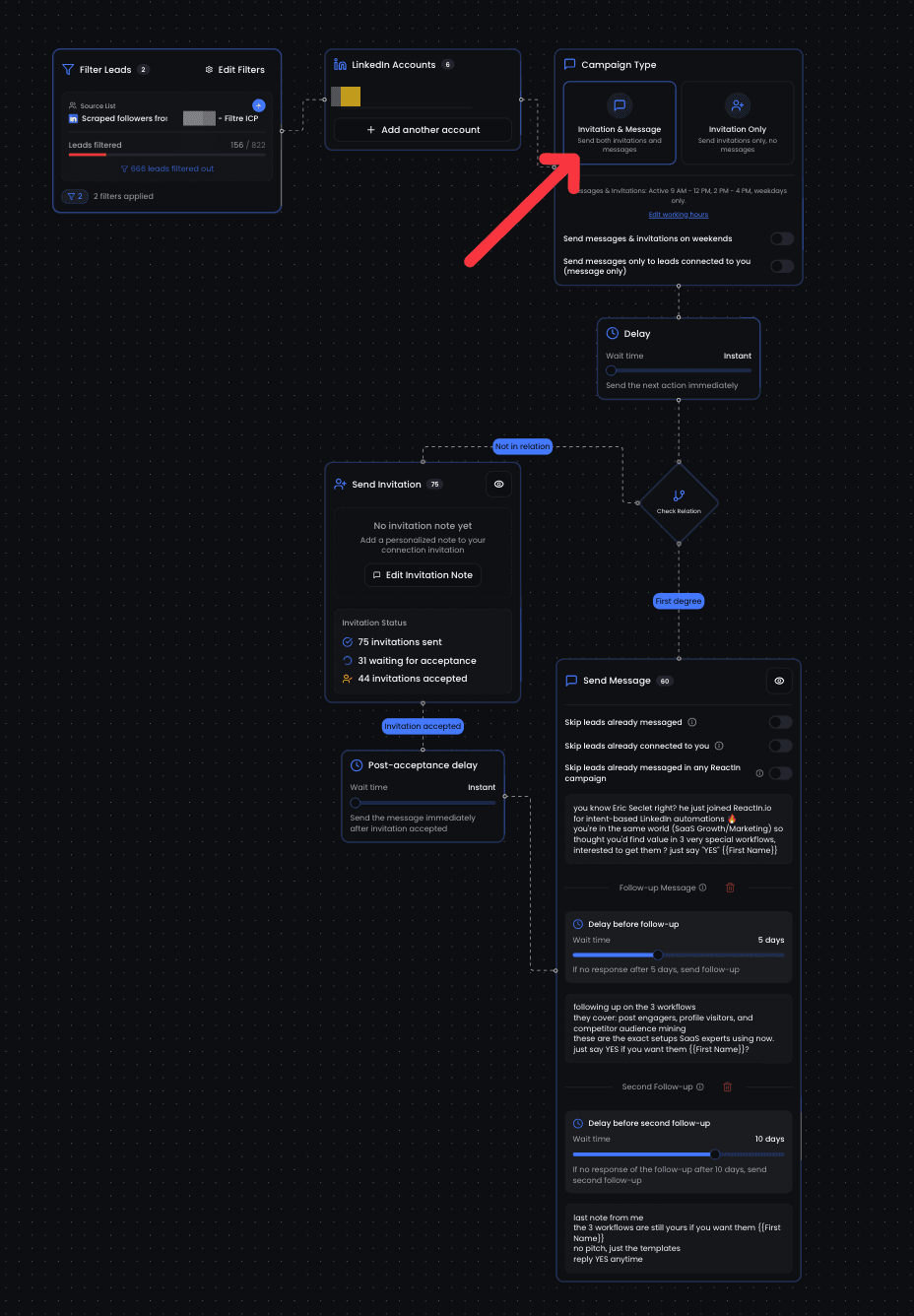
The result: 20-60% reply rates vs. the 5-15% you get with cold outreach tools. You're not interrupting strangers - you're responding to intent.
| Plan | Price | What You Get |
|---|---|---|
| Basic | $29/mo | Connection requests, SmartLists, basic intent signals |
| Growth | $69/mo | + DMs, smart inbox, all intent signals, advanced campaigns |
| Agency | $999/mo | up to 50 senders (~$20/sender), white-label, priority support |
Alternative: Expandi ($99/mo) - solid for volume-based automation, but lacks intent signals and costs 3x more per seat.
Cold Email: Instantly
Instantly ($30-77/mo)
Instantly is purpose-built for cold email at scale. Unlimited email accounts, built-in warmup, and a sending infrastructure designed to land in primary inboxes - not spam.
Where Instantly shines is email account rotation. Connect 10+ sending accounts and Instantly distributes your campaigns across them automatically, keeping each account under the radar.
- Unlimited email accounts with automatic rotation
- Built-in warmup that runs in the background
- AI-powered sequence generation and A/B testing
- Lead database with verified B2B contacts
Alternative: Lemlist - better for multichannel sequences (email + LinkedIn + phone), but more expensive and LinkedIn features require the $79/mo plan.
Email Deliverability: The Hidden GTM Stack Layer
You can have the best cold email copy in the world, but if your emails land in spam, your GTM stack is broken. Email deliverability has become a standalone discipline in 2026 - and the smartest teams treat it as a dedicated layer in their stack, not an afterthought.
The challenge is that inbox providers like Google and Microsoft have tightened their filtering algorithms significantly since 2024. Bulk senders now need proper authentication (SPF, DKIM, DMARC), dedicated warmup infrastructure, and careful volume management to consistently reach the primary inbox.
Email Deliverability Tools for Your GTM Stack
Here are the top email deliverability tools that complement Instantly and other cold email platforms in your GTM stack:
| Tool | Core Feature | Price | Best For |
|---|---|---|---|
| Instantly (built-in) | Auto-warmup & account rotation | Included | Teams already using Instantly for cold email |
| Mailreach | Email warmup & spam score testing | $25-50/mo per inbox | Standalone warmup for multi-tool email setups |
| GlockApps | Inbox placement testing | $59-99/mo | Teams needing detailed deliverability audits |
| Mail-Tester | Spam score analysis | Free-$30/mo | Quick sanity checks before launching campaigns |
Email Deliverability Best Practices for GTM Teams
- Domain separation: Never send cold email from your main company domain. Use a separate domain (e.g., team-company.com) with proper DNS records to protect your primary domain reputation.
- Gradual warmup: New email accounts need 2-3 weeks of warmup before sending campaigns. Instantly handles this automatically, but if using other tools, dedicate a warmup service like Mailreach.
- Volume management: Keep each sending account under 50 emails per day. Use Instantly's account rotation to distribute volume across 10+ accounts instead of pushing one account too hard.
- Authentication stack: Configure SPF, DKIM, and DMARC for every sending domain. Without all three, major inbox providers will flag your emails as suspicious regardless of content quality.
Sales Intelligence & Conversations
Apollo (Free-$79/mo)
Apollo is the best free prospecting tool on the market. The free tier gives you 60 email credits per month, basic filters, and access to a 275M+ contact database. The paid tiers unlock advanced filters, intent data, and bulk export.
- 275M+ verified B2B contacts with email and phone data
- Advanced filters: company size, funding stage, tech stack, job changes
- Intent signals based on topic research and website visits
- Native CRM integrations with HubSpot and Salesforce
Gong (Custom pricing, ~$150/user/mo)
Gong records and analyzes every sales call, giving you deal intelligence that's impossible to get manually. It's expensive, but the insight into what's actually happening in your pipeline is worth it at scale.
- Automatic call recording and transcription with AI summaries
- Deal intelligence: risk signals, competitor mentions, next steps tracking
- Coaching insights: talk-to-listen ratio, question frequency, topic analysis
Alternatives: Chorus (now ZoomInfo) for conversation intelligence. For Apollo alternatives, consider ZoomInfo (enterprise) or Lusha (simpler, cheaper).
Operations: Cal.com, Make, Notion, Loom
These four tools form the operational backbone of your GTM stack. Individually they're simple. Together, they eliminate 80% of the manual work that slows down sales teams.
Cal.com (Free-$12/mo)
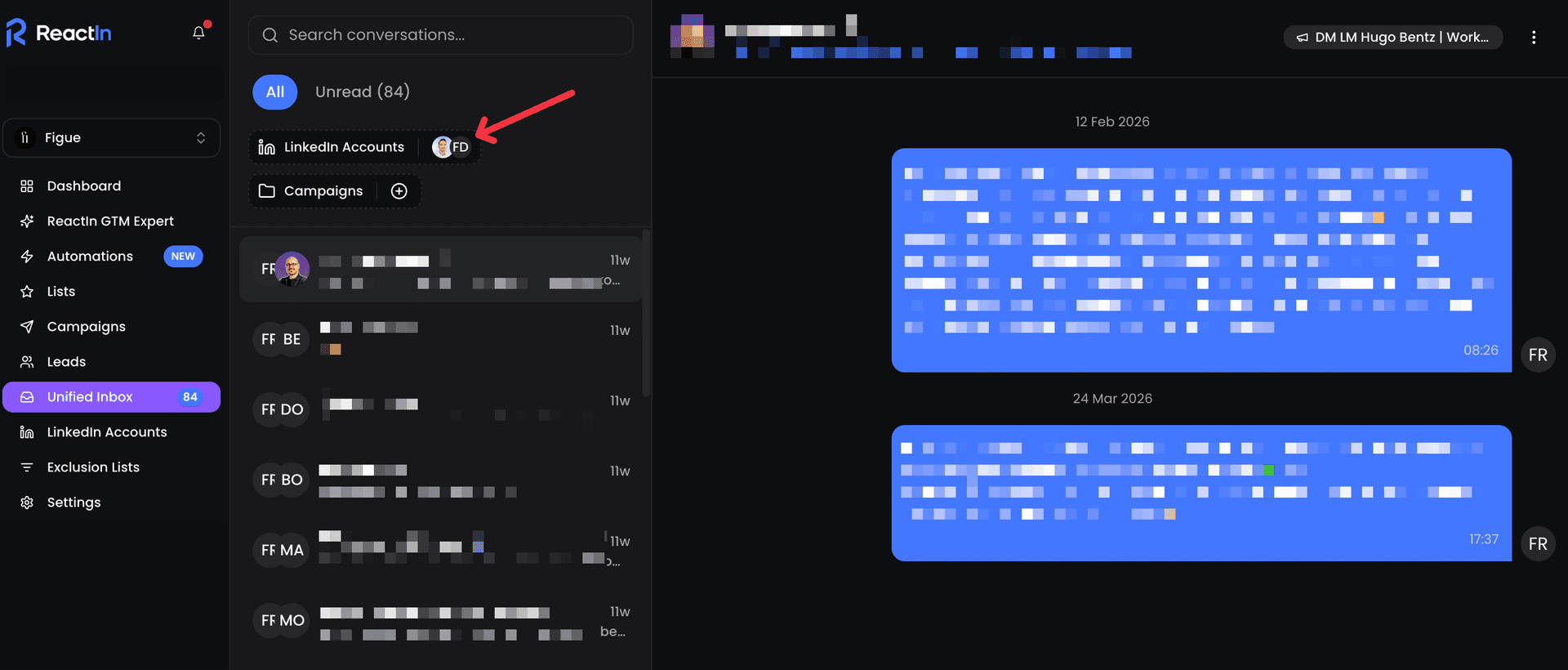
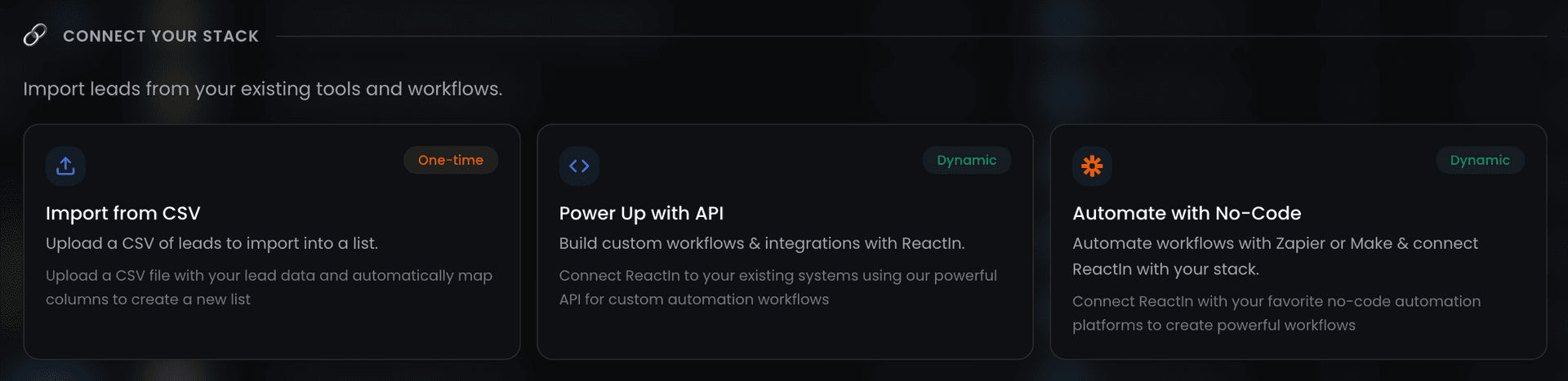
Open-source scheduling that integrates with everything. Cal.com's native ReactIn integration means that every meeting booked automatically triggers a LinkedIn connection request and CRM update.
- Native ReactIn integration: auto-connect with prospects who book meetings
- HubSpot sync: every booking creates or updates a CRM contact
- Round-robin routing for team scheduling
Make ($9-16/mo)
Make (formerly Integromat) is the automation glue that connects your entire stack. Build workflows that trigger across tools without writing code.
- Visual workflow builder with 1,500+ app integrations
- Conditional logic, error handling, and data transformation
- 10x cheaper than Zapier for the same number of operations
Notion (Free-$10/mo)
Notion AI handles content planning, meeting notes, playbook documentation, and team wikis. The AI features summarize meeting notes and draft follow-up content automatically.
- Content calendar and editorial planning
- Sales playbooks and battlecards accessible to the whole team
- AI-powered meeting note summaries and action items
Loom (Free-$12.50/mo)
Loom replaces live demos and internal walkthroughs with async video. Record a personalized product demo in 3 minutes instead of scheduling a 30-minute call.
- Personalized video messages for outbound prospecting
- Product demos and feature walkthroughs at scale
- Internal onboarding and process documentation
Analytics & SEO: Mixpanel, Ahrefs
Mixpanel (Free-$20/mo)
Mixpanel tracks what happens after the lead enters your funnel. Signup-to-activation rates, feature adoption, and revenue attribution - the metrics that tell you if your GTM is actually working. To know what a good signup-to-activation rate looks like, compare yours with our B2B SaaS funnel conversion benchmarks, stage by stage.
- Event-based analytics with funnel and retention analysis
- Free tier with 20M events/month (more than enough for most SaaS)
- Cohort analysis to track which acquisition channels produce the best users
Ahrefs ($99-199/mo)
Ahrefs is the SEO engine that drives organic pipeline. Track keyword rankings, analyze competitors' content strategies, and find content gaps that turn into lead magnets.
- Keyword tracking, site audit, and backlink analysis
- Content gap analysis: find what competitors rank for and you don't
- Content explorer: discover top-performing content in your niche
Alternatives: Semrush for all-in-one SEO (pricier). PostHog or Amplitude as Mixpanel alternatives.
Intent Data & B2B Data Provider Integrations
Intent data has become the secret weapon of high-performing GTM teams in 2026. Instead of blasting messages to cold lists, intent data tells you which companies are actively researching solutions like yours - before they ever fill out a form.
The best GTM automation software with intent data combines multiple data signals - topic research, website visits, job postings, and technographic changes - to surface accounts that are most likely to buy right now.
Top Intent Data & Contact Data Providers for GTM
Here's how the leading B2B data providers compare for GTM automation in 2026:
| Provider | Intent Signal Type | Price Range | Best For |
|---|---|---|---|
| Bombora | Topic-level research intent | $25K+/year | Enterprise ABM with granular topic signals |
| 6sense | AI-predicted buying stage | $30K+/year | Full-funnel ABM with predictive analytics |
| Apollo | Job change & topic intent | Free-$79/mo | SMB teams needing affordable intent signals |
| Clay | 75+ enrichment sources | $149-349/mo | Waterfall enrichment and custom signals |
| ReactIn | LinkedIn behavioral intent | $29-69/mo | Profile visitors, post engagers, competitor signals |
Key Integrations a B2B Data Provider Should Support
When evaluating B2B contact data providers for your GTM stack, the integrations matter as much as the data quality. A modern data provider should connect to:
- Your CRM (HubSpot, Salesforce) for automatic contact creation and enrichment
- Outreach tools (ReactIn, Instantly) to trigger campaigns based on intent signals
- Automation platforms (Make, Zapier) for custom workflows and data routing
- Enrichment tools (Clay) for waterfall data completion across multiple providers
Warm Outbound vs Cold Outbound: GTM Strategy Comparison
The biggest shift in B2B GTM strategy for 2026 is the move from cold outbound to warm outbound. Cold outbound - blasting unsolicited emails and LinkedIn messages to strangers - still works at scale, but reply rates have dropped below 2% for most teams.
Warm outbound flips the model: you only reach out to people who have already shown buying intent - they visited your website, engaged with your LinkedIn content, followed a competitor, or changed jobs into a role that matches your ICP.
| Dimension | Cold Outbound | Warm Outbound |
|---|---|---|
| Reply rate | 1-5% | 20-60% |
| Volume needed | 1,000+ contacts/week | 50-200 contacts/week |
| Personalization | Template-based with merge tags | Contextual, based on real behavior |
| Best tool | Instantly (cold email at scale) | ReactIn (intent-based LinkedIn) |
| Risk | Spam filters, domain reputation | Lower volume, needs intent signals |
Building a Warm Outbound GTM Engine
The best warm outbound GTM automation software combines three layers:
- Signal capture: ReactIn SmartLists automatically capture profile visitors, post engagers, and competitor followers on LinkedIn.
- Enrichment: Clay enriches each warm lead with company data, tech stack, funding, and contact info - so your first message references something real.
- Multichannel follow-up: If a warm lead doesn't respond on LinkedIn within 5 days, Instantly sends a complementary email sequence. Make orchestrates the handoff automatically.
Scaling Your GTM Stack: From Series A to Series B (10 to 50+ Reps)
A typical GTM stack for a Series B SaaS company looks very different from a seed-stage setup. As you scale from 10 to 50+ sales reps, every tool decision gets magnified - a $10/seat difference means $500/month at 50 reps.
The key to scaling your GTM stack is adding tools that solve the problems created by growth, not the problems you wish you had. Here's what to add at each stage:
Seed to Series A (1-10 reps)
At this stage, you need coverage, not sophistication. Every rep should be able to find prospects, reach out, and track deals without asking for help.
- HubSpot Free CRM - single source of truth for all pipeline data
- ReactIn Basic ($29/mo/seat) - LinkedIn outreach with intent signals
- Instantly ($30/mo) - cold email with unlimited sending accounts
- Make ($9/mo) - basic automation to connect CRM, outreach, and scheduling
Series A to Series B (10-30 reps)
Now the problems shift from "not enough pipeline" to "pipeline quality is inconsistent" and "reps are doing things differently." Add tools that standardize and enrich.
- Clay ($149-349/mo) - enrich every lead before it enters a sequence, so messaging is consistent and personalized
- Apollo Basic ($49/mo) - advanced filters and intent data to focus reps on the right accounts
- Gong (~$150/user/mo) - call recording and coaching to standardize what "good" looks like
- HubSpot Starter ($20/mo) - unlock automation workflows, reporting dashboards, and team-level features
Series B+ (50+ reps)
At 50+ reps, the GTM stack needs to support territory management, advanced reporting, and cross-functional alignment between sales, marketing, and CS.
- HubSpot Professional ($800/mo) - custom reporting, predictive lead scoring, and advanced automation
- 6sense or Bombora - enterprise-grade intent data for ABM programs across the full buying committee
- ReactIn Agency ($999/mo for up to 50 senders) - centralized LinkedIn automation at ~$20/sender with white-label management
- Ahrefs Standard ($199/mo) - SEO-driven content strategy to reduce dependence on outbound as the sole pipeline source
ReactIn Agency plan cost per seat at 50+ reps
vs. $69-99/seat for competitors at scale
Scaling the 12-Tool Stack: Startup to Enterprise Evolution
The 12-tool playbook isn't meant to be adopted all at once. The most successful GTM teams evolve their stack through three distinct phases, adding tools only when the previous tier creates a clear bottleneck.
The common mistake is buying tools for problems you don't have yet. A 3-person team doesn't need Gong. A solo founder doesn't need Clay. Match your tools to your actual stage, not your aspirational one.
Phase 1: Startup (3-5 tools, $68/mo)
At the startup phase, you need coverage across the three core GTM functions: pipeline tracking, outreach, and scheduling. Every other function is handled manually or skipped entirely.
- HubSpot Free + ReactIn Basic + Instantly Growth = core pipeline engine for under $70/month
- Cal.com Free + Make Core = scheduling and basic automation glue
- Skip enrichment, SEO, and conversation intelligence - they add cost without enough volume to justify them
Phase 2: Growth (8-10 tools, $466/mo)
Growth phase kicks in when your pipeline is flowing but reply rates plateau or personalization becomes a bottleneck. This is when enrichment and intelligence tools earn their cost.
- Add Clay ($149/mo) when your outreach templates feel generic and reply rates stall below 15%
- Add Apollo Basic ($49/mo) when you exhaust your LinkedIn network and need to prospect beyond warm connections
- Add Ahrefs ($99/mo) when you need organic pipeline to complement outbound - typically around 5,000+ monthly website visitors
- Upgrade HubSpot to Starter ($20/mo) when you need automation workflows and team-level reporting
Phase 3: Enterprise (12+ tools, $1,500+/mo)
Enterprise phase is for teams with 30+ reps where consistency, coaching, and cross-functional alignment matter more than raw pipeline volume.
- Add Gong (~$150/user/mo) when call coaching and deal intelligence become revenue drivers
- Upgrade HubSpot to Professional ($800/mo) for predictive lead scoring and custom reporting
- Add enterprise intent data (6sense or Bombora) for full-funnel ABM programs
- Switch to ReactIn Agency ($999/mo for up to 50 senders) for centralized LinkedIn automation at ~$20/sender
- Layer in specialized deliverability tools (Mailreach, GlockApps) as email volume scales past 1,000 emails/day
Startup (3-5 tools) → Growth (8-10) → Enterprise (12+)
Match tools to bottlenecks, not aspirations
GTM Playbook 2026: A Step-by-Step Strategy Framework for B2B SaaS
A GTM strategy for B2B SaaS isn't just a list of tools - it's a repeatable playbook that connects positioning, targeting, outreach, and measurement into a system. Here's a 5-step GTM playbook that works for SaaS teams at any stage in 2026.
This SaaS GTM playbook is designed to be executed in 30 days. Each step builds on the previous one, so don't skip ahead.
Define Your ICP and Buying Signals
Start with your last 10 closed-won deals. What do they have in common? Build your Ideal Customer Profile from real data, not assumptions.
- Company attributes: industry, size (employees/revenue), funding stage, tech stack
- Persona: job title, seniority, department, pain points they mentioned in sales calls
- Buying signals: what actions did they take before becoming a lead? (visited pricing page, engaged on LinkedIn, downloaded a resource)
Build Your Signal Capture Layer
Set up the tools that automatically capture buying intent so reps never start from a cold list.
- ReactIn SmartLists: capture LinkedIn profile visitors, post engagers, and competitor followers automatically, each from a template for people lists and company lists
- Apollo saved searches: monitor job changes, funding events, and tech stack changes in your ICP
- Clay enrichment: auto-enrich every captured lead with company data, verified email, and custom AI research
Design Your Outreach Sequences
Create warm-first outreach sequences that reference the specific signal that triggered the outreach.
- LinkedIn first: ReactIn sends a personalized connection request referencing why you're reaching out (their post, profile visit, mutual connection)
- Email follow-up: If no LinkedIn reply in 5 days, Instantly sends a complementary email sequence with a different angle
- Meeting booking: Every sequence ends with a Cal.com link that syncs directly to HubSpot
Connect Everything to Your CRM
Use Make to build automated workflows that ensure every touchpoint is tracked and no lead falls through the cracks.
- ReactIn → HubSpot: every LinkedIn interaction (connection, message, reply) creates or updates a CRM contact
- Clay → HubSpot: enrichment data auto-populates contact and company fields
- Cal.com → HubSpot: every booked meeting updates the deal stage and triggers a Slack notification
Measure, Iterate, and Cut
After 30 days, review every tool and every sequence. Keep what generates pipeline, cut what doesn't.
- Mixpanel: track conversion rates from lead to activated user - which channels produce the best customers?
- HubSpot reports: measure pipeline velocity by source (warm LinkedIn vs. cold email vs. inbound)
- Tool ROI: divide monthly cost by meetings booked. Any tool above $50/meeting should be reconsidered
12-Tool Quick Comparison Matrix: GTM Stack at a Glance
Use this comparison matrix to evaluate all 12 tools side by side. Each tool is rated by category, pricing tier, key differentiator, and the stage at which it becomes essential.
| Tool | Category | Pricing Tier | Key Differentiator | Essential From |
|---|---|---|---|---|
| HubSpot | CRM | Free / Mid / High | Largest integration ecosystem in B2B | Day 1 |
| Clay | Data Enrichment | Mid | 75+ data sources in one waterfall query | Growth stage |
| ReactIn | LinkedIn Outreach | Low / Mid | Intent-based automation with 20-60% reply rates | Day 1 |
| Instantly | Cold Email | Low / Mid | Unlimited accounts with built-in warmup | Day 1 |
| Apollo | Sales Intelligence | Free / Low | 275M+ contacts with free tier | Day 1 |
| Gong | Conversation Intelligence | High | AI-powered deal intelligence and coaching | Scale stage (30+ reps) |
| Cal.com | Scheduling | Free / Low | Open-source with native ReactIn integration | Day 1 |
| Make | Automation | Low | 10x cheaper than Zapier, 1,500+ integrations | Day 1 |
| Notion | Content & Docs | Free / Low | AI-powered notes, content planning, team wiki | Day 1 |
| Loom | Video | Free / Low | Async video replacing live demos at scale | Day 1 |
| Mixpanel | Analytics | Free / Low | Event-based funnel analytics with 20M free events | Week 4 |
| Ahrefs | SEO | Mid / High | Content gap analysis and keyword tracking | Growth stage |
GTM Stack for Scaling Your SaaS Business: Budget Tiers & Data Flow
Not every team needs the full stack from day one. Whether you're a solo founder or scaling a SaaS business to Series B, here's how to invest in go-to-market tools based on your stage:
Starter (~$68/mo)
| Tool | Plan | Cost |
|---|---|---|
| HubSpot | Free | $0 |
| Apollo | Free | $0 |
| ReactIn | Basic | $29 |
| Instantly | Growth | $30 |
| Cal.com | Free | $0 |
| Notion | Free | $0 |
| Loom | Free | $0 |
| Make | Core | $9 |
| Mixpanel | Free | $0 |
Growth (~$466/mo)
| Tool | Plan | Cost |
|---|---|---|
| HubSpot | Starter | $20 |
| Clay | Starter | $149 |
| Apollo | Basic | $49 |
| ReactIn | Growth | $69 |
| Instantly | Growth | $30 |
| Cal.com | Team | $12 |
| Ahrefs | Lite | $99 |
| Notion | Plus | $10 |
| Make | Pro | $16 |
| Mixpanel | Free | $0 |
| Loom | Business | $12.50 |
Scale (~$1,500/mo)
| Tool | Plan | Cost |
|---|---|---|
| HubSpot | Professional | $800 |
| Clay | Pro | $349 |
| Gong | Custom | ~$150/user |
| Ahrefs | Standard | $199 |
Data Flow
Every tool in the stack feeds data forward through five stages. No manual handoffs, no data silos.
Discovery (Apollo) → Outreach (ReactIn + Instantly) → Engagement (HubSpot + Cal.com) → Close (Gong + HubSpot) → Expand (Mixpanel + Notion)
Build Your Stack: 4-Week Plan
Week 1: Foundation
Set up HubSpot CRM, Cal.com for scheduling, and Loom for async demos. These three are free and give you the backbone.
Week 2: Outreach
Add ReactIn for LinkedIn outreach and Instantly for cold email. Connect both to HubSpot so every touchpoint is tracked.
Week 3: Intelligence
Add Apollo for prospect discovery and Make for workflow automation. Build your first automated flow: Apollo finds leads → Make pushes to ReactIn.
Week 4: Enrichment & Analytics
Add Clay for data enrichment and Mixpanel for funnel analytics. Now your outreach is personalized and you can measure what's working.
GTM Stack Cost Calculator
| Tool | Category | Plan | $/mo | |
|---|---|---|---|---|
| HubSpot CRM | Operations | $20 | ||
| Clay | Enrichment | $149 | ||
| ReactIn | Outreach | $69 | ||
| Instantly | Outreach | $77 | ||
| Apollo.io | Discovery | $49 | ||
| Gong | Analytics | $100 | ||
| Cal.com | Operations | $12 | ||
| Make | Operations | $9 | ||
| Notion | Operations | $10 | ||
| Loom | Outreach | $15 | ||
| Mixpanel | Analytics | $28 | ||
| Ahrefs | Discovery | $129 |
Cost breakdown by tool
Spend by category
This stack costs $667/mo vs hiring an SDR at $4,500/mo (base salary + commission not included).
Conclusion: The Best GTM Stack for Scaling Your SaaS in 2026
You don't need a $50,000/year enterprise suite to run world-class GTM. You need the best go-to-market tools for B2B SaaS - 12 automation platforms that each do one thing exceptionally well, connected by workflows that eliminate manual work.
The total cost? ~$500-800/month for a Growth-tier stack that covers discovery, enrichment, outreach, engagement, and analytics. That's less than what most teams spend on a single enterprise tool.
Start with the Starter tier at $68/month. Add tools as they earn their place by creating real pipeline value. Cut anything that doesn't deliver ROI within 30 days.
Looking for the best LinkedIn automation tool specifically? Read our detailed comparison of the top 6 LinkedIn automation tools for 2026.
This article is part of our Best LinkedIn Tools 2026 guide - covering automation, scraping, AI sales, and CRM tools ranked and compared.
Frequently Asked Questions
Sources & Further Reading
- According to HubSpot's State of Sales report, the average sales team uses 10+ tools daily.
- For more GTM frameworks, see SaaStr's go-to-market resources.
Related Articles
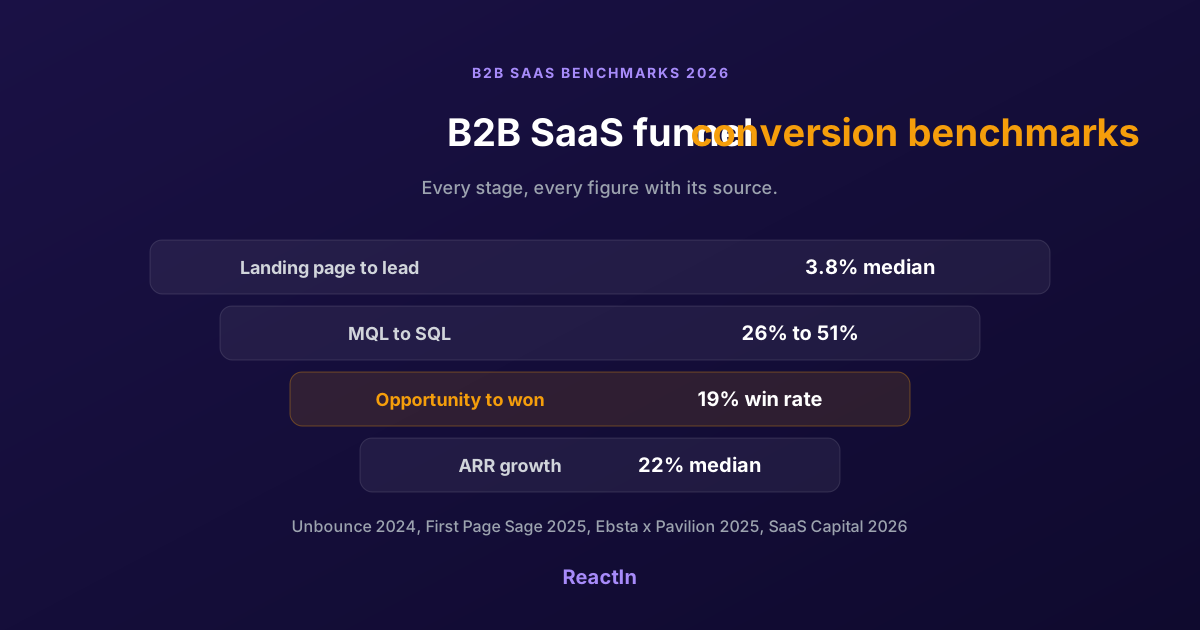
B2B SaaS Funnel Conversion Benchmarks 2026: Every Stage, With Sources
Sourced conversion benchmarks for each stage of the B2B SaaS funnel, from landing page to closed-won, plus growth and retention medians, and why the numbers you find online disagree.
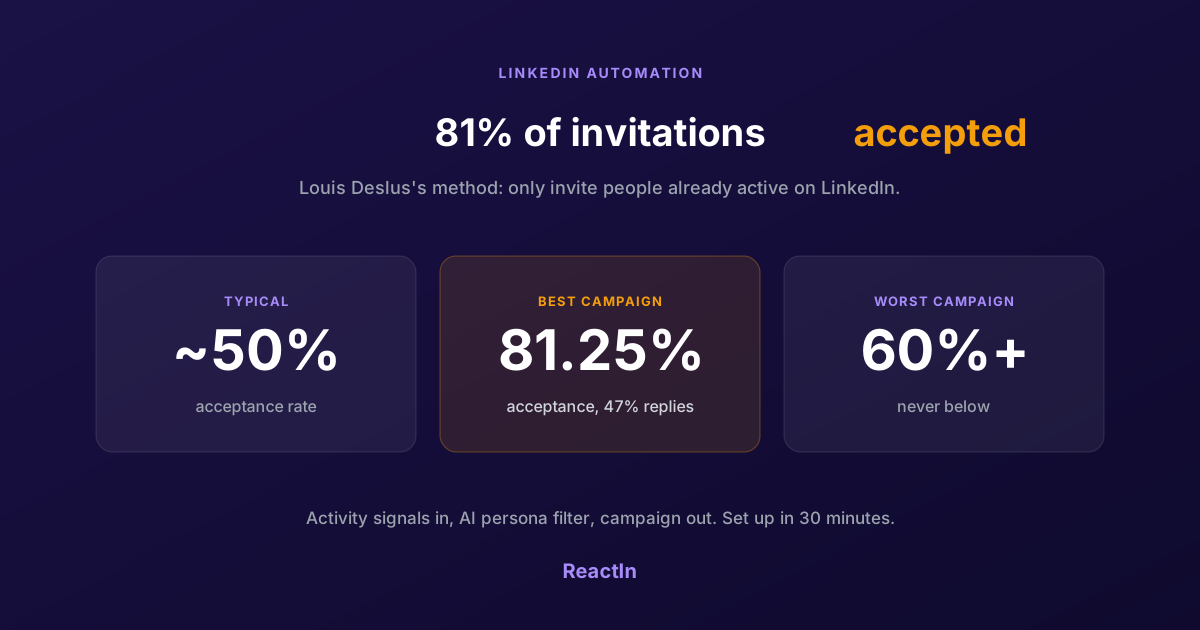
81% LinkedIn Acceptance Rate: Louis Deslus's Method, Set Up in 30 Minutes
Louis Deslus gets 81% of his LinkedIn invitations accepted and no campaign under 60%. The method: invite only people already active on LinkedIn, filter them to your persona, and let the list feed the campaign.
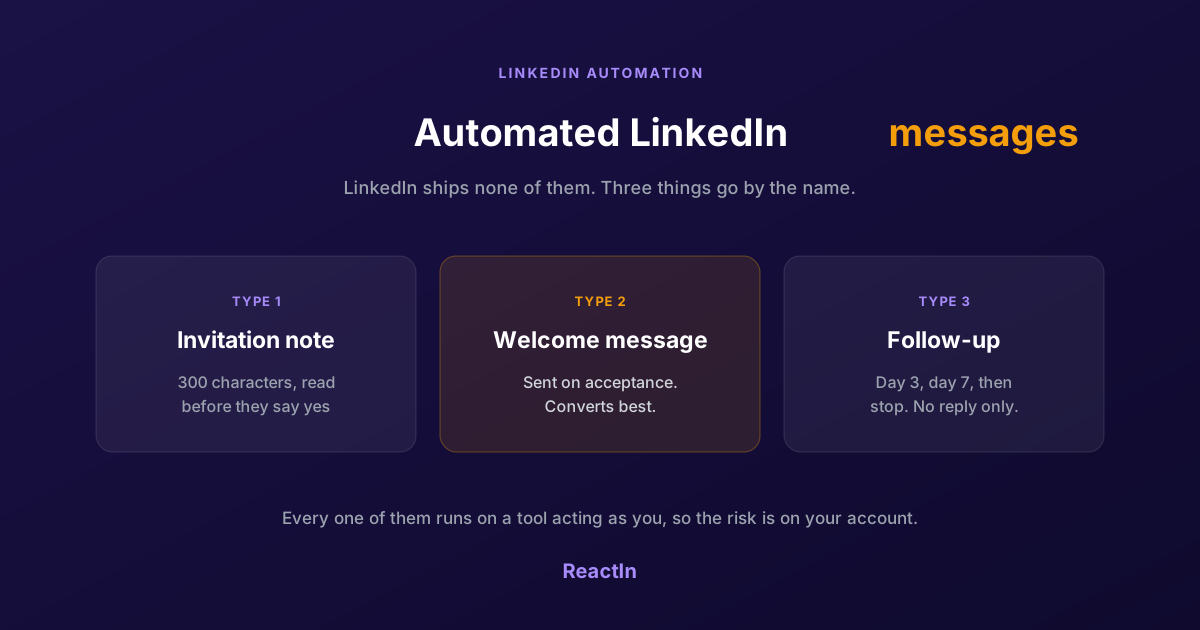
Automated LinkedIn Messages: How to Send Them Without Getting Restricted (2026)
LinkedIn ships no automated messaging at all. Here are the three things people call an automated LinkedIn message, how to set one up, what the terms actually say, and the four cases where writing by hand wins.
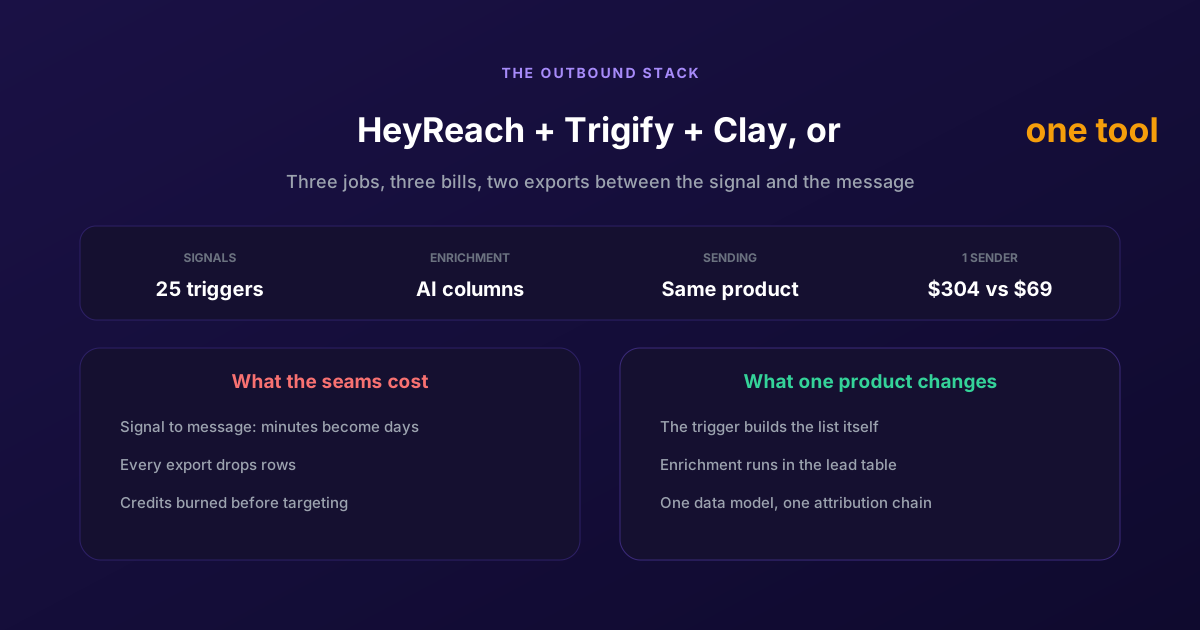
ReactIn = HeyReach + Trigify + Clay: One Tool for Cold and Warm Outreach
Three products, three bills, and two exports between the signal and the message. Here is what each tool owns, what the seams cost in latency and credits, and when keeping the stack is still the right call.