ReactIn = HeyReach + Trigify + Clay: One Tool for Cold and Warm Outreach
Three products, three bills, and two exports between the signal and the message. Here is what each tool owns, what the seams cost in latency and credits, and when keeping the stack is still the right call.
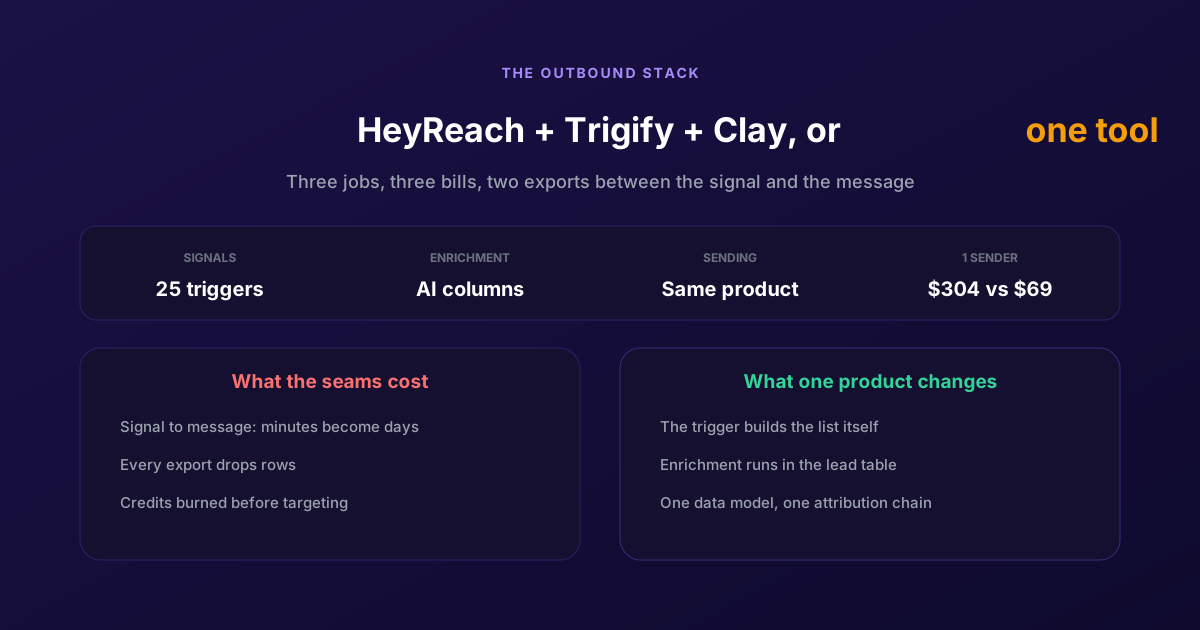
A prospect likes your competitor's post on Tuesday morning. Trigify catches it. The row lands in Clay, where a waterfall runs and a GPT column writes an icebreaker. You export a CSV. You import it into HeyReach. The message goes out Thursday afternoon.
Fifty hours after the only moment that mattered. You paid three subscriptions for that delay: three data models, two exports, and one attribution chain nobody can follow back to the reply.
The all-in-one cold and warm outreach question is not about saving money on seats. It is about whether the signal survives the trip from the moment someone moved to the moment you wrote to them.

What each tool actually does
| Job | HeyReach | Trigify | Clay | ReactIn |
|---|---|---|---|---|
| Find who is warm right now | No | Yes, social signals | No | Yes, 25 triggers |
| Enrich and score the lead | Credits only | No | Yes, best in class | Yes, AI columns |
| Send from LinkedIn, rotate senders | Yes, core | No | No | Yes |
| Reply in a unified inbox | Yes | No | No | Yes |
| Cold lists: CSV, LinkedIn search, Sales Navigator | Yes | No | Partial | Yes |
| Signal to first message | Manual handoff | Export | Export | Same product |
| Drive it from an AI agent | MCP server | Not published | Not published | MCP server |
| Entry price | $79 per sender per month | From $40 per month | Free, then $185 per month | $29 per month, $69 with sending |
Pricing verified 15 September 2026 on each vendor's public pages. All four change their terms often, so check before you buy.
Read it the short way: HeyReach sends, Trigify listens, Clay enriches. Each one is good at its job. The question this article answers is what the three seams between them cost you, in hours and in money.
Why ReactIn is shaped this way
Most outbound tools start from a list. ReactIn started from a signup.
The first version existed to solve one flow. Someone creates an account on a SaaS with an email and a password. An API resolves that email to a LinkedIn profile. The founder sends a DM a few minutes later: hey, you just signed up, anything I can help with?
That was the whole product. It worked because the message arrived while the person still had the tab open.
Every signal added since is the same idea pointed at a new surface:
- someone likes a competitor's post
- someone engages with a company's ads
- someone follows a page
- someone comments under a post matching a keyword
- someone attends a LinkedIn event
- someone views your profile
- someone books a call or submits a form
- a company starts hiring for a role that implies your problem
Warm first, always. The cold features came last, on purpose: CSV import, LinkedIn search, Sales Navigator search. They exist because pipeline math needs volume too, not because they are the interesting part.
That order matters. A sending tool that later bolts on signals treats intent as a filter on a list. A tool born on intent treats the list as a by-product of the trigger. Same words on a feature page, opposite behavior in production.
Two of those triggers have their own guides: contacting the people who viewed your profile and building a lookalike audience from your best customers. Both are lists that refill themselves rather than exports you redo every Monday.
The three jobs, and the tax between them
Outbound is three jobs: find who is warm, enrich them, write to them. Three products do those jobs well. What nobody prices for you is the work of joining them.
Job 1: signals, which is Trigify's job
Trigify is a social listening and GTM signal product. It tracks engagement on posts and profiles and hands you the people who moved. Plans start at $40 per month on a credit system, with a Max tier at $199 per month and a pay as you go option. It is good at what it does.
What it does not do is enrich in depth, and send. It is a source, and a source needs two other products behind it.
ReactIn covers the same surface natively, with 25 trigger types today. The families:
| Signal family | Examples | Temperature |
|---|---|---|
| Post engagement | Likes, comments, engagers on posts matching a keyword | Warm |
| Competitor and audience | Everyone who likes a given profile's posts, page followers, ad engagement | Warm |
| Inbound on you | Profile visitors, received connection requests, lookalikes of your best customers | Hot |
| Product and GTM | Your own API on signup, Cal.com bookings, Tally submissions, Brevo list adds, Zapier and Make | Hot |
| Company level | Company watchlists, company followers, hiring signals, competitor relationships | Warm |
| Cold basics | LinkedIn search, Sales Navigator search, CSV import | Cold |
Each one builds a SmartList that refills itself. The list is never a snapshot, it is a subscription to a behavior.
Job 2: enrichment, which is Clay's job
Clay is the strongest enrichment product on the market and this article is not going to pretend otherwise. Its 2026 plans run Free, Launch at $185 per month with 15,000 actions and 3,000 data credits, Growth at $495 per month with 40,000 actions and 6,000 credits, then Enterprise. Legacy Starter, Explorer and Pro seats at $149, $349 and $800 still exist for customers who had them.
What you are buying is breadth: more than a hundred providers in a waterfall, on any data type, for any go to market motion.
What you are paying for that breadth is a second data model, credits that burn on rows you never message, and an export step between the enrichment and the send.
ReactIn enriches inside the lead table instead. AI columns on every row, for icebreakers drawn from recent activity, ICP fit scoring and company context, plus verified contact data. Growth includes 2,000 enrichment credits per month. It is narrower than Clay by design: it covers the LinkedIn centric enrichment that outbound actually consumes, and skips the rest.

Job 3: sending, which is HeyReach's job
HeyReach solved multi sender rotation properly, and agencies rightly love it for that. The grid, verified on their pricing page on 15 September 2026: Growth at $79 per sender per month with 100 enrichment credits per sender, Agency at $999 per month for 25 senders with whitelabel and 1,000 credits, Unlimited at $2,999 per month with 3,000 credits, plus a custom done for you tier. Quarterly billing takes 10 percent off, yearly 20 percent.
What HeyReach does not have is a targeting layer. It sends what you give it. The quality of the outcome is decided one tool earlier in the chain, which is exactly the part it does not own. Our full head to head covers this in detail in the ReactIn vs HeyReach comparison.
The tax you pay between the three
Three products, three bills, and three joins you maintain by hand:
- Latency. Signal to message goes from minutes to days. On a post like, decay is brutal: the person remembers the post for about 48 hours.
- Leakage. Every export drops rows. Bad match keys, duplicate profiles, a column someone renamed last week.
- Credits spent on nobody. You enrich the whole list because enrichment happens before targeting rather than after it.
- Attribution. Which signal produced the reply? The answer lives in three dashboards that do not share an ID.
The cost, honestly
| Stack | 1 sender | 5 senders | 25 senders |
|---|---|---|---|
| HeyReach plus Trigify Starter plus Clay Launch | $304 | $620 | $1,224 |
| HeyReach plus Trigify Max plus Clay Growth | $773 | $1,089 | $1,693 |
| ReactIn | $69 | $345 | $999 |
Computed from the public prices above on 15 September 2026. Only the sending line scales with sender count, since Trigify and Clay are billed per workspace. At 25 senders both platforms switch to their agency tier: $999 either way, except HeyReach caps that tier at 25 senders and ReactIn carries it to 50.
That last line is the one worth re-reading. At 25 senders the two agency plans cost exactly the same, $999. The difference is what the $999 contains: 25 senders and a static list on one side, 50 senders and 25 live signal triggers on the other.
The honest caveat: this is not a like for like swap. You lose Clay's provider breadth, and you lose the uncapped sender count of HeyReach Unlimited along with its multi-brand whitelabels. What you gain is that the signal reaches the message without a CSV in between. The seat math is broken down further in our HeyReach pricing breakdown.
When you should not consolidate
- You run more than 50 senders, or you need multi-brand whitelabel. Stay on HeyReach. Unlimited at $2,999 removes the sender cap entirely, multi-brand whitelabels are an add-on there, and done for you migration comes with it. Nothing here beats it at its own game, and our guide to the best HeyReach alternatives says the same thing.
- Enrichment is your product. If your team lives in waterfalls across non LinkedIn data, keep Clay. Pair it with ReactIn rather than replacing it.
- You only need a signal feed. If your sending already works and you want a listening layer for it, Trigify at $40 is a cheaper answer than changing platforms.
- Email carries half your pipeline. ReactIn is LinkedIn first. A multichannel motion with real email volume needs a multichannel tool.
If the decision comes down to two products rather than a stack, the side by side is here: ReactIn against HeyReach, feature by feature and price by price.
Who this is for
| Profile | Best pick |
|---|---|
| Founder led sales, one or two senders | ReactIn Growth at $69, warm signals are the whole point |
| B2B SaaS with product signups to work | ReactIn, the API trigger is the original use case |
| Agency, 10 to 25 client senders | ReactIn Agency at $999 for up to 50 senders |
| Agency, 50 or more senders, or multi-brand whitelabel | HeyReach Unlimited |
| RevOps team doing data work beyond LinkedIn | Clay, plus a sender |
See what a warm signal looks like before you change anything: pull the people who liked any LinkedIn post with the free LinkedIn likes scraper. No login, no credit card. That list is the exact input a ReactIn SmartList refills for you on its own.
The signal has a half life measured in hours. Every product you add between the like and the message spends a piece of it. That, rather than the invoice, is the reason to look hard at the seams.
Frequently Asked Questions
Sources & Further Reading
- HeyReach publishes its per sender and agency grid on its pricing page, which is where the $79, $999 and $2,999 tiers quoted above come from.
- Trigify lists its credit based plans on its own pricing page, including the pay as you go option.
- Clay's action and credit tiers are documented on the Clay pricing page, where the legacy seats are also still described.
- For buyer opinions rather than vendor pages, the HeyReach reviews on G2 are the most useful read on how the sending layer behaves at agency scale.
Related Articles
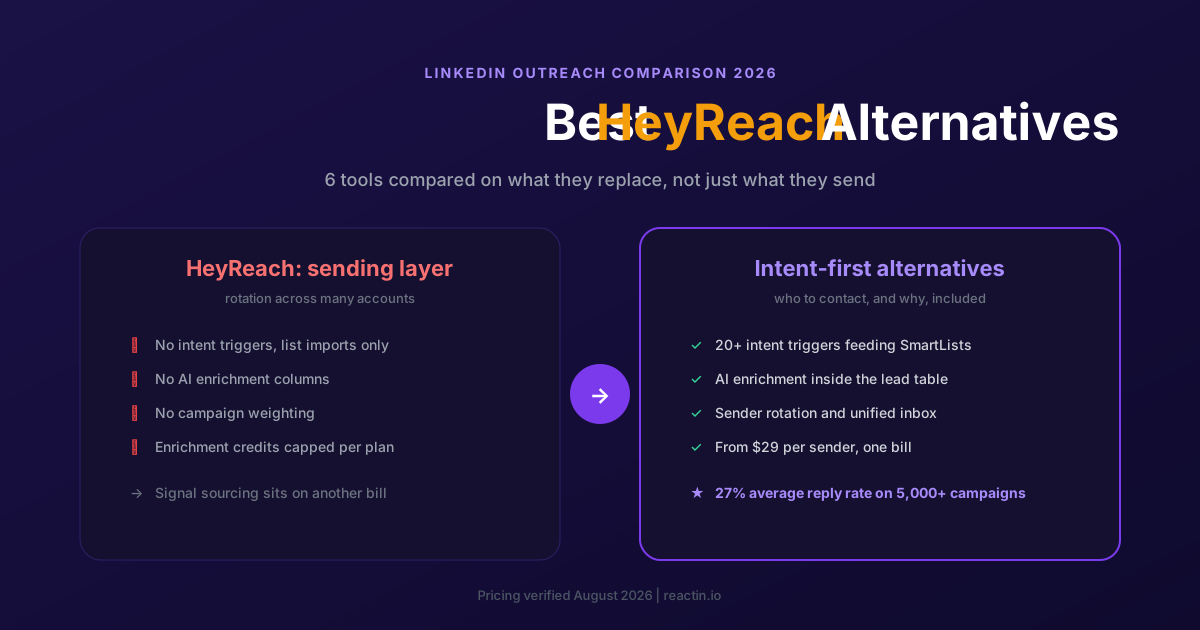
The 6 Best HeyReach Alternatives in 2026 (Priced and Compared)
HeyReach scales sending across many accounts, but it does not tell you who to contact. Here are the 6 best alternatives for 2026, with verified pricing and the cost of the stack HeyReach does not include.
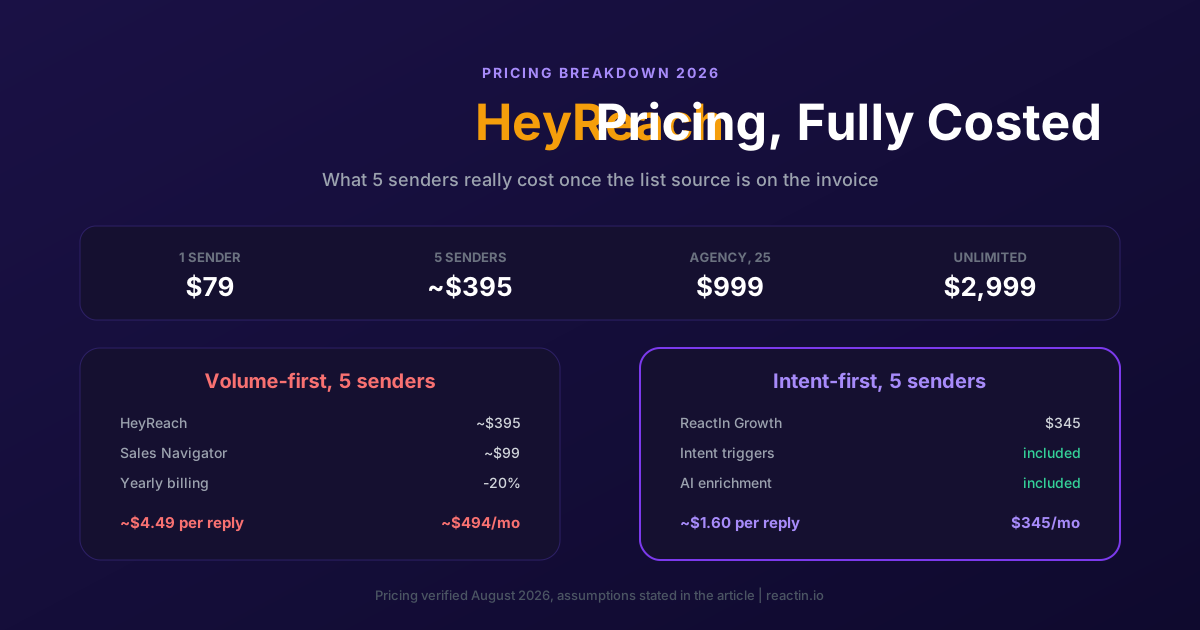
HeyReach Pricing in 2026: Real Cost per Sender and 5 Cheaper Alternatives
HeyReach Growth starts at $79 per sender, Agency is $999 for 25 senders and Unlimited is $2,999. Here is every plan, what the price includes and leaves out, and how to compare cost per reply instead of cost per seat.
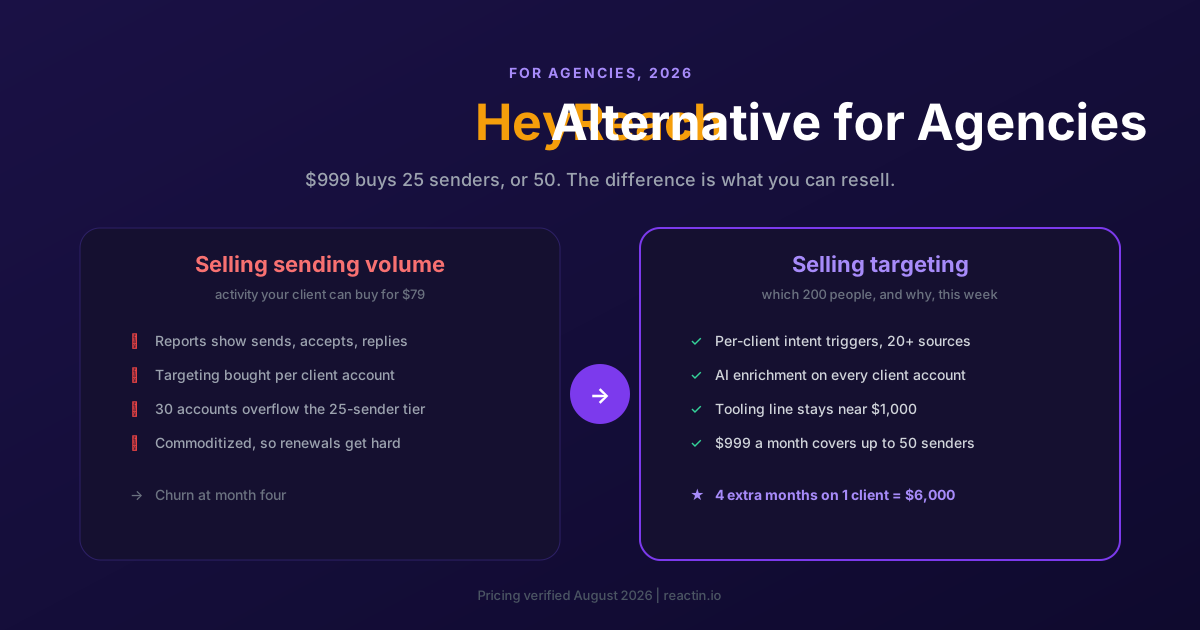
The Best HeyReach Alternative for Agencies in 2026 (5 Options Compared)
Agencies rarely leave HeyReach because the sending broke. They leave because volume services get commoditized. Here are 5 options compared on margin per client and months retained.
Waalaxy Chrome Extension Removed: The 6 Best Alternatives in 2026
Waalaxy removed its Chrome extension in 2026 and moved fully to the cloud. Here are the 6 best alternatives, with verified pricing and the right pick for your motion.