The Best HeyReach Alternative for Agencies in 2026 (5 Options Compared)
Agencies rarely leave HeyReach because the sending broke. They leave because volume services get commoditized. Here are 5 options compared on margin per client and months retained.
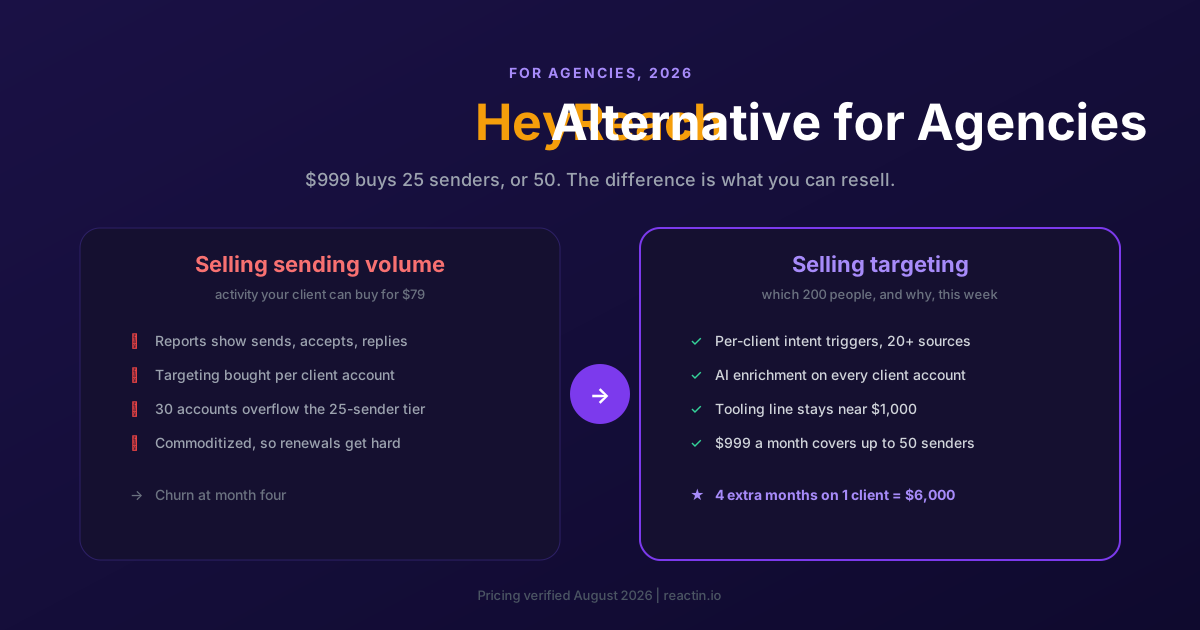
The client called at month four. The dashboard looked fine, 4,000 connection requests sent, acceptance rate holding, and they still booked six meetings all quarter. That call is why agencies start shopping for a HeyReach alternative built for agencies, and it is almost never about the software failing.
HeyReach earned its position. Multi-account rotation, client workspaces, whitelabel and done-for-you onboarding solved a real operational problem, and the company crossed 13M dollars in ARR doing it. But it solves the sending problem, and in 2026 sending is not what agencies get fired over. This guide compares the options through the only two lenses that matter to an agency owner: margin per client and months retained.

Why agencies look for a HeyReach alternative
Ask ten agency owners why they are evaluating something else and none of them say the tool broke. They say some version of the same three things.
- Retention. Volume services get commoditized. When the client can buy 4,000 invitations from someone cheaper, your renewal depends on results you can defend, not activity you can screenshot.
- Margin. Per-sender pricing plus Sales Navigator plus an enrichment layer eats a retainer fast, and the tier steps are steep: 999 dollars covers 25 senders, the next stop is 2,999.
- Reporting. Sends, accepts and replies describe effort. Clients renew on pipeline, and a sending platform has no data to connect the two.
There is also a structural point. If your entire delivery is sending capacity, you are selling something your client could buy directly for 79 dollars a month. The agencies with the best retention in 2026 sell targeting: knowing which 200 people to contact this week and why. That capability has to come from somewhere, and it is not in a sending tool.
For the platform-level breakdown, read the full ReactIn vs HeyReach comparison.
The agency requirements checklist
Before you compare vendors, write down what an agency actually needs. Six items, roughly in order of how often they get skipped.
- Client isolation. Separate workspaces so one client's data, senders and campaigns never touch another's.
- Predictable seat economics. A flat tier at your account count beats a per-sender rate that changes every time a client onboards.
- A targeting layer you can resell. Intent triggers and enrichment are the part of the deliverable a client cannot replicate alone.
- Account safety controls. Rotation, ramp-up and daily limits, because a restricted client account is a lost account and often a lost client.
- Reporting you can send without editing. If you rebuild the report in a spreadsheet every month, that is billable time you are absorbing.
- White label, if your positioning needs it. Useful, but check whether your clients actually care before paying for it.
Most agencies weight items one, two and six highly because those are operational, and underweight item three because it is strategic. Item three is the one that decides renewals.
For a broader ranking by agency use case, read our guide to the best LinkedIn automation tool for agencies.
5 options compared for agencies in 2026
Five platforms, judged on agency operations rather than feature counts. Pricing verified August 2026.
1. ReactIn, best when your deliverable is qualified conversations
At a glance: 29 to 69 dollars per sender per month, agency plan at 999 dollars per month for up to 50 senders with custom terms. 2,000 enrichment credits included. Cloud based, 7-day free trial, no card.
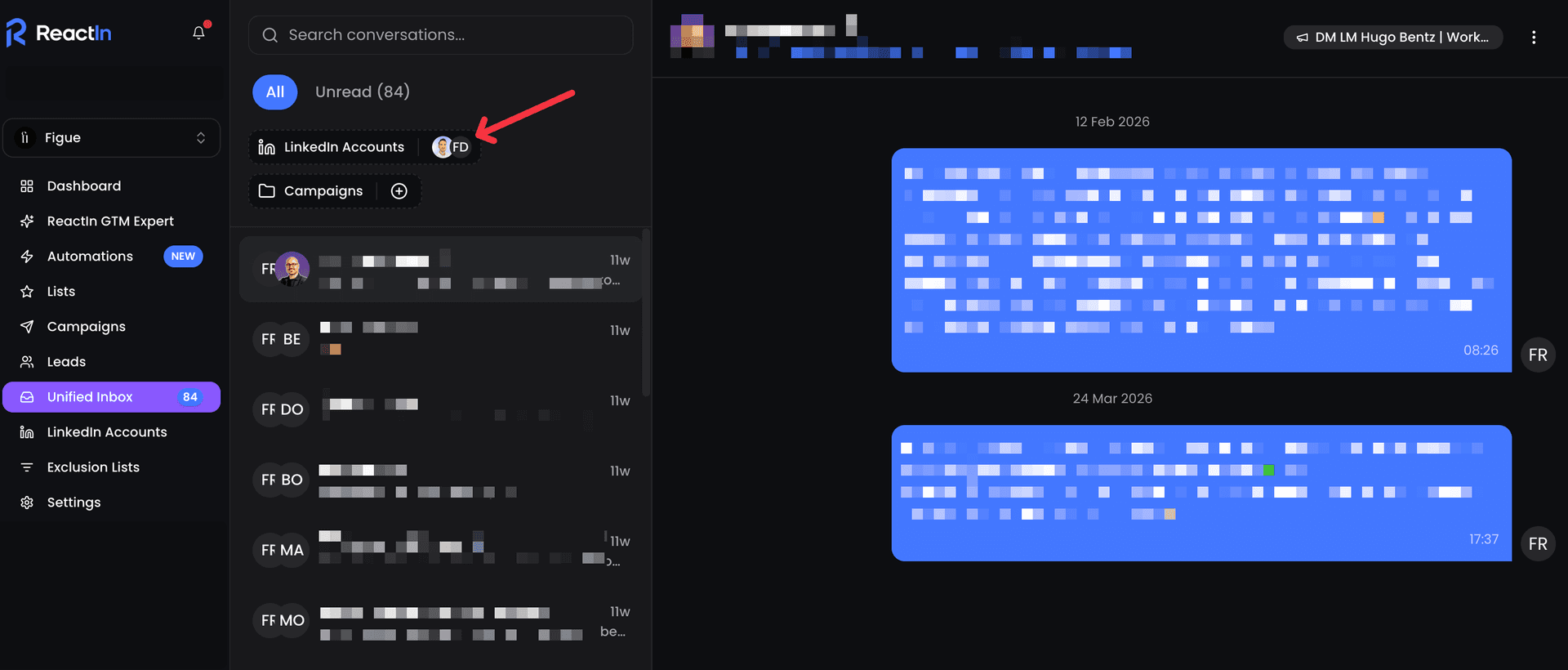
ReactIn matches the agency price point and changes what you are selling. Instead of importing a client list and sequencing it, you connect SmartLists fed by 20+ intent triggers: people engaging with the client's posts or a competitor's, Sales Navigator searches, website visitors through the Pixel, lead magnet downloads, webinar signups, Calendly bookings, Tally submissions and Stripe events. Each client account gets its own signal sources, so the targeting is specific to that client rather than a generic ICP filter.
AI enrichment columns generate an ICP score, a contextual hook and company insight on every lead inside the platform, with 2,000 enrichment credits included rather than metered per sender, so you are not paying a separate enrichment subscription per client. Campaign ponderation splits daily quota across campaigns with sliders, which matters when one client account runs four campaigns at once. Sender rotation, a unified inbox and unlimited automations are included. Across 5,000+ campaigns the average reply rate is 27 percent.
What works
- Intent triggers and AI enrichment included, so the targeting layer is not a per-client add-on.
- Agency plan at 999 dollars for up to 50 senders, double the sender cap of HeyReach's 999 dollar Agency tier.
- Campaign ponderation and per-client signal sources make multi-campaign accounts manageable.
Watch out for
- No whitelabel today. If reselling under your own brand is non-negotiable, HeyReach and Skylead have it and we do not, so ask us about the roadmap before you commit.
- LinkedIn-led, so an email-heavy client program needs a second tool.
Best for: Agencies selling qualified pipeline rather than sending volume.
2. HeyReach, the operational benchmark
At a glance: From 79 dollars per sender on Growth, 999 dollars per month for 25 senders on Agency, 2,999 dollars for Unlimited. Whitelabel, workspaces and permissions, done-for-you onboarding, dedicated Slack channel. Cloud based.
If the job is running many client accounts safely from one place, HeyReach is the most complete answer on the market. Workspaces and permissions keep accounts isolated, whitelabel lets you present it as your own, done-for-you onboarding and a dedicated Slack channel come with the Agency plan, and Unlimited adds multi-brand whitelabels and done-for-you migration. Where it stops is targeting: no intent detection, no AI enrichment columns, no campaign weighting. Your list quality, and therefore your renewal rate, depends on tools you buy elsewhere.
What works
- The most mature agency operations toolkit: workspaces, whitelabel, done-for-you onboarding, dedicated Slack channel.
- Sender rotation and account safety controls that hold up at 50 accounts.
Watch out for
- No intent triggers or AI enrichment, so the targeting stack is a separate cost per client.
- Sender caps are tight for the price: 25 senders at 999 dollars, and the next tier is 2,999.
Best for: Agencies whose delivery model works and whose only constraint is scaling accounts.
3. Skylead, white label at a per-seat price
At a glance: Around 100 dollars per seat per month billed annually, 129 dollars monthly. White label available on request. Cloud based.
Skylead is worth a look when white label matters and your headcount is small relative to the number of accounts you run. It bills per seat rather than per sender, so one operator managing several client accounts pays once. Everything is in a single plan: LinkedIn automation, email, an email finder and smart sequences with if/then branching. The trade-off is that it was not designed around a 50-client book, so workspace management is lighter than HeyReach, and there is no intent layer.
What works
- One plan with LinkedIn, email and branching sequences, plus white label on request.
- Per-seat billing is efficient when one operator runs many accounts.
Watch out for
- Client workspace management is lighter than a purpose-built agency platform.
- No intent triggers, and Sales Navigator is close to mandatory for list quality.
Best for: Small agencies with a lean team, many accounts and a white label requirement.
4. La Growth Machine, when clients want multichannel
At a glance: From 60 euros per identity per month to 165 euros per identity per month. Cloud based.
Some client programs are not LinkedIn programs. If your retainers cover LinkedIn plus email plus follow-up on X, La Growth Machine sequences all of it in one workflow with enrichment included, which removes an integration you would otherwise maintain. Per-identity pricing is the catch: at 20 client identities the bill climbs past the flat agency tiers, so it fits agencies with fewer, larger accounts rather than a long tail of small ones.
What works
- Genuine multichannel sequencing with enrichment built in.
- Strong fit for European clients with data residency questions.
Watch out for
- Per-identity pricing scales badly across a large client book.
- No intent trigger layer, so list building stays manual.
Best for: Agencies running multichannel programs for a small number of larger clients.
5. Expandi, when a client account cannot be restricted
At a glance: 99 dollars per account per month, less on annual billing. Dedicated IP per account. Cloud based.
Expandi is the option to keep in your back pocket for high-stakes accounts. A dedicated IP per account in a real location, gradual ramp-up and conservative limits make it the safest posture of the five. When you are running the personal profile of a client's founder, the one with 40,000 followers that also drives their inbound, that safety margin is worth the premium. It is not economical as your whole stack at 30 accounts, and it has no intent or enrichment layer.
What works
- Dedicated IP and conservative ramp-up, the lowest restriction risk of the five.
- Webhooks and granular controls for agencies that wire their own reporting.
Watch out for
- Per-account price makes a large book expensive.
- No intent detection or enrichment, and heavier setup per account.
Best for: High-stakes founder profiles where a restriction would end the relationship.
Agency comparison, side by side
Pricing verified August 2026. The last two columns are the ones that decide most agency switches: what a 50-account book costs, and whether the platform gives you something to resell beyond sending.
| Tool | Billing model | White label | Intent triggers |
|---|---|---|---|
| HeyReach | 999 dollars for 25 senders | Yes | No |
| ReactIn | 999 dollars up to 50 senders | Not today | Yes, 20+ sources |
| Skylead | around 100 dollars per seat | On request | No |
| La Growth Machine | 60 euros and up per identity | No | No |
| Expandi | 99 dollars per account | No | No |
For the wider field beyond agency use, see the best HeyReach alternatives in 2026.
The margin math at 10 clients
Take an agency with 10 clients, 3 sender accounts each, so 30 accounts. Retainer is 1,500 dollars per client, revenue 15,000 dollars per month. Note the account count: 30 does not fit in a 25-sender tier, which is where the arithmetic gets interesting.
Volume-first stack
At 30 accounts you are past the 999 dollar Agency tier that covers 25, so you either trim accounts or move to the 2,999 dollar Unlimited plan. Add Sales Navigator seats and an AI enrichment layer for personalization and the tooling line lands somewhere between 1,300 and 3,200 dollars a month depending on which side of that step you fall. The exposure is not just the cost, it is that the deliverable is activity.
Intent-first stack
An agency tier at 999 dollars covering up to 50 senders absorbs all 30 accounts with room to grow, and including signals and enrichment removes the second and third subscriptions, so the line stays near 1,000 dollars. The saving is real, but it is not the point. The point is what the saved subscription buys you: a report that says which buying signals drove which meetings.
The number that actually decides the year
One client retained for four extra months at 1,500 dollars is 6,000 dollars. That is more than a year of the tooling difference. Every evaluation should be weighted toward whatever moves retention, because at agency scale retention dominates the cost line by an order of magnitude.
For every plan and the real cost per sender, see our HeyReach pricing guide for 2026.
How to migrate a client book without a bad month
Never move 30 accounts in one weekend. Migrate the way you would roll out any change across a client base: in waves, with a control group.
Start with two clients, not ten
Pick one client who is happy and one who is wobbling. Move both. The happy one proves the migration is safe, the wobbling one tells you whether the new approach actually changes results.
Export lists and reply history, then rebuild on signals
Take the CSVs out of HeyReach along with campaign performance. Do not recreate the same static lists. Connect the triggers that map to each client's best replies, so their list refills itself instead of running dry between exports.
Report on cost per meeting for 30 days
Track spend per booked meeting per client during the pilot, on both the old and new setups. That is the number that survives a renewal conversation, and it is the one to put in front of the rest of your book before you move them.
Agencies do not lose clients because they sent too few messages. They lose them because nobody could explain why the messages were sent to those people.
Frequently Asked Questions
Sources & Further Reading
- Compare verified agency feedback on the HeyReach G2 reviews page.
- Running automation across many client profiles carries specific risks. Read the LinkedIn Help Center on account restrictions before onboarding a new client account.
- Every tool here operates under the same rules. Review the LinkedIn User Agreement.
- Compare the agency tiers and sender caps directly on the HeyReach pricing page.
Related Articles
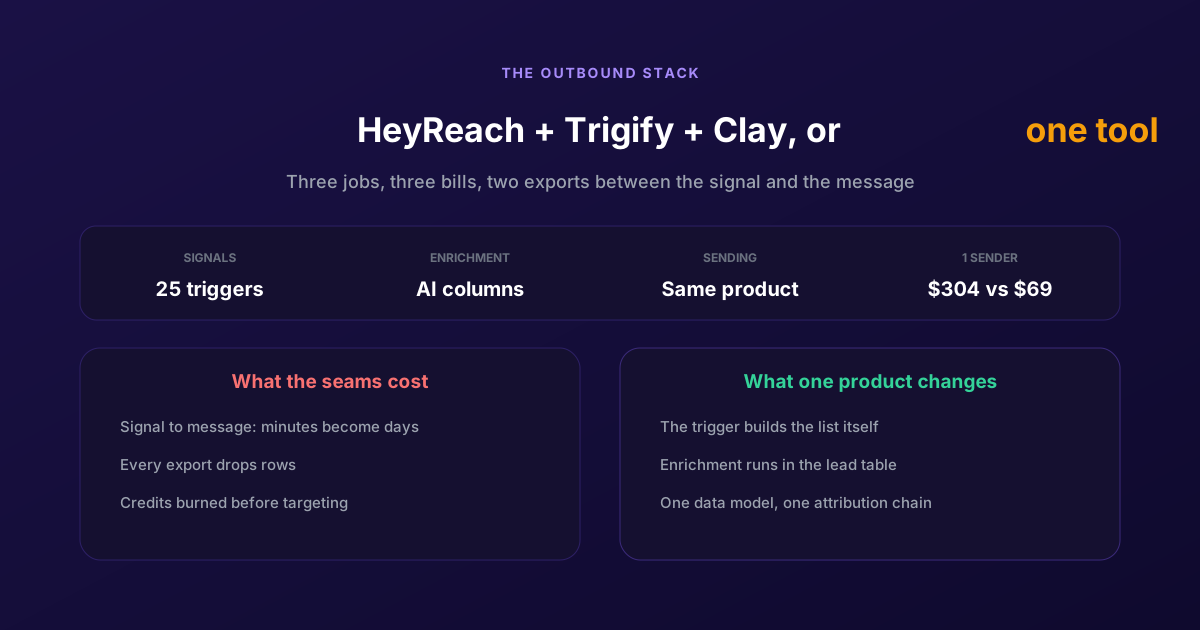
ReactIn = HeyReach + Trigify + Clay: One Tool for Cold and Warm Outreach
Three products, three bills, and two exports between the signal and the message. Here is what each tool owns, what the seams cost in latency and credits, and when keeping the stack is still the right call.
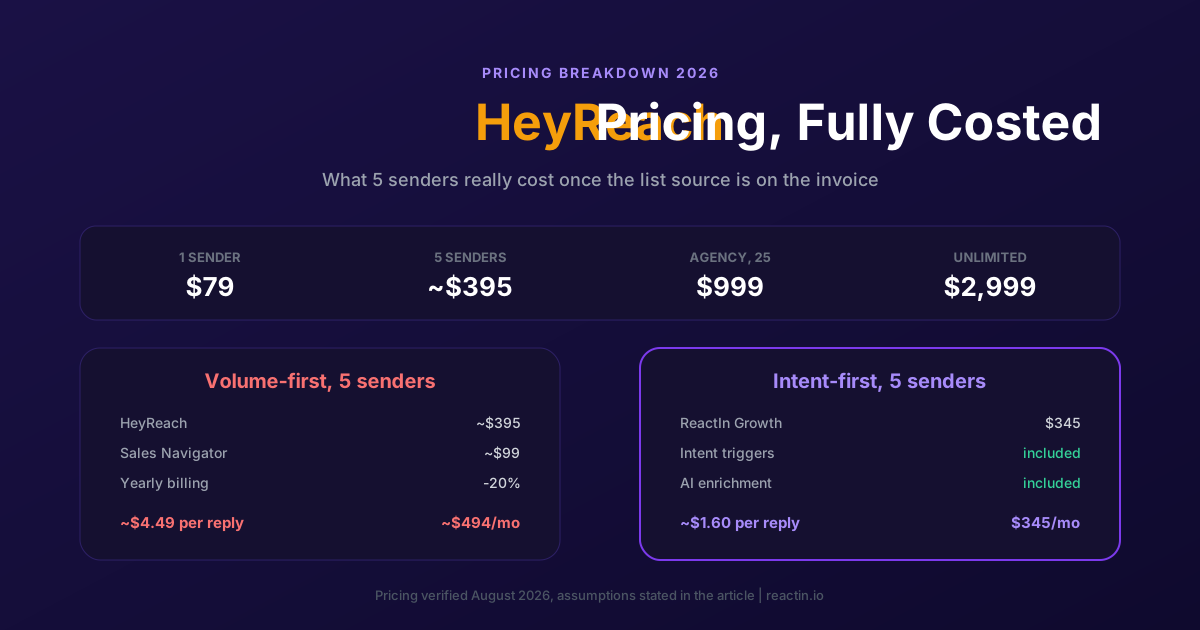
HeyReach Pricing in 2026: Real Cost per Sender and 5 Cheaper Alternatives
HeyReach Growth starts at $79 per sender, Agency is $999 for 25 senders and Unlimited is $2,999. Here is every plan, what the price includes and leaves out, and how to compare cost per reply instead of cost per seat.
ReactIn Alternatives & Comparisons 2026: Find the Right LinkedIn Tool
Compare ReactIn with every major LinkedIn automation tool in 2026. Head-to-head comparisons with BeReach, Gojiberry, Phantombuster, Waalaxy, and more. Find the right tool for your use case.
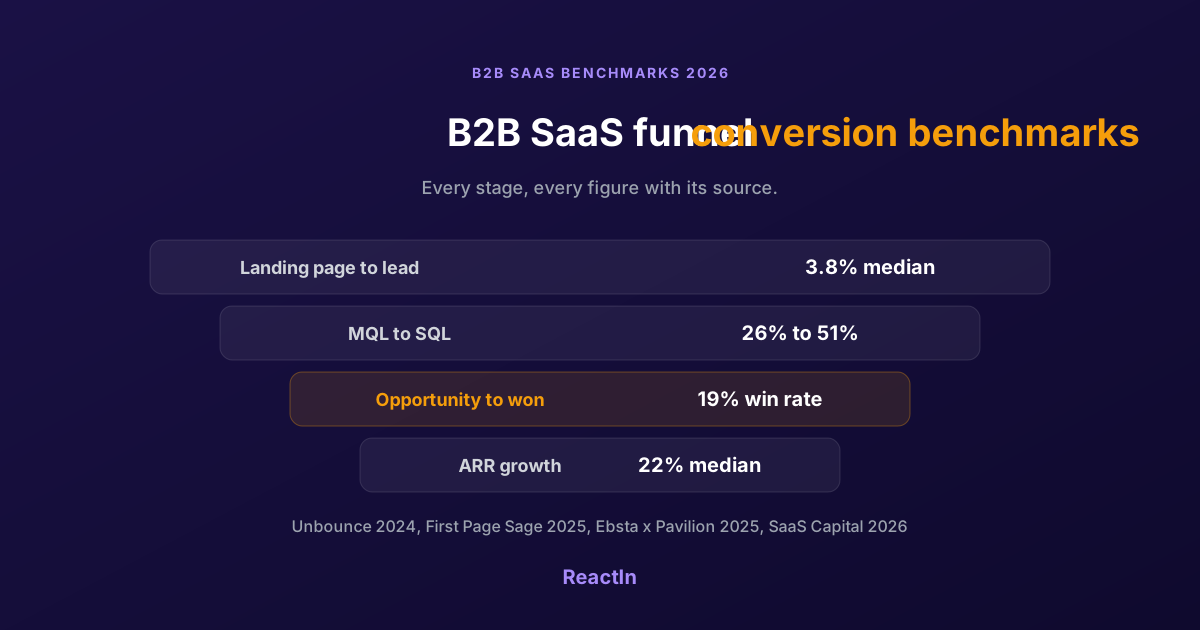
B2B SaaS Funnel Conversion Benchmarks 2026: Every Stage, With Sources
Sourced conversion benchmarks for each stage of the B2B SaaS funnel, from landing page to closed-won, plus growth and retention medians, and why the numbers you find online disagree.