Trigify Is Closing: The 5 Best Trigify Alternatives in 2026
HubSpot acquired Trigify and the platform closes on 22 October 2026. Here is what to export first, and the 5 best Trigify alternatives with verified pricing, including the one that listens, enriches and sends in one product.
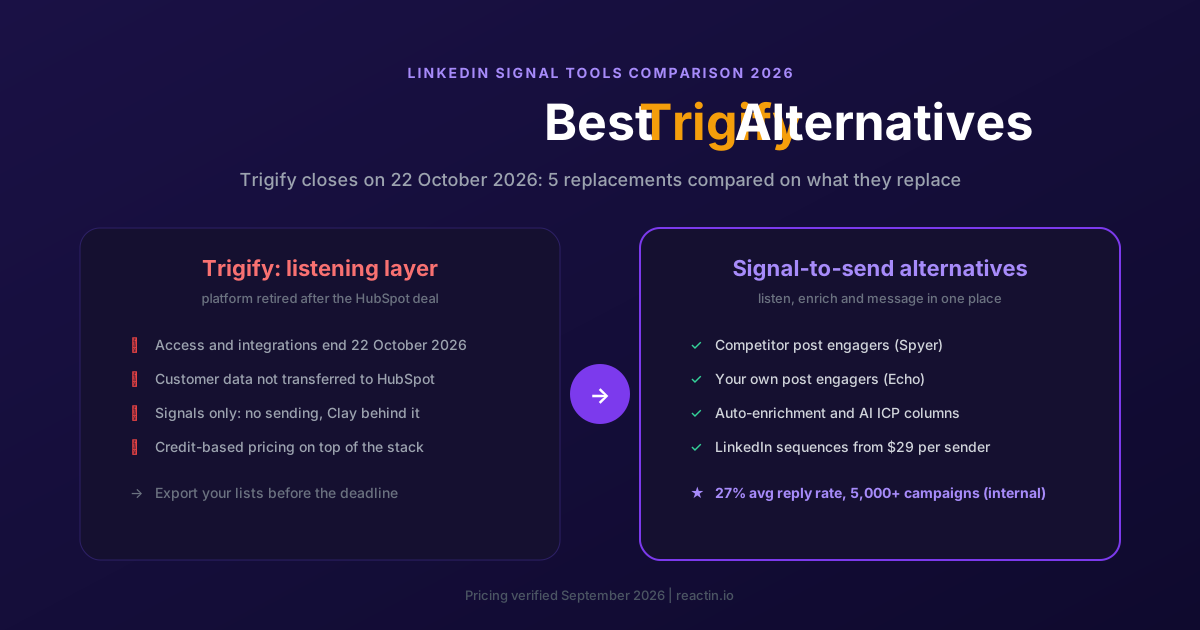
Trigify stops working at 11:59pm BST on 22 October 2026. HubSpot acquired the company on 23 September, the team is joining HubSpot, and the standalone platform is being retired. Your account does not move to HubSpot. If your signal workflows run through Trigify, you need one of these Trigify alternatives in place before that date.
The shutdown is the trigger, not the only reason teams were looking. Trigify listens: it tells you who engaged with a post, a competitor or a keyword. It does not send or enrich in depth. So most teams ran Clay behind it and a sender like HeyReach behind Clay: three tools, two exports between a signal and a message. Replacing Trigify is the moment to decide whether you rebuild that chain or collapse it.
Why teams look for a Trigify alternative
The main reason is simple: Trigify is closing on 22 October 2026. Before that, it was good at one job. It watched LinkedIn engagement, competitor mentions and keyword conversations, and turned them into lists of people who had just moved. Plans started at $40 per month on credits, with Max at $199. The reasons to replace it come in two layers.
The first layer is forced. The second was already there, and it should decide what you buy next.
- The platform is closing. For standard customers, access, integrations, API and signal collection stop at 11:59pm BST on 22 October 2026. Subscriptions do not renew, and no Trigify product continues inside HubSpot.
- Your data does not follow you. Trigify states that customer data is not transferred to HubSpot. Lists and searches you want to keep have to be exported before your end date.
- Signals without outreach. Trigify was a source. Enrichment usually meant Clay and sending meant HeyReach or another sender, so each signal crossed two exports before anyone wrote to the person.
- Credits on top of the stack. Searches and actions drew on credits, so the cost grew with how much you listened, next to the enrichment and sending bills.
The 5 best Trigify alternatives in 2026
Five tools, grouped by what they replace. ReactIn and Gojiberry replace the listener, the enrichment and the sender. Valley does the same for one LinkedIn seat. Teamfluence replaces the listener only. Clay covers enrichment and brings its own signals. Prices checked on each vendor's site on 24 September 2026.
1. ReactIn: signal, enrichment and LinkedIn sending in one product
At a glance: LinkedIn outreach triggered by intent signals. Basic $29 per sender per month (signals and enrichment, no outreach), Growth $69 (adds sequences and sender rotation), Agency $999 per month for up to 50 senders. 7-day free trial, no card.
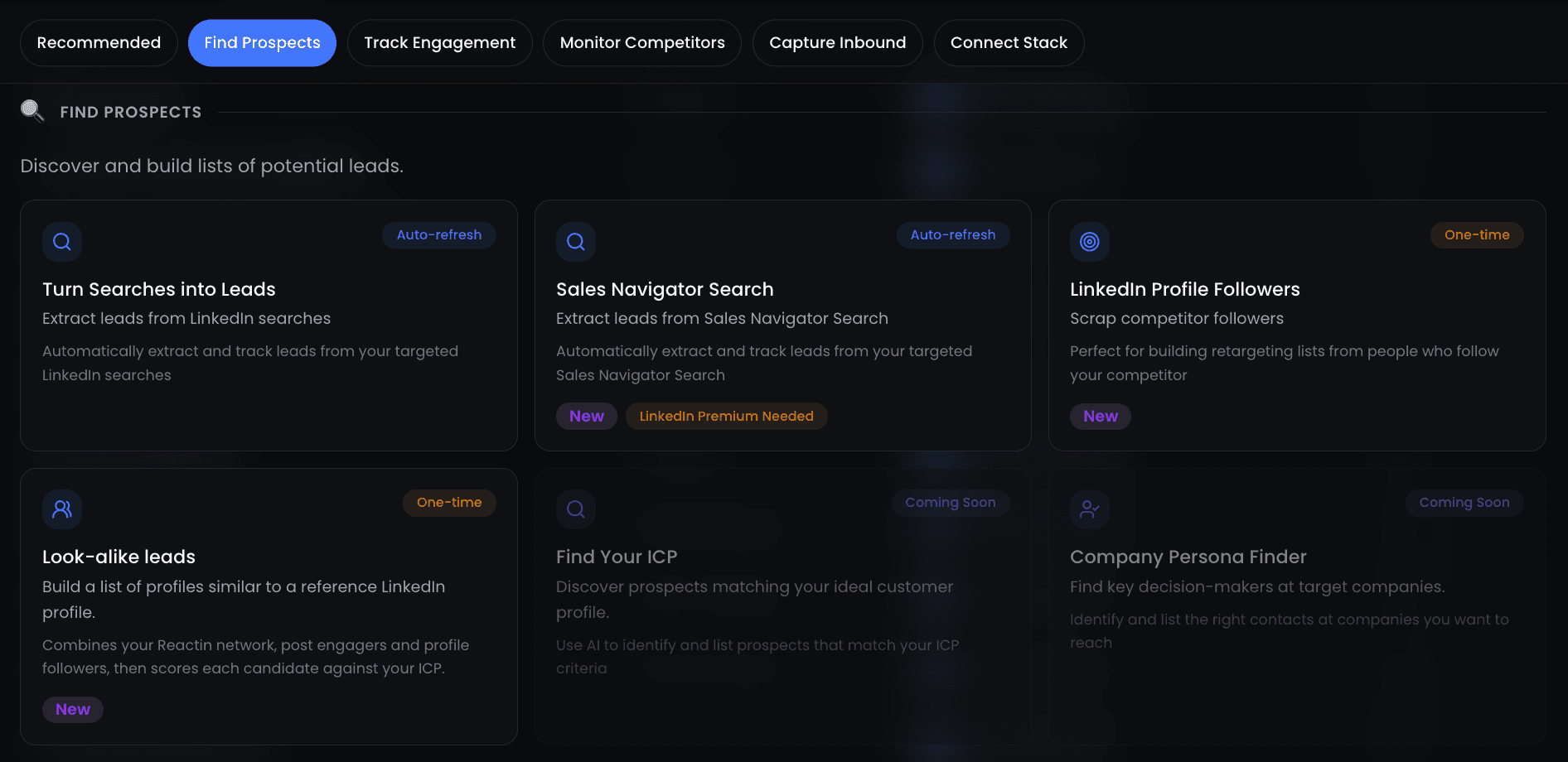
ReactIn covers the signals Trigify users relied on most, natively. Spyer tracks the people who like or comment on a competitor's posts. Echo tracks the people who engage with your own posts. Pixel catches profile visitors, Shift catches job changes, and Scout, Gather, Tribe and Orbit pull Sales Navigator searches, event attendees, group members and company page followers. That is 20+ signals, plus CSV and API import.
The difference is what happens next. Leads are enriched automatically with emails, phone numbers and company data, and AI columns filter them against your ICP. A multi-step LinkedIn campaign (invitation, message, follow-ups) then runs with sender rotation, daily limits per sender and campaign weighting, and replies land in one inbox. No export sits between the signal and the message. ReactIn's internal benchmark is a 27% average reply rate across 5,000+ campaigns.
Pros
- One product from signal to reply, so no CSV between a listener, Clay and your sender.
- Competitor post engagers (Spyer) and your own post engagers (Echo) are native signals, not a separate subscription.
- Basic at $29 keeps signals and enrichment only, with HubSpot, Zapier, webhooks and a REST API to feed the tool you already send from.
Cons
- Sending is LinkedIn only: no email sequences and no calls.
- Signals come from LinkedIn, CSV and API. Reddit or wider web listening is out of scope, and the interface is in English only.
Best for: B2B teams whose pipeline starts on LinkedIn and who want Trigify's signals to become messages without a second and third tool.

2. Gojiberry: AI agents that act on intent signals
At a glance: AI SDR on intent signals. Pro at $99 per month (2 AI agents, up to 1,800 prospects contacted per month), Custom on request. Free trial.
Gojiberry's agents detect 15+ buying and social signals, such as competitor engagement or people following your company. They score each prospect against your ICP, then reach out on LinkedIn and email with AI-written messages, fully autonomous or with your approval before each send. Pro bundles a unified inbox, lookalike audiences, email waterfall enrichment across 15+ data providers and CRM integrations. It replaces the listener, the enrichment and the sender in one bill.
Pros
- Signals, scoring, enrichment and outreach in one product, live in minutes.
- Covers email as well as LinkedIn, with an email waterfall across 15+ providers.
Cons
- Beyond 2 AI agents and 1,800 prospects a month, pricing moves to a custom quote.
- Built for agents that run outreach for you, so teams that hand-build sequences and weight campaigns get fewer controls.
Best for: Founders and small teams who want an AI agent to find warm leads and contact them on LinkedIn and email.
3. Teamfluence: the closest like-for-like LinkedIn listener
At a glance: LinkedIn signal tracking. Economy €89 per seat per month, Business €129 per seat, GTM Unlimited €199 per workspace with 2 seats included. Billed monthly.
Teamfluence tracks who engages with your team on LinkedIn: profile visits on teammates and the company page, likes, comments, shares, follows and new connections. It also watches competitor posts, influencer activity and any keyword you choose. Workflows push each signal to HubSpot, Salesforce, Slack or a webhook, for example into Clay. It can send connection requests with a follow-up DM, but it is not a sequencing tool. Trigify customers get a 3-month price match when they migrate.
Pros
- Closest to Trigify's job: LinkedIn engagement, competitor posts and keywords, pushed into the stack you already run.
- Strong on your own team's network, which matters when several employees post.
Cons
- Per-seat pricing adds up as you track more teammates.
- Outreach stops at connection requests and a follow-up DM, so multi-step sequences still need a separate sender.
Best for: Teams happy with their sender and enrichment who only need to replace the listening layer, fast.
4. Clay: enrichment first, with its own signals
At a glance: Data enrichment and GTM workflows. Free plan, Launch from $185 per month ($167 billed annually), Growth from $495 per month, Enterprise on request.
Many Trigify users already had Clay behind it. Clay now ships its own signals: job changes, company news, keyword social listening on LinkedIn, Reddit and YouTube, and web intent on Growth. Launch includes 15,000 actions and 3,000 data credits per month, and email campaigns run natively. Clay does not send on LinkedIn, so a LinkedIn sender stays in the stack.
Pros
- The broadest enrichment on the market, with waterfalls across many data providers.
- Keyword listening on LinkedIn, Reddit and YouTube can replace part of Trigify inside a tool you may already pay for.
Cons
- No LinkedIn sending: you still need HeyReach or another sender, plus a sync between the two.
- Actions and data credits are consumed per row, and CRM sync starts on Growth at $495 per month.
Best for: RevOps teams whose real job is data work across many sources, with a LinkedIn sender already in place.
5. Valley: an AI SDR for one LinkedIn seat
At a glance: AI SDR for LinkedIn. Everything plan from $149 per month billed quarterly ($199 month to month) for one seat and one LinkedIn account. Scale on request from 5 seats. 7-day free trial.
Valley calls itself an AI outbound platform for signal-based outreach. It watches profile viewers, company page visitors, post engagers and commenters, and competitor followers, then qualifies and researches each lead against your ICP. It writes messages in your voice, sends connection requests and InMails within LinkedIn's limits, emails through your own inbox, and handles replies. Valley Deep, on the $499 plan, adds lead search from a plain-English description.
Pros
- Signal to sent message on autopilot, with research and personalization handled by the AI.
- One flat plan with API access and HubSpot and Clay integrations included.
Cons
- Priced per seat with one LinkedIn account each; multi-account teams move to a Scale quote with a 5-seat minimum.
- Built around AI-written messages in your voice, so teams that want to own every template get less control.
Best for: A founder or single SDR who wants one LinkedIn profile to prospect on signals with little manual work.
Trigify vs the alternatives, side by side
Alternative prices checked on each vendor's site on 24 September 2026. Trigify prices are its public plans as of 15 September 2026, before the HubSpot announcement. Gojiberry takes the last column: it also listens, enriches and sends in one bill.
| Criterion | ReactIn | Trigify | Gojiberry |
|---|---|---|---|
| Starting price | $29 per sender per month (Basic, no outreach), $69 with outreach (Growth) | $40 per month on credits (Starter), $199 (Max); closes 22 October 2026 | $99 per month (Pro, 2 AI agents), Custom on request |
| Intent signals | 20+ LinkedIn signals, including competitor post engagers (Spyer) and your post engagers (Echo) | Social listening: post and profile engagement, competitor mentions, keywords | 15+ buying and social signals, plus lookalikes |
| Enrichment | Automatic (emails, phones, company data) plus AI ICP columns, 2,000 credits included | Not in depth, usually paired with Clay | Email waterfall across 15+ providers, ICP scoring |
| Multi-account sending | Yes: sender rotation, daily limits per sender, campaign weighting, up to 50 senders on Agency | No sending | 2 AI agents on Pro, more on Custom |
| Channels | LinkedIn only | None: signals go to your CRM and other tools | LinkedIn and email |
| Best for | LinkedIn-led B2B outbound triggered by intent | No longer an option: the platform closes on 22 October 2026 | Hands-off AI outreach on LinkedIn and email |
How to choose your Trigify replacement
You have until 22 October 2026 to move. Start from what Trigify actually fed, not from feature lists. Four steps, in order.
List what Trigify fed before you shop
Open every search and workflow. Note the signal (competitor engagers, your post engagers, keywords), where it went (CRM, Clay, sender) and which ones produced replies. Export them before 22 October 2026. That list is your spec.
If your sender works, replace only the listener
Teamfluence is the fastest like-for-like swap, with a 3-month price match for Trigify customers. ReactIn Basic at $29 per sender also fits: signals and enrichment, pushed out through HubSpot, Zapier, webhooks or the API.
If the exports were the problem, collapse the chain
Pick ReactIn if your pipeline is LinkedIn-led and you want control of campaigns, templates and volume per sender. Pick Gojiberry (LinkedIn plus email) or Valley (one LinkedIn seat) if you would rather let an AI agent write and send.
If your signals go beyond LinkedIn, go wider
Keyword listening on Reddit and YouTube, web intent and data work across many sources point to Clay. Enterprise teams mixing product usage, website and CRM signals can look at Common Room, now part of Zoom, from $2,500 per month billed annually.
A forced migration is annoying. It is also the one moment to redesign the chain instead of copying it. Rebuild around the signals that produced replies, and cut every export you can.
Frequently Asked Questions
Sources & Further Reading
- Trigify's shutdown dates, data policy and integration cut-off are in the Trigify announcement and FAQ, published on 23 September 2026.
- Gojiberry lists its Pro and Custom plans in the pricing section of its homepage.
- Teamfluence publishes its per-seat and workspace plans on the Teamfluence pricing page.
- Clay's plans, actions and data credits are on the Clay pricing page, with the annual discount.
- Valley's seat plans and trial terms are on the Valley pricing page.
- Common Room's Essential, Advanced and Enterprise tiers are listed on the Common Room pricing page.
Related Articles
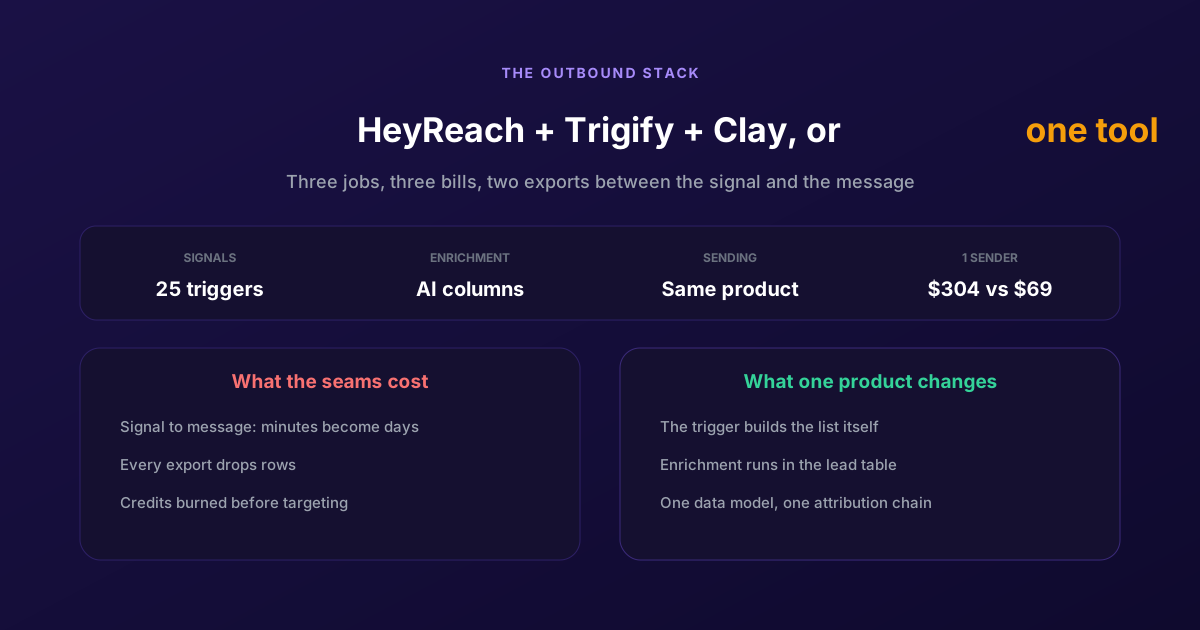
ReactIn = HeyReach + Trigify + Clay: One Tool for Cold and Warm Outreach
Three products, three bills, and two exports between the signal and the message. Here is what each tool owns, what the seams cost in latency and credits, and when keeping the stack is still the right call.
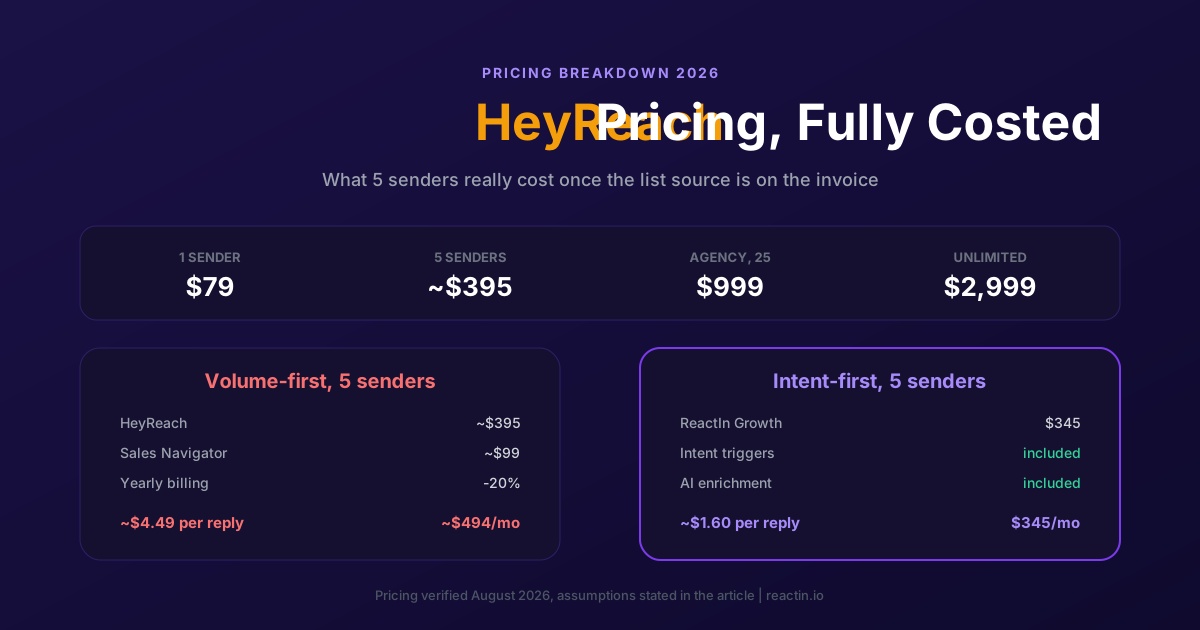
HeyReach Pricing in 2026: Real Cost per Sender and 5 Cheaper Alternatives
HeyReach Growth starts at $79 per sender, Agency is $999 for 25 senders and Unlimited is $2,999. Here is every plan, what the price includes and leaves out, and how to compare cost per reply instead of cost per seat.
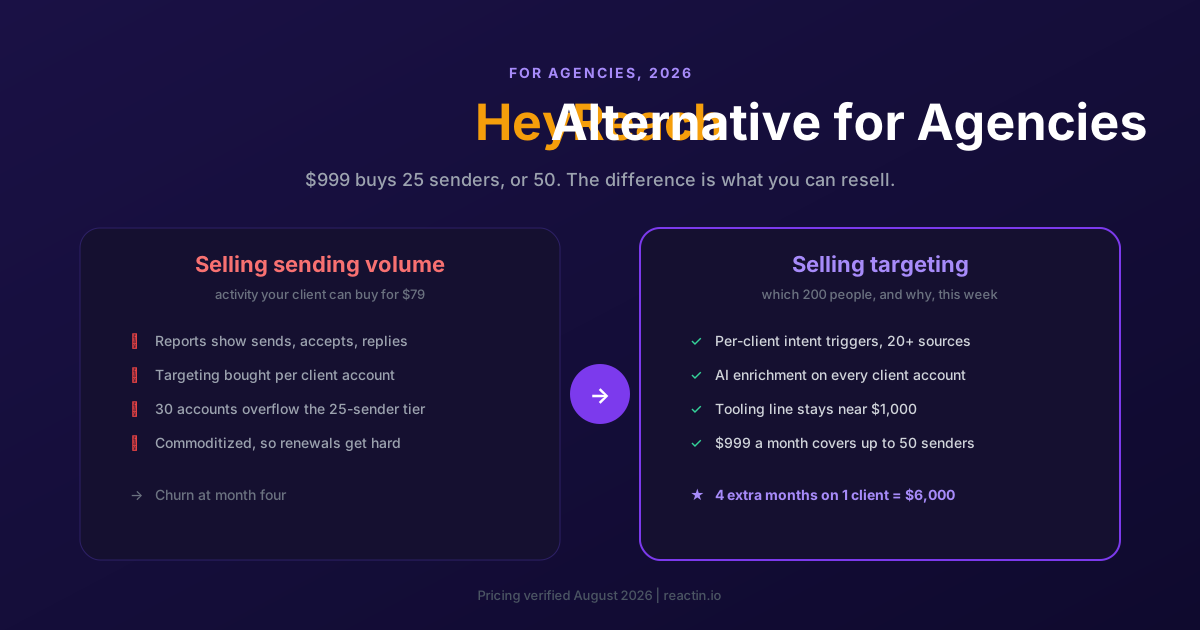
The Best HeyReach Alternative for Agencies in 2026 (5 Options Compared)
Agencies rarely leave HeyReach because the sending broke. They leave because volume services get commoditized. Here are 5 options compared on margin per client and months retained.
ReactIn Alternatives & Comparisons 2026: Find the Right LinkedIn Tool
Compare ReactIn with every major LinkedIn automation tool in 2026. Head-to-head comparisons with BeReach, Gojiberry, Phantombuster, Waalaxy, and more. Find the right tool for your use case.