Hire an SDR or Automate Your LinkedIn Outreach? The Real 2026 Math
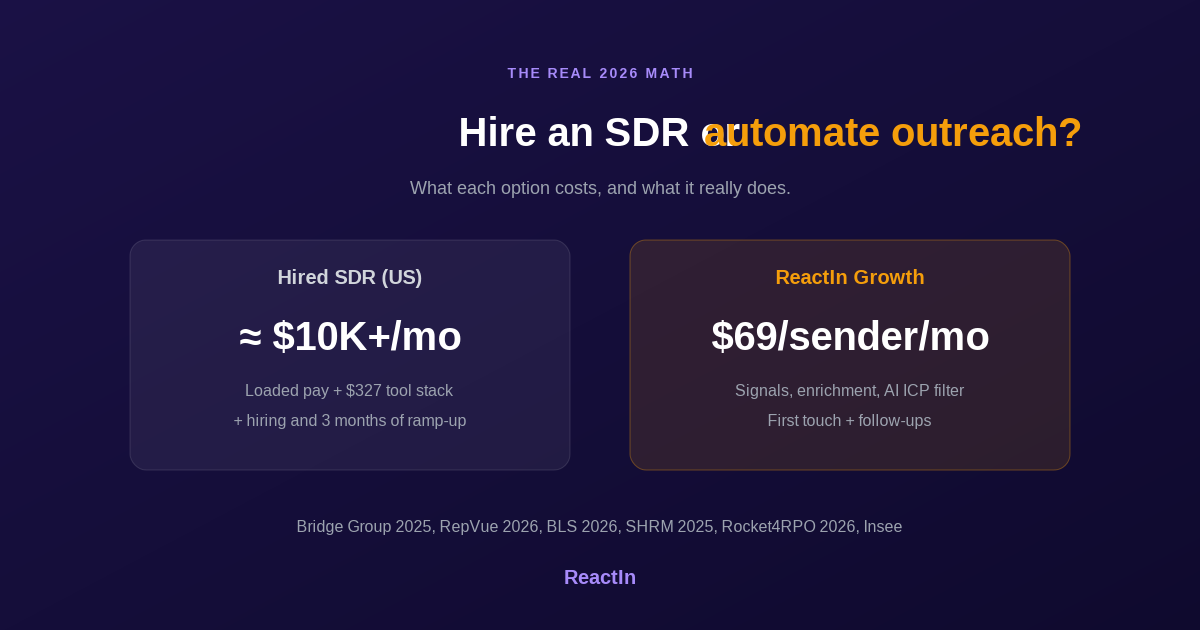
An SDR costs about $10,000 to $11,300 a month in the US once you add employer costs and the tool stack; ReactIn Growth costs $69 per sender. Sourced SDR costs (US and France), what each option really does, side by side, and when to hire, automate or do both.
No, and it doesn't have to. LinkedIn automation replaces the part of an SDR's week spent finding leads, checking ICP fit, sending first touches and follow-ups. It doesn't replace the calls and the closing. For most early-stage B2B teams, automate first and hire once replies outgrow your calendar.
You need pipeline. You have two ways to buy it: a salary or a tool. One costs around $10,000 a month in the US once you add employer costs and the tool stack, before hiring and ramp-up. The other costs $69 per sender.
That gap doesn't settle the question on its own. An SDR and an automation tool don't do the same job, and the honest answer depends on where your replies stand today. This page lays out the real cost of each option, what each one actually does, and when you need both.
What an SDR really costs in 2026
Start with pay. The Bridge Group's 2025 SDR report (351 B2B companies, February 2025) puts median SDR on-target earnings at $80K: a $55K base and $25K of variable pay, a 68/32 split. Self-reported data on RepVue runs higher: a $60K median base and $90K median OTE in the United States (data updated November 2026).
In France, Rocket4RPO's 2026 salary guide (June 2026, packages negotiated on SaaS B2B hires) gives a junior SDR €35K to €45K of fixed gross salary and €45K to €60K OTE, usually on a 70/30 split. Apec lists business developer job ads (the French label that covers most SDR roles) at €31K to €65K gross a year, variable included, €45K on average.
Then add what an employer pays on top of the paycheck. In the BLS employer cost survey (June 2026), benefits make up 31.5% of total compensation for full-time private-industry workers in the US, about 46 cents for every dollar of wages. In France, Insee measures employer contributions and other labor costs at 43.7% of gross pay on average (2022 data, firms with 10+ employees).
| Cost line | United States | France |
|---|---|---|
| Base salary (per year) | $55K to $60K | €35K to €45K gross |
| On-target earnings, at 100% of quota (per year) | $80K to $90K | €45K to €60K gross |
| Employer costs on top of pay | +46% of wages (BLS average) | +43.7% of gross pay (Insee average) |
| Loaded cost (per month) | ≈ $9,700 to $10,900 | ≈ €5,400 to €7,200 |
| Tool stack: Trigify + Clay + HeyReach | $327/mo per seat | $327/mo per seat |
| Total per month | ≈ $10,000 to $11,300 | ≈ €5,400 to €7,200 + $327 |
Loaded cost = OTE × employer cost ratio ÷ 12. The ratios are national averages across all jobs, so read the result as an order of magnitude: your benefits, city and payroll taxes will move it. Recruiting, ramp-up and management, below, are not included.
The hidden costs: hiring, ramp-up, management, turnover
The salary is the visible part. Four costs come with it:
- Hiring. SHRM's 2025 benchmarking puts the average cost per hire at $5,475 for non-executive roles (SHRM, 2025; the median is $1,200), and the median time to fill a role at about a month and a half (SHRM, 2025).
- Ramp-up. A new SDR takes 3.0 months on average to ramp (Bridge Group, 2025). Add the time to hire, and you wait about four and a half months for a full-speed SDR.
- Management. Someone builds the lists, reviews the messages and coaches the calls. In the same report, the median SDR manager earns $146K OTE. Without a manager, a founder does that job.
- Turnover. Median annual SDR turnover is 40%, average tenure is 1.9 years, and only 60% of SDRs hit quota (Bridge Group, 2025). Part of that turnover is promotion, which is good news for the SDR, but it means you hire and ramp again.
The Bridge Group sample is 78% North American and 83% SaaS. No French survey of the same scope came up for ramp-up and turnover, so treat those figures as a US reference.
The tools an SDR needs
An SDR still needs something to find leads, something to enrich them and something to send. The ReactIn homepage prices that stack at $327/mo per seat: Trigify + Clay + HeyReach.
An SDR doesn't replace the stack. They sit on top of it. Hiring one means paying the salary and the stack tax.
What $69/sender/mo does
Take an SDR's prospecting week step by step. Here is what ReactIn Growth runs for each step, and what it leaves to you.
Find: 20+ intent signals
ReactIn watches more than 20 intent signals: profile visits, engagement on posts, competitors' audiences, webinar sign-ups and more. You reach people who just showed interest instead of a cold list. See intent signals.
Qualify: enrichment and AI filtering
Every lead is enriched automatically (company, role, contact data), then filtered by AI against your ICP: "Is B2B", "Matches ICP", "Decision maker". In one campaign, the filters kept 86 leads out of 822. See enrichment.
Reach out and follow up
Multi-step campaigns with conditional logic send the first touch and the follow-ups. If a lead is already a connection, the connection step is skipped. Sender rotation spreads the volume, and daily caps and active hours are managed for each sender. See campaigns.
Centralize the replies
Every reply, from every sender, lands in one inbox. See the inbox.
The results ReactIn publishes on its homepage:
“Users who target intent signals see 27% reply rates vs 8% from cold lists.”
“500 competitor followers scraped → ICP filtered → campaign launched → 42 replies → 14 calls → 5 clients. 30% reply rate.”
Across 5,000+ campaigns run, the average reply rate is 27%. These are figures from ReactIn users, not a market average.
SDR vs LinkedIn automation, criterion by criterion
Same goal, booked conversations. Here is how the two options compare on price, speed and scope.
| Criterion | Hired SDR | ReactIn Growth |
|---|---|---|
| Monthly cost | ≈ $10,000 to $11,300 (loaded pay + $327 stack) | $69/sender/mo, 2,000 enrichment credits included |
| Time to full speed | ≈ 1.5 months to hire + 3.0 months to ramp | 7-day free trial, no card. First replies in 7 days or the trial is extended |
| Lead research and qualification | Manual | Signals + enrichment + AI filtering |
| Follow-ups | Depend on their discipline | Automatic, multi-step |
| Scaling volume | One more person | One more sender, rotation included |
| Calls, discovery, closing | ❌ (that part is yours) | |
| Best for | Teams that already get more replies than they can handle | Founders, small teams and consultants who want pipeline without hiring |
An SDR plus the stack they need costs about $10,000 to $11,300 a month in the US. ReactIn Growth costs $69/mo per sender.
Hire an SDR or automate outreach? The verdict
Our take, in three cases.
Automate first if…
- you're still finding your ICP: test segments with signals and AI filters before you train a person on one;
- you don't have the budget for a salary yet;
- you (founder, consultant) can take the calls yourself.
Hire an SDR when your inbox overflows
The signal is simple: replies come in faster than you can turn them into calls. That's when a person pays for themselves. Keep the tool running: it keeps feeding the SDR, who spends their time on conversations instead of research.
Do both: an SDR on warm leads
An SDR equipped with ReactIn works on people who just showed intent, not on cold lists. ReactIn users who target intent signals see 27% reply rates against 8% from cold lists. Same person, same hours, more conversations.
Frequently Asked Questions
Sources & methodology
Pay and labor cost figures come from public salary surveys, sector reports and statistics offices, compiled on November 20, 2026 from the pages listed below. Each one carries the date of its data. ReactIn figures are quoted as published on reactin.io.
Monthly totals are our arithmetic: on-target earnings × the national employer cost ratio ÷ 12, plus the $327 stack. They are orders of magnitude, not quotes.
- The Bridge Group, SDR Models, Motions & Metrics: 2025 Research Report (February 2025): OTE, ramp-up, tenure, turnover, quota attainment, manager pay.
- RepVue, Sales Development Representative salary in the United States (self-reported data, updated November 2026).
- US Bureau of Labor Statistics, Employer Costs for Employee Compensation (June 2026 data).
- SHRM, 2025 Benchmarking Reports (2025): cost per hire.
- SHRM, The State of Recruiting 2025 (2025): time to fill.
- Rocket4RPO, Salaires Sales France 2026 (June 2026): SDR fixed pay and OTE in France.
- Apec, Business developer job profile (salaries in job ads, page read in November 2026).
- Insee, Coût du travail et salaires, Les entreprises en France (2022 data): employer contributions as a share of gross pay.
Related Articles
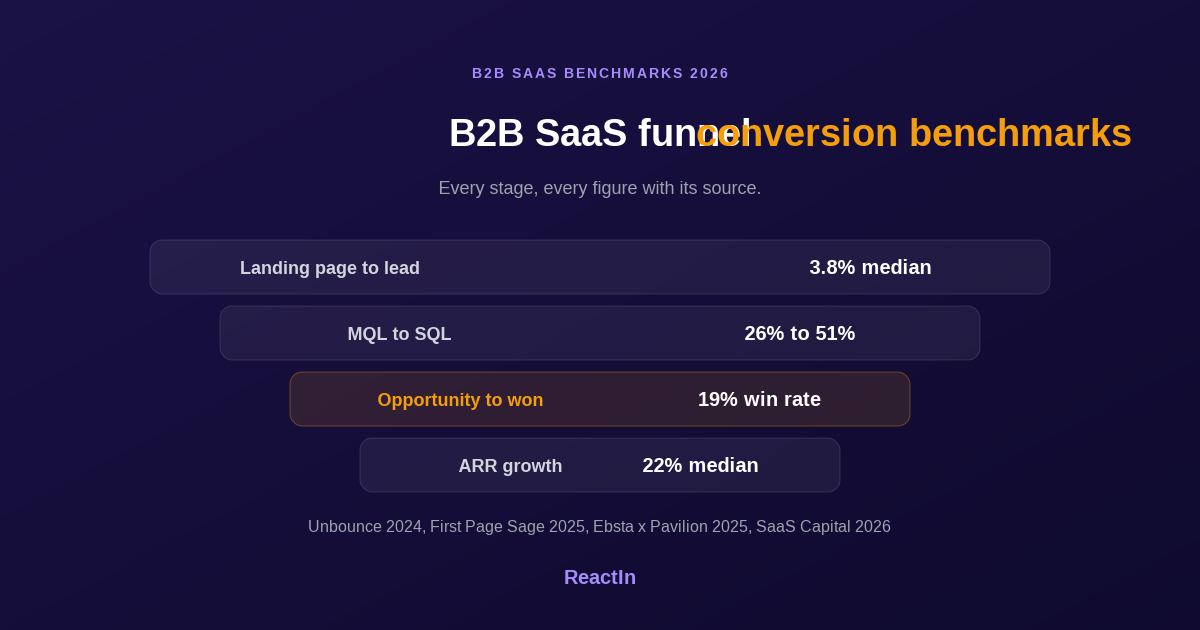
B2B SaaS Funnel Conversion Benchmarks 2026: Every Stage, With Sources
Sourced conversion benchmarks for each stage of the B2B SaaS funnel, from visitor to closed-won and trial to paid: the formula, sales-led and product-led rates, non-SaaS benchmarks, and where to fix the funnel first.

The B2B SaaS GTM Stack in 2026: What a Series B Team Actually Runs
The best go-to-market tools for B2B SaaS in 2026. A complete 12-tool GTM stack with automation platforms that actually integrate - from prospecting to closing, built for scaling SaaS businesses. ~$500/month total.
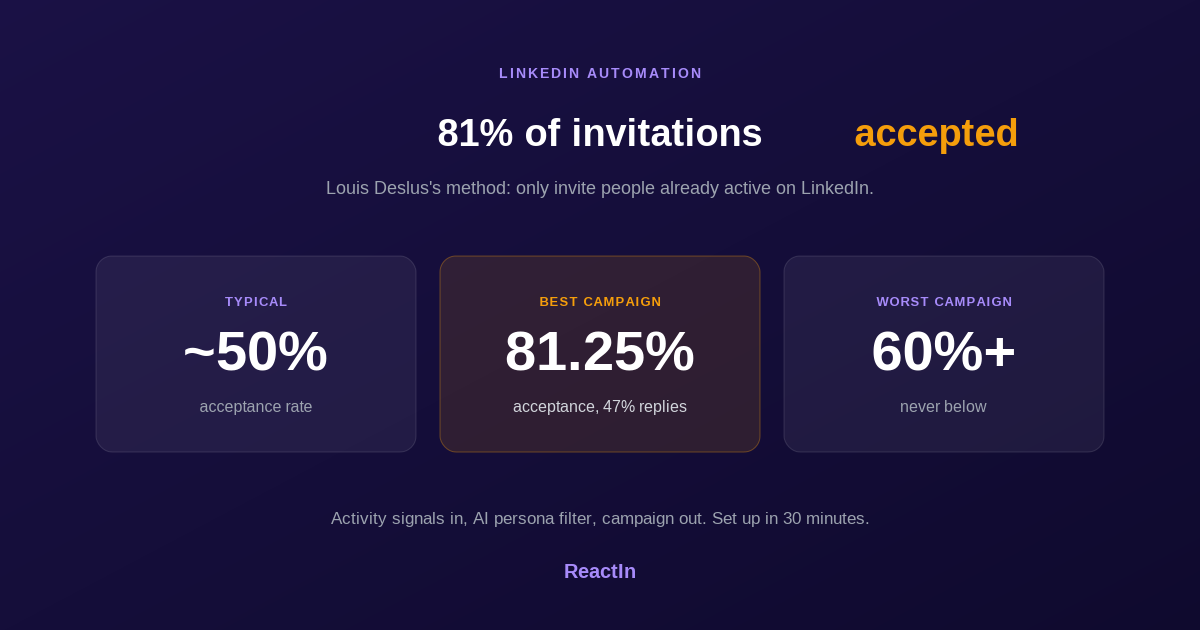
81% LinkedIn Acceptance Rate: Louis Deslus's Method, Set Up in 30 Minutes
Louis Deslus gets 81% of his LinkedIn invitations accepted and no campaign under 60%. The method: invite only people already active on LinkedIn, filter them to your persona, and let the list feed the campaign.
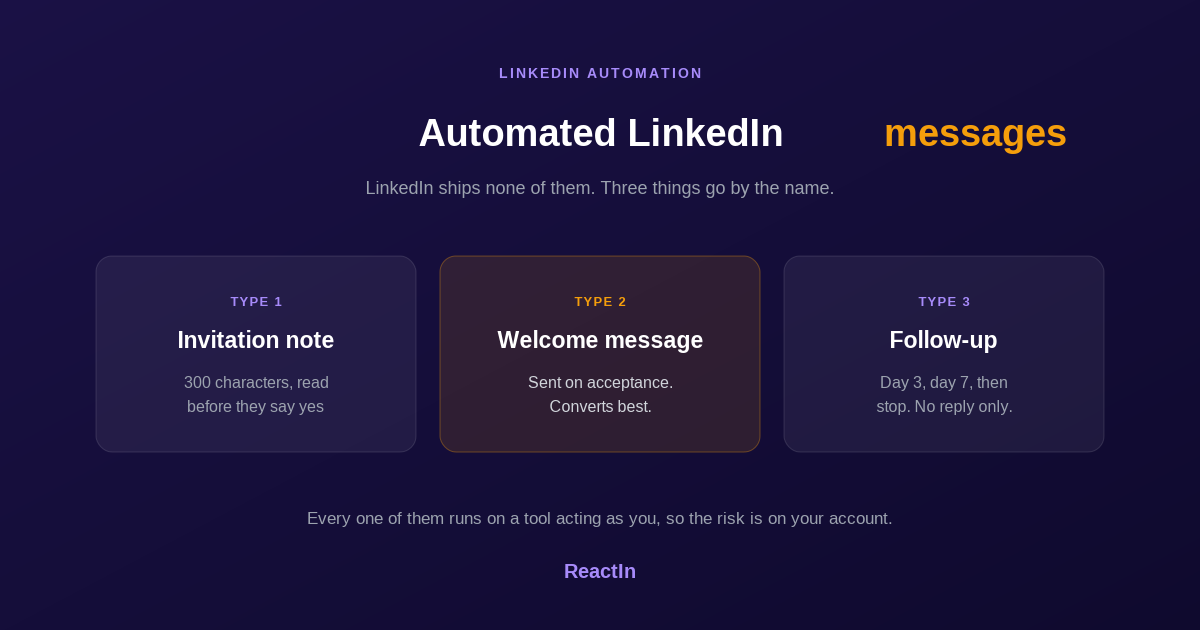
Automated LinkedIn Messages: How to Send Them Without Getting Restricted (2026)
LinkedIn ships no automated messaging at all. Here are the three things people call an automated LinkedIn message, how to set one up, what the terms actually say, and the four cases where writing by hand wins.