You're in the right place if:
Your LinkedIn DM reply rate is below 10%
You're getting ignored despite "personalization"
You want proven rules, not generic advice
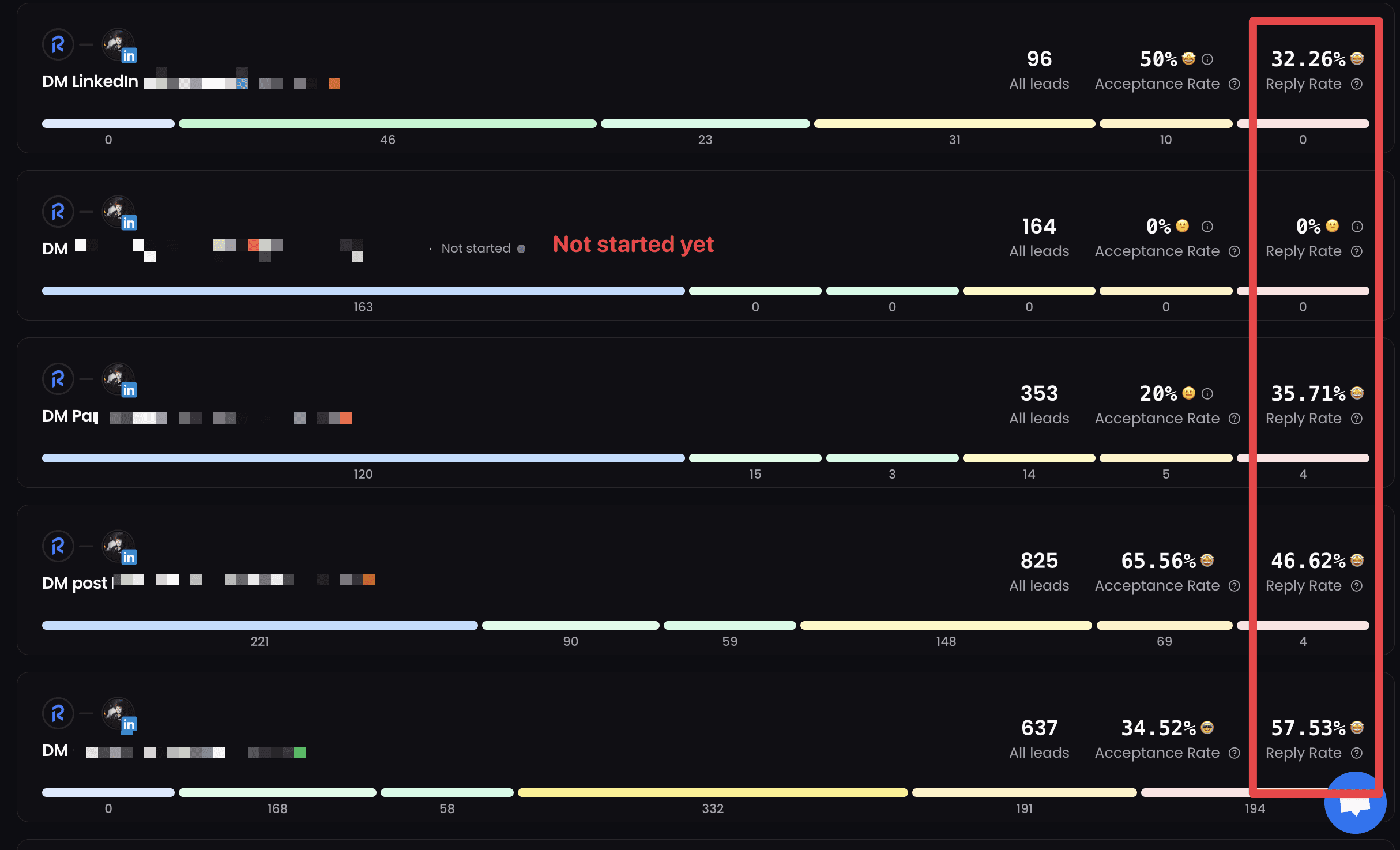
This guide breaks down the 9 copywriting rules behind 32-57% reply rates across 5,000+ campaigns.
The Data: What 32-57% Reply Rates Look Like
Before we dive into the rules, here's proof they work.
Real reply rates from 5 of my ReactIn LinkedIn campaigns using the 9 rules
Campaign breakdown:
Campaign 1: 96 leads → 32.26% reply rate
Campaign 2: 353 leads → 35.71% reply rate
Campaign 3: 825 leads → 46.62% reply rate
Campaign 4: 637 leads → 57.53% reply rate
Average LinkedIn DM reply rate: 8-12%.
My average LinkedIn DM reply rate: 35-45%.
The difference? Following these 9 rules.
The 9 LinkedIn DM Copywriting Rules
Rule 1: Never Start with "Hello {{firstname}}"
Your brain instantly recognizes automation.
"Hello Jean," triggers the same pattern-recognition as spam emails.
❌ Bad:
✅ Good:
The principle: Names should feel natural, not like a mail merge.
Rule 2: Don't Reveal Your Tracking Sources
This is counterintuitive.
Standard advice: "I saw you commented on [Name]'s post about [Topic]..."
Why this kills conversion: It makes people feel watched 🔍
What to do instead:
Use behavioral signals to segment, not personalize.
Someone engaged with a post about LinkedIn automation? Send them a message about that topic. But don't tell them you're tracking them.
❌ Bad:
✅ Good:
Same targeting. Different framing.
Exception: When the signal is public and adds value.
Rule 3: One Message = One Goal
Don't try to qualify, pitch, and book a call in the same message.
❌ The mistake:
This has 3 goals. Too much cognitive load.
What to do instead:
Pick one micro-goal per message.
✅ Message 1: Get a reply
✅ Message 2: Qualify interest
✅ Message 3: Offer value
The principle: Move them forward one step at a time.
Rule 4: Write Like WhatsApp, Not Corporate Email
Read your DM out loud.
Does it sound like a text message or a cover letter?
❌ Corporate:
✅ Conversational:
Key differences:
No "Dear" or "Hello"
Short sentences
Natural language
Questions, not monologues
The principle: LinkedIn is social. Write socially.
Rule 5: 2-Line Question >>> 10-Line Pitch
The data:
Messages with a question in the first 2 lines: 23% reply rate. Messages that pitch for 10 lines: 7% reply rate
Why questions win: They engage. Pitches create resistance.
❌ 10-line pitch:
✅ 2-line question:
The principle: Ask first. Pitch later.
Rule 6: Highlight the Pain First, Then Your Solution
Don't lead with your product.
The mistake:
Nobody cares about your product yet. They care about their problem.
✅ Pain-first structure:
The principle: Agitate the problem before offering the solution.
Rule 7: Build Context Before Selling
Don't pitch immediately.
The timeline:
Message 1: Ask a question
Message 2: Respond to their answer
Message 3: Offer value (now you can mention your product)
❌ Immediate pitch:
✅ Context-first:
Message 1: "Running any LinkedIn outreach?" They reply: "Yeah, using [Tool]." Message 2: "How's it working? Getting leads or conversations?" They reply: "Mostly conversations. 8% reply rate." Message 3:
The principle: Earn the right to pitch.
Rule 8: Max 2 Emojis (You're Not 16)
The trap:
This doesn't make you memorable. It makes you look desperate.
The rule: 1-2 emojis max.
✅ Good usage:
The principle: Emojis are punctuation, not decoration.
Rule 9: Make Replying Easier Than Ignoring
If your message requires effort to respond to, it won't get a response.
High-friction:
Low-friction:
Examples of easy questions:
"LinkedIn working for you?"
"Getting leads or conversations?"
"Happy with your current tool?"
"Tried automation before?"
All answerable in 1-5 words.
The principle: The easier you make it to reply, the more replies you get.
Putting It All Together: Before and After
❌ Before (8% Reply Rate)
Breaks 6+ rules.
✅ After (32%+ Reply Rate)
Message 1:
Message 2 (after they reply):
Message 3 (only if engaged):
Follows all 9 rules.
Common Mistakes
Mistake 1: Being Too Vague
Bad:
This follows Rule 2 but is too vague.
Better:
The fix: Be vague about how you found them, not what you're asking.
Mistake 2: Giving Up After Message 1
Most replies come on message 2 or 3.
Follow-up template:
The principle: Persistence (with respect) wins.
Tools That Help You Scale
Writing good DMs is one thing. Doing it at scale is another.
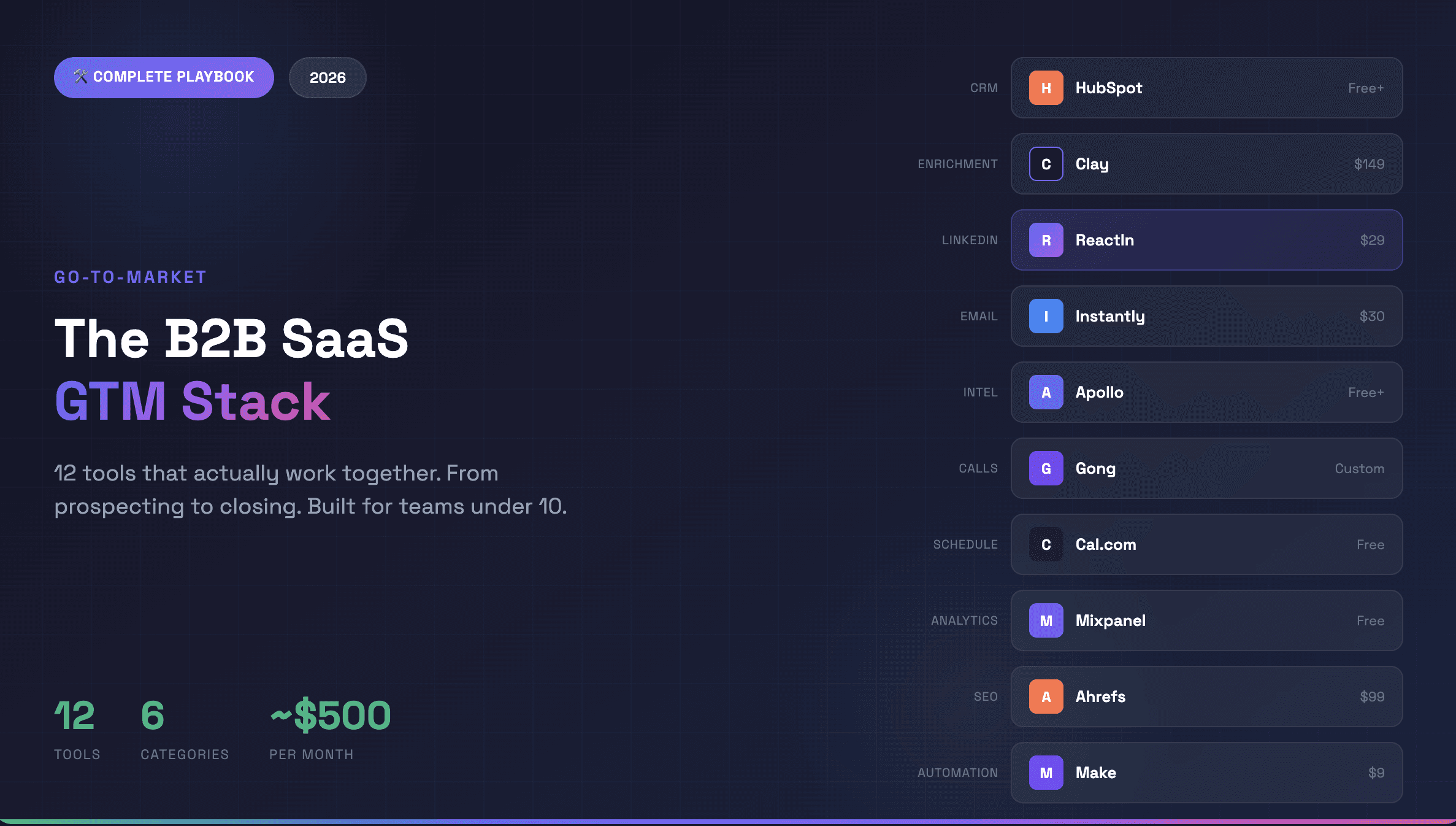
ReactIn is built for intent-based automation:
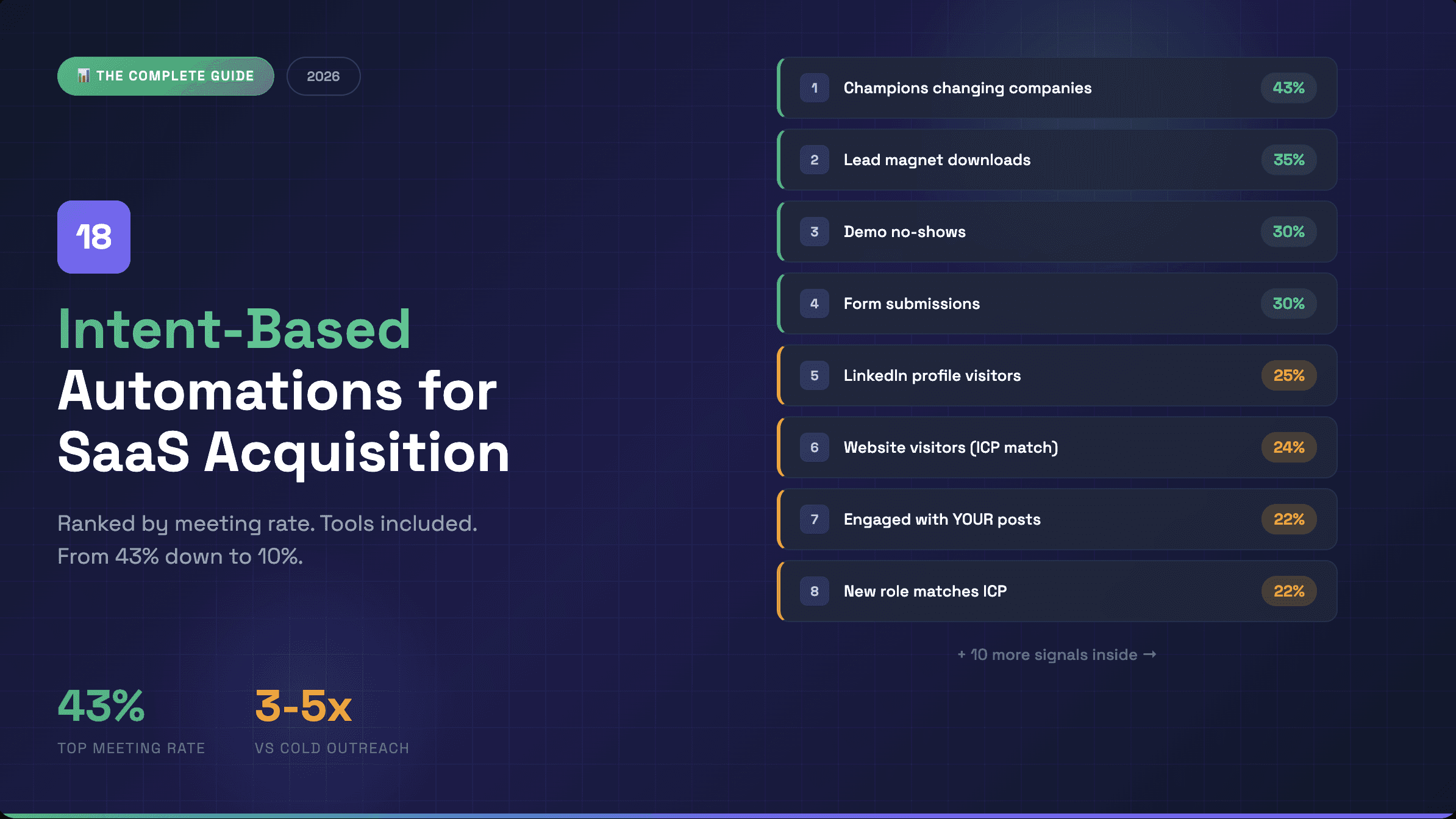
Track behavioral signals (post engagement, profile visits, webinar attendance)
Automatically build lists of people who showed interest
Send messages following the 9 rules
Track reply rates and optimize
Relevant templates:
Your Post Engagers (Pixel): Capture everyone who likes/comments on your content
Profile Visitors: Scrape all daily visitors (LinkedIn Premium required)
LinkedIn Webinar Attendees: Scrape attendees of LinkedIn Events
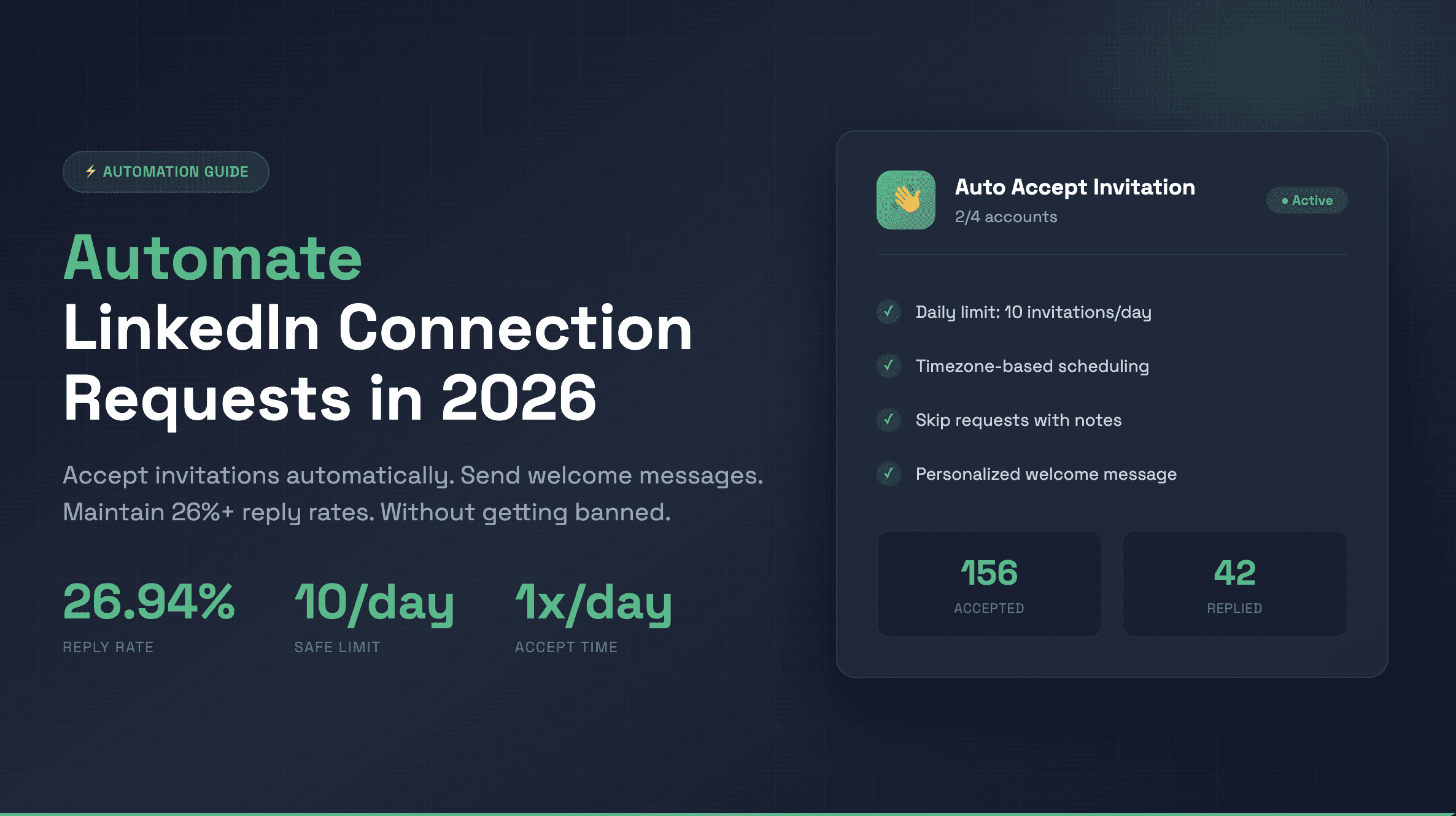
Received Connection Requests: Auto-accept incoming invites + send welcome DM
Competitor Post Engagers (Spyer): Track engagers from competitors and influencers
Key Takeaways
The 9 rules:
Never start with "Hello {{firstname}}"
Don't reveal tracking sources
One message = one goal
Write like WhatsApp
2-line question >>> 10-line pitch
Pain first, solution second
Build context before selling
Max 2 emojis
Make replying easier than ignoring
Result: 32-57% reply rates vs 8-12% average.
Strategy: Track behavioral signals. Target intent. Follow the 9 rules.
Tool to scale: ReactIn handles signal-tracking and list-building automatically. You focus on writing messages that convert.
Try ReactIn free. No credit card required. 💙
27% average reply rate across 5,000+ user campaigns
François D.
Founder, ReactIn
My LinkedIn profile
Related Articles:
How to Automatically Accept LinkedIn Connection Requests (and Send a Welcome DM)
Should You Add a Note to LinkedIn Connection Requests? (2025 Data)
Last Updated: 2026
FAQ
Do these rules work for cold outreach?
Yes, but they work better with warm leads (people who showed intent).
How many messages per day?
Conservative: 20-30/day. Aggressive: 50-80/day (higher risk). Focus on quality > quantity.
How long before following up?
Follow-up 1: 3-4 days. Follow-up 2: 7 days later. Then move on.