Best Go-to-Market Tools for B2B SaaS 2026: The 12-Tool GTM Stack
The best go-to-market tools for B2B SaaS in 2026. A complete 12-tool GTM stack with automation platforms that actually integrate — from prospecting to closing, built for scaling SaaS businesses. ~$500/month total.
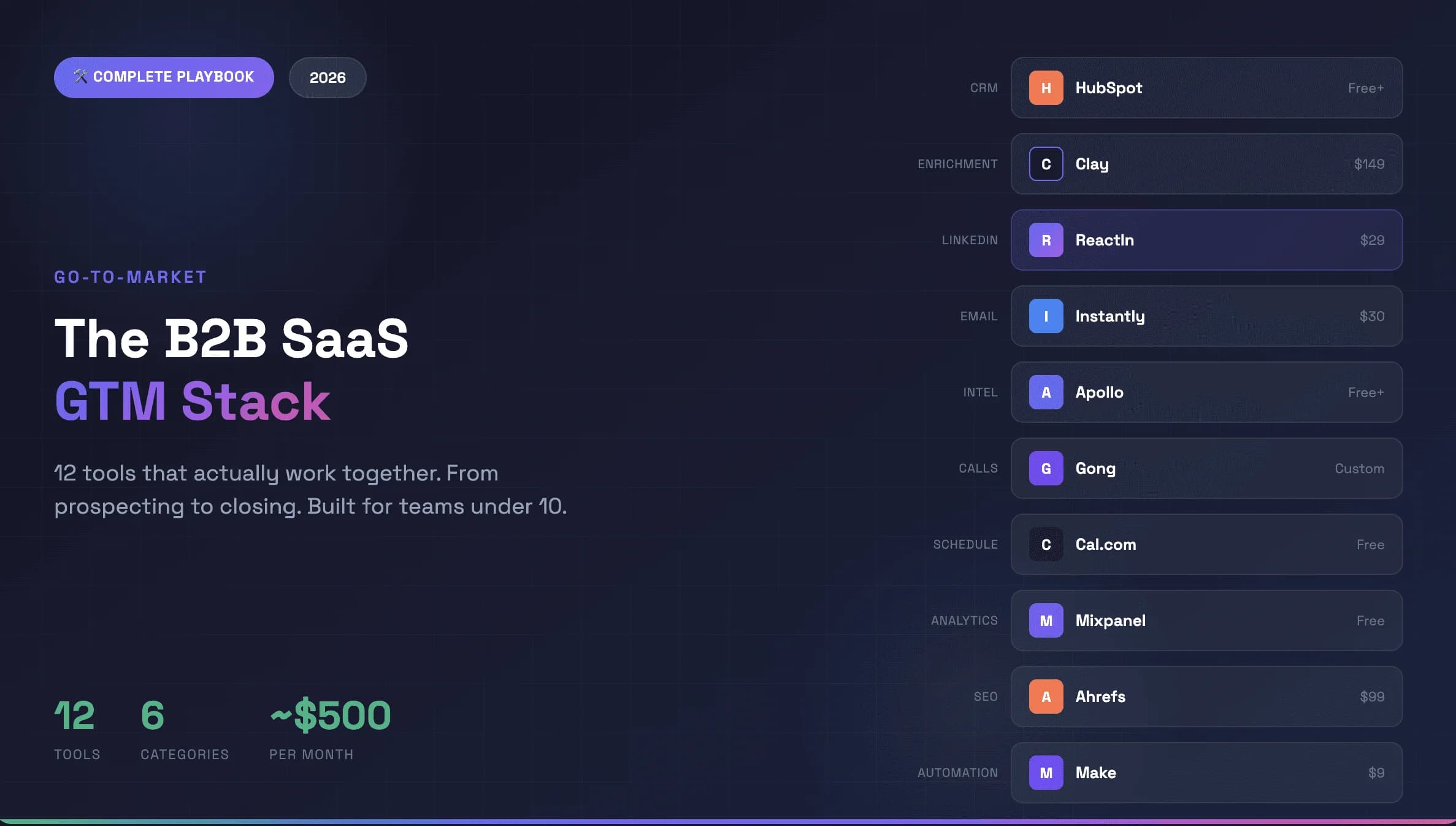
Looking for the best go-to-market tools for B2B SaaS in 2026? Most teams either overspend on enterprise suites they barely use, or cobble together random tools that don't talk to each other. Both approaches waste money and pipeline.
After building and optimizing GTM stacks for multiple SaaS companies, I've landed on a 12-tool sales automation stack that covers every stage from discovery to close — the best GTM stack automation platforms for SaaS, for a fraction of what legacy solutions charge.
Total monthly cost for a complete GTM stack
Based on Growth tier pricing
Best Go-to-Market Tools for B2B SaaS: The 12-Tool Stack
Here are the best go-to-market tools for B2B SaaS in 2026 at a glance. Scroll down for the detailed breakdown of each tool and how they connect into a modern sales automation stack.
| Tool | Category | Price | Key Job |
|---|---|---|---|
| HubSpot | CRM | Free–$800/mo | Single source of truth for pipeline |
| Clay | Data Enrichment | $149–349/mo | Enrich leads from 75+ sources |
| ReactIn | LinkedIn Outreach | $29–69/mo | Intent-based LinkedIn automation |
| Instantly | Cold Email | $30–77/mo | High-volume cold email at scale |
| Apollo | Sales Intelligence | Free–$79/mo | Prospect discovery and contact data |
| Gong | Conversation Intelligence | Custom | Call recording and deal intelligence |
| Cal.com | Scheduling | Free–$12/mo | Meeting booking with CRM sync |
| Make | Automation | $9–16/mo | Workflow glue between all tools |
| Notion | Content & Docs | Free–$10/mo | Content planning and team wiki |
| Loom | Video | Free–$12.50/mo | Async video for sales and onboarding |
| Mixpanel | Analytics | Free–$20/mo | Product and funnel analytics |
| Ahrefs | SEO | $99–199/mo | Organic traffic and keyword tracking |
The Philosophy: Integration Over Features
Enterprise sales suites promise everything in one dashboard. In practice, they do 20 things at 60% quality. A curated GTM stack of specialist automation platforms does 12 things at 95% quality — and costs less.
The key is how well the tools connect, not how many features each one has. Three principles guide this stack:
- One job per tool. Each tool does one thing exceptionally well. No overlap, no redundancy.
- Data flows automatically. Every tool feeds data to the next one in the pipeline. No manual exports, no copy-pasting.
- Replace, don't accumulate. If a tool isn't earning its cost back within 30 days, cut it. No shelf-ware.
With that mindset, here's the stack broken down by category.
CRM: HubSpot
HubSpot (Free–$800/mo)
HubSpot's free CRM is genuinely one of the best products in SaaS. Unlimited contacts, deal pipelines, email tracking, and meeting scheduling — all without paying a cent.
The reason HubSpot wins isn't features. It's ecosystem. Every tool in this stack integrates with HubSpot natively or through Make. That makes it the natural hub for your pipeline data.
- Free tier with unlimited contacts and deal tracking
- Native integrations with most GTM tools on the market
- Built-in email tracking, templates, and sequences
- Scales from solo founder to 200-person sales org without migration
Alternative: Attio — a modern CRM with a cleaner UI and better data modeling. Great for teams that find HubSpot bloated, but the integration ecosystem is smaller.
Data Enrichment: Clay
Clay ($149–349/mo)
Clay is the data enrichment layer that makes every other tool in your stack perform better. It pulls from 75+ data providers in a single query, waterfall-style — if one source doesn't have the data, it tries the next.
The real power is enrichment workflows. Import a list of companies, and Clay returns verified emails, tech stack data, funding info, employee count, LinkedIn URLs, and custom AI-generated research — all in one table.
- 75+ data providers in one platform (no separate subscriptions needed)
- Waterfall enrichment: automatically tries multiple sources per field
- AI-powered research agent that summarizes company news, blog posts, and hiring signals
- Direct integrations with HubSpot, Instantly, and outreach tools
Alternative: Clearbit (now part of HubSpot) — simpler enrichment with fewer sources, but tightly integrated if you're already on HubSpot paid plans.
LinkedIn Outreach: ReactIn
ReactIn ($29–69/mo)
LinkedIn is where B2B deals start. But most LinkedIn automation tools treat it like email — blast generic messages to thousands of strangers and hope for the best. ReactIn takes the opposite approach.
ReactIn's SmartLists capture people who already showed interest in you or your competitors — profile visitors, post engagers, competitor followers — and auto-enrolls them in personalized outreach campaigns.
- Spyer: Monitor any LinkedIn profile's network for new connections and engagements
- Pixel: Track website visitors and match them to LinkedIn profiles
- Profile visitor capture with automatic campaign enrollment
- Native Cal.com and Tally.so integrations for instant lead capture
- Cloud-based execution with human-like delays for account safety
The result: 20-60% reply rates vs. the 5-15% you get with cold outreach tools. You're not interrupting strangers — you're responding to intent.
| Plan | Price | What You Get |
|---|---|---|
| Basic | $29/mo | Connection requests, SmartLists, basic intent signals |
| Growth | $69/mo | + DMs, smart inbox, all intent signals, advanced campaigns |
| Agency | $1,000/mo | 50 accounts ($20/account), white-label, priority support |
Alternative: Expandi ($99/mo) — solid for volume-based automation, but lacks intent signals and costs 3x more per seat.
Cold Email: Instantly
Instantly ($30–77/mo)
Instantly is purpose-built for cold email at scale. Unlimited email accounts, built-in warmup, and a sending infrastructure designed to land in primary inboxes — not spam.
Where Instantly shines is email account rotation. Connect 10+ sending accounts and Instantly distributes your campaigns across them automatically, keeping each account under the radar.
- Unlimited email accounts with automatic rotation
- Built-in warmup that runs in the background
- AI-powered sequence generation and A/B testing
- Lead database with verified B2B contacts
Alternative: Lemlist — better for multichannel sequences (email + LinkedIn + phone), but more expensive and LinkedIn features require the $79/mo plan.
Sales Intelligence & Conversations
Apollo (Free–$79/mo)
Apollo is the best free prospecting tool on the market. The free tier gives you 60 email credits per month, basic filters, and access to a 275M+ contact database. The paid tiers unlock advanced filters, intent data, and bulk export.
- 275M+ verified B2B contacts with email and phone data
- Advanced filters: company size, funding stage, tech stack, job changes
- Intent signals based on topic research and website visits
- Native CRM integrations with HubSpot and Salesforce
Gong (Custom pricing, ~$150/user/mo)
Gong records and analyzes every sales call, giving you deal intelligence that's impossible to get manually. It's expensive, but the insight into what's actually happening in your pipeline is worth it at scale.
- Automatic call recording and transcription with AI summaries
- Deal intelligence: risk signals, competitor mentions, next steps tracking
- Coaching insights: talk-to-listen ratio, question frequency, topic analysis
Alternatives: Chorus (now ZoomInfo) for conversation intelligence. For Apollo alternatives, consider ZoomInfo (enterprise) or Lusha (simpler, cheaper).
Operations: Cal.com, Make, Notion, Loom
These four tools form the operational backbone of your GTM stack. Individually they're simple. Together, they eliminate 80% of the manual work that slows down sales teams.
Cal.com (Free–$12/mo)
Open-source scheduling that integrates with everything. Cal.com's native ReactIn integration means that every meeting booked automatically triggers a LinkedIn connection request and CRM update.
- Native ReactIn integration: auto-connect with prospects who book meetings
- HubSpot sync: every booking creates or updates a CRM contact
- Round-robin routing for team scheduling
Make ($9–16/mo)
Make (formerly Integromat) is the automation glue that connects your entire stack. Build workflows that trigger across tools without writing code.
- Visual workflow builder with 1,500+ app integrations
- Conditional logic, error handling, and data transformation
- 10x cheaper than Zapier for the same number of operations
Notion (Free–$10/mo)
Notion AI handles content planning, meeting notes, playbook documentation, and team wikis. The AI features summarize meeting notes and draft follow-up content automatically.
- Content calendar and editorial planning
- Sales playbooks and battlecards accessible to the whole team
- AI-powered meeting note summaries and action items
Loom (Free–$12.50/mo)
Loom replaces live demos and internal walkthroughs with async video. Record a personalized product demo in 3 minutes instead of scheduling a 30-minute call.
- Personalized video messages for outbound prospecting
- Product demos and feature walkthroughs at scale
- Internal onboarding and process documentation
Analytics & SEO: Mixpanel, Ahrefs
Mixpanel (Free–$20/mo)
Mixpanel tracks what happens after the lead enters your funnel. Signup-to-activation rates, feature adoption, and revenue attribution — the metrics that tell you if your GTM is actually working.
- Event-based analytics with funnel and retention analysis
- Free tier with 20M events/month (more than enough for most SaaS)
- Cohort analysis to track which acquisition channels produce the best users
Ahrefs ($99–199/mo)
Ahrefs is the SEO engine that drives organic pipeline. Track keyword rankings, analyze competitors' content strategies, and find content gaps that turn into lead magnets.
- Keyword tracking, site audit, and backlink analysis
- Content gap analysis: find what competitors rank for and you don't
- Content explorer: discover top-performing content in your niche
Alternatives: Semrush for all-in-one SEO (pricier). PostHog or Amplitude as Mixpanel alternatives.
GTM Stack for Scaling Your SaaS Business: Budget Tiers & Data Flow
Not every team needs the full stack from day one. Whether you're a solo founder or scaling a SaaS business to Series B, here's how to invest in go-to-market tools based on your stage:
Starter (~$68/mo)
| Tool | Plan | Cost |
|---|---|---|
| HubSpot | Free | $0 |
| Apollo | Free | $0 |
| ReactIn | Basic | $29 |
| Instantly | Growth | $30 |
| Cal.com | Free | $0 |
| Notion | Free | $0 |
| Loom | Free | $0 |
| Make | Core | $9 |
| Mixpanel | Free | $0 |
Growth (~$466/mo)
| Tool | Plan | Cost |
|---|---|---|
| HubSpot | Starter | $20 |
| Clay | Starter | $149 |
| Apollo | Basic | $49 |
| ReactIn | Growth | $69 |
| Instantly | Growth | $30 |
| Cal.com | Team | $12 |
| Ahrefs | Lite | $99 |
| Notion | Plus | $10 |
| Make | Pro | $16 |
| Mixpanel | Free | $0 |
| Loom | Business | $12.50 |
Scale (~$1,500/mo)
| Tool | Plan | Cost |
|---|---|---|
| HubSpot | Professional | $800 |
| Clay | Pro | $349 |
| Gong | Custom | ~$150/user |
| Ahrefs | Standard | $199 |
Data Flow
Every tool in the stack feeds data forward through five stages. No manual handoffs, no data silos.
Discovery (Apollo) → Outreach (ReactIn + Instantly) → Engagement (HubSpot + Cal.com) → Close (Gong + HubSpot) → Expand (Mixpanel + Notion)
Build Your Stack: 4-Week Plan
Week 1: Foundation
Set up HubSpot CRM, Cal.com for scheduling, and Loom for async demos. These three are free and give you the backbone.
Week 2: Outreach
Add ReactIn for LinkedIn outreach and Instantly for cold email. Connect both to HubSpot so every touchpoint is tracked.
Week 3: Intelligence
Add Apollo for prospect discovery and Make for workflow automation. Build your first automated flow: Apollo finds leads → Make pushes to ReactIn.
Week 4: Enrichment & Analytics
Add Clay for data enrichment and Mixpanel for funnel analytics. Now your outreach is personalized and you can measure what's working.
Conclusion: The Best GTM Stack for Scaling Your SaaS in 2026
You don't need a $50,000/year enterprise suite to run world-class GTM. You need the best go-to-market tools for B2B SaaS — 12 automation platforms that each do one thing exceptionally well, connected by workflows that eliminate manual work.
The total cost? ~$500-800/month for a Growth-tier stack that covers discovery, enrichment, outreach, engagement, and analytics. That's less than what most teams spend on a single enterprise tool.
Start with the Starter tier at $68/month. Add tools as they earn their place by creating real pipeline value. Cut anything that doesn't deliver ROI within 30 days.
Looking for the best LinkedIn automation tool specifically? Read our detailed comparison of the top 6 LinkedIn automation tools for 2026.
Frequently Asked Questions
Related Articles
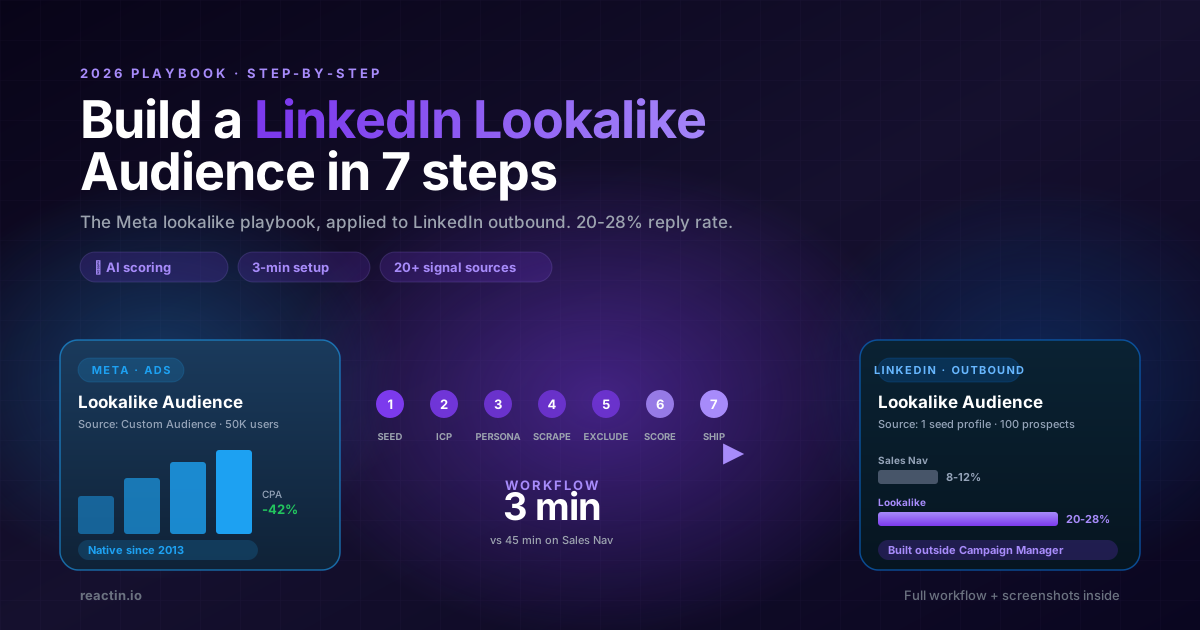
How to Build a LinkedIn Lookalike Audience in 2026 (Full Workflow + Screenshots)
LinkedIn never shipped a native Lookalike Audience for outbound. Here is the full 2026 workflow: pick the seed, write your ICP, run the waterfall scrape, ship a 50-lead audience in under 5 minutes that hits 20-28% reply rates.
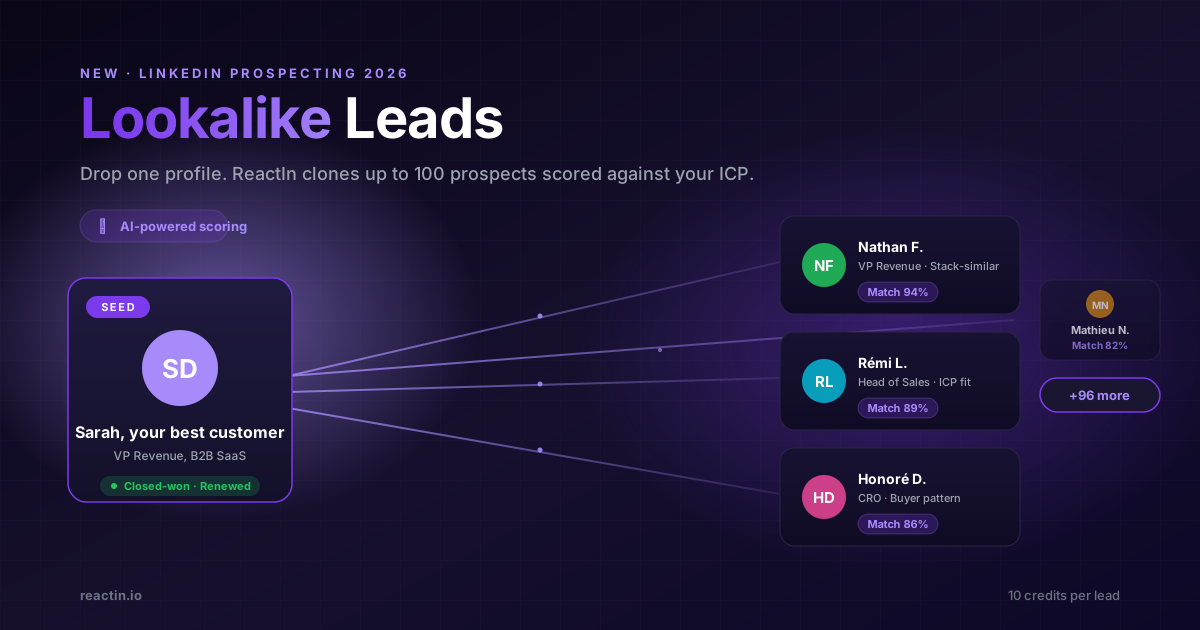
LinkedIn Lookalike Leads: Clone Your Best Customers in 3 Minutes (2026)
Drop one LinkedIn profile, describe your ICP and persona, and ReactIn returns up to 100 prospects who match. The Meta Lookalike playbook, applied to B2B prospecting. 22% reply rates vs 8% from Sales Nav.
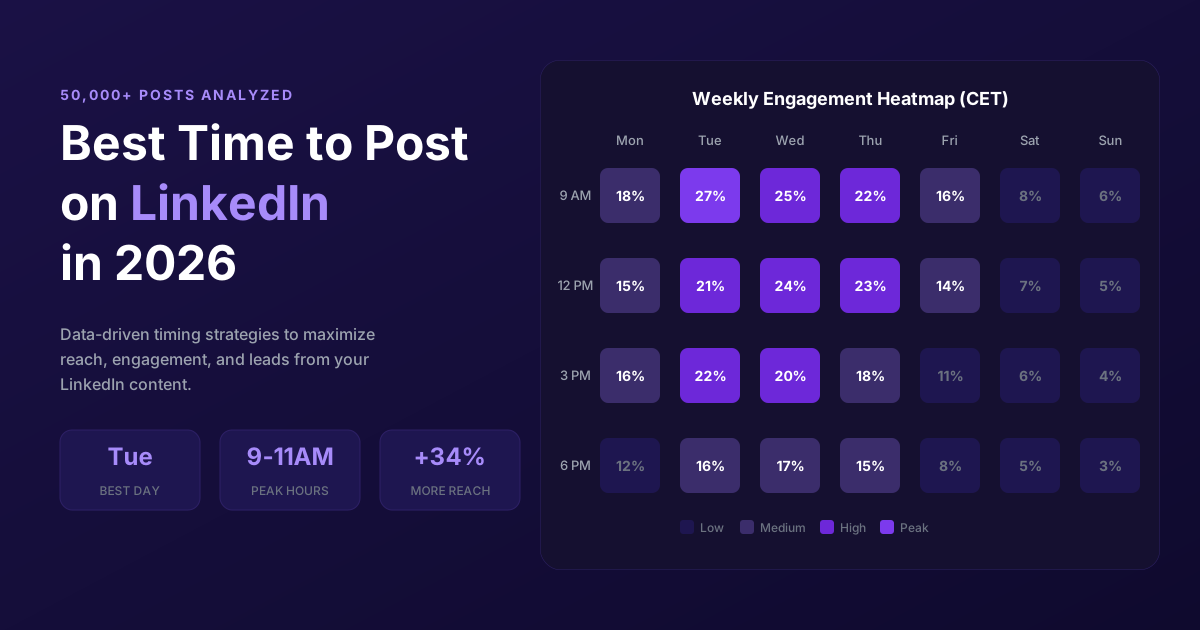
Best Time to Post on LinkedIn in 2026 (50,000+ Posts Analyzed)
When should you post on LinkedIn for maximum engagement? Analysis of 50,000+ posts reveals the best times, days, and strategies to maximize reach in 2026.
LinkedIn Connection Requests: With or Without a Note? (2026 Data)
Should you add a note to LinkedIn connection requests? 80,000+ requests analyzed. No-note invites get 55–68% acceptance vs 28–45% with notes. See when each approach wins.
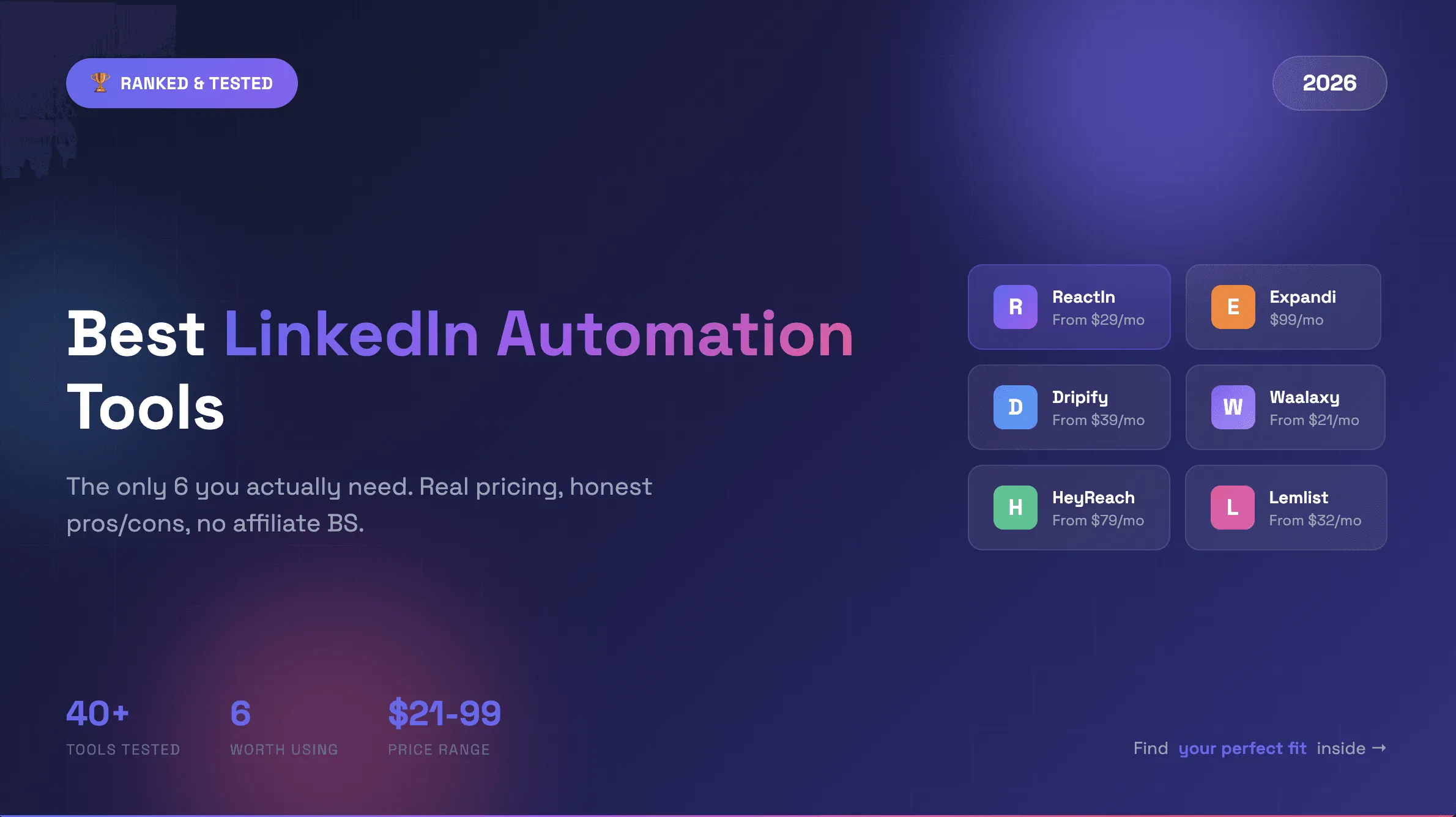
Best LinkedIn Automation Tools 2026 — Top 6 Ranked
Honest comparison of the 6 best LinkedIn automation tools in 2026. Tested hands-on with real campaigns. ReactIn, Expandi, Dripify, Waalaxy, HeyReach, and Lemlist ranked by results.

How to Automate LinkedIn Connection Requests: 5 Rules for 26% Reply Rates (2026)
Stop losing leads. 5 proven rules to automate LinkedIn connection requests safely and hit 26%+ reply rates with personalized welcome messages.
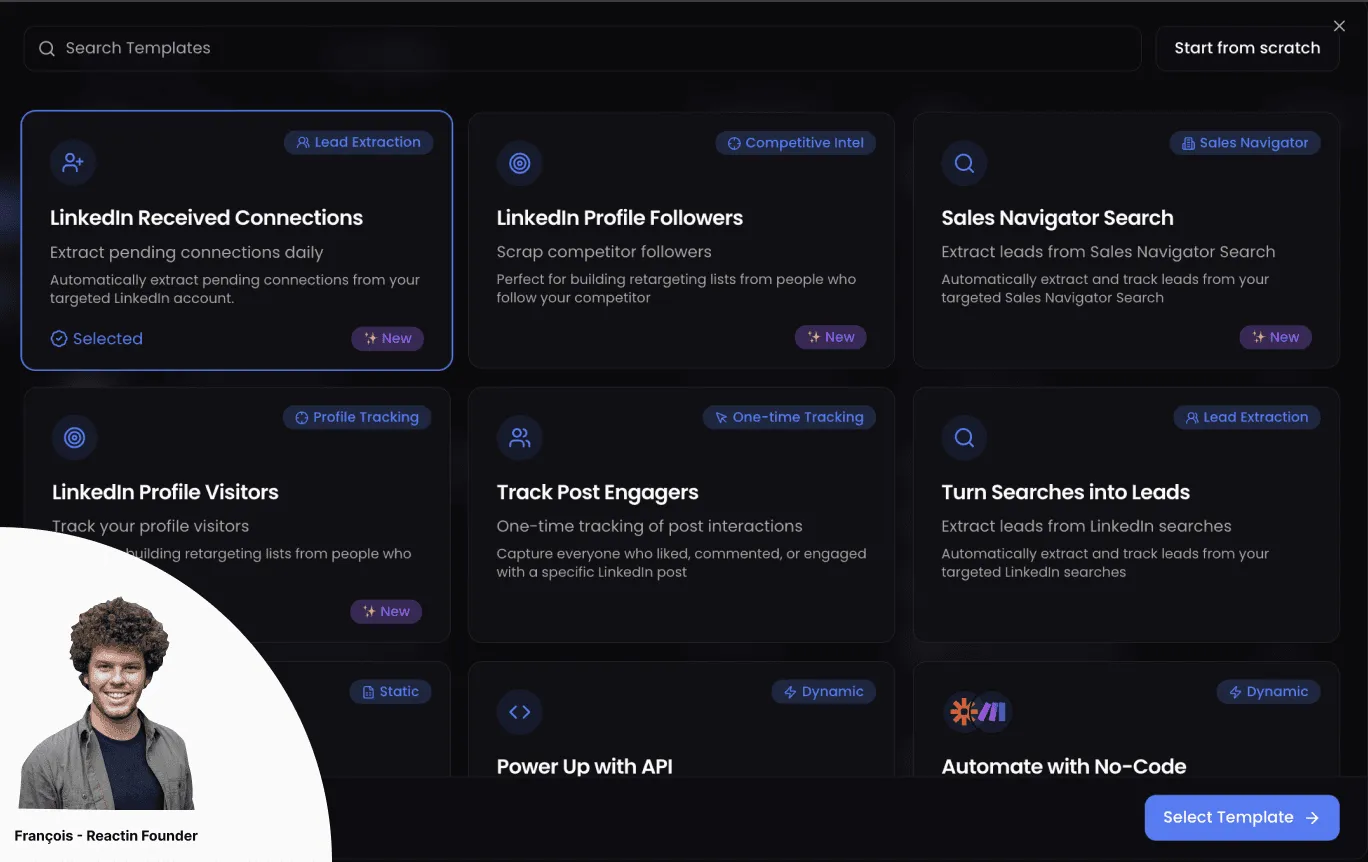
How to Automatically Accept LinkedIn Connection Requests (and Send a Welcome DM)
Learn how to automatically accept LinkedIn connection requests and send personalized welcome DMs. Step-by-step ReactIn setup, compare 5 tools, and maintain 26%+ reply rates safely.

How to Warm Up a LinkedIn Account Safely Before Scaling Outreach (2026)
Step-by-step 4-week plan to warm up your LinkedIn account safely. Daily limits, organic engagement strategy, and how to scale outreach without getting restricted.
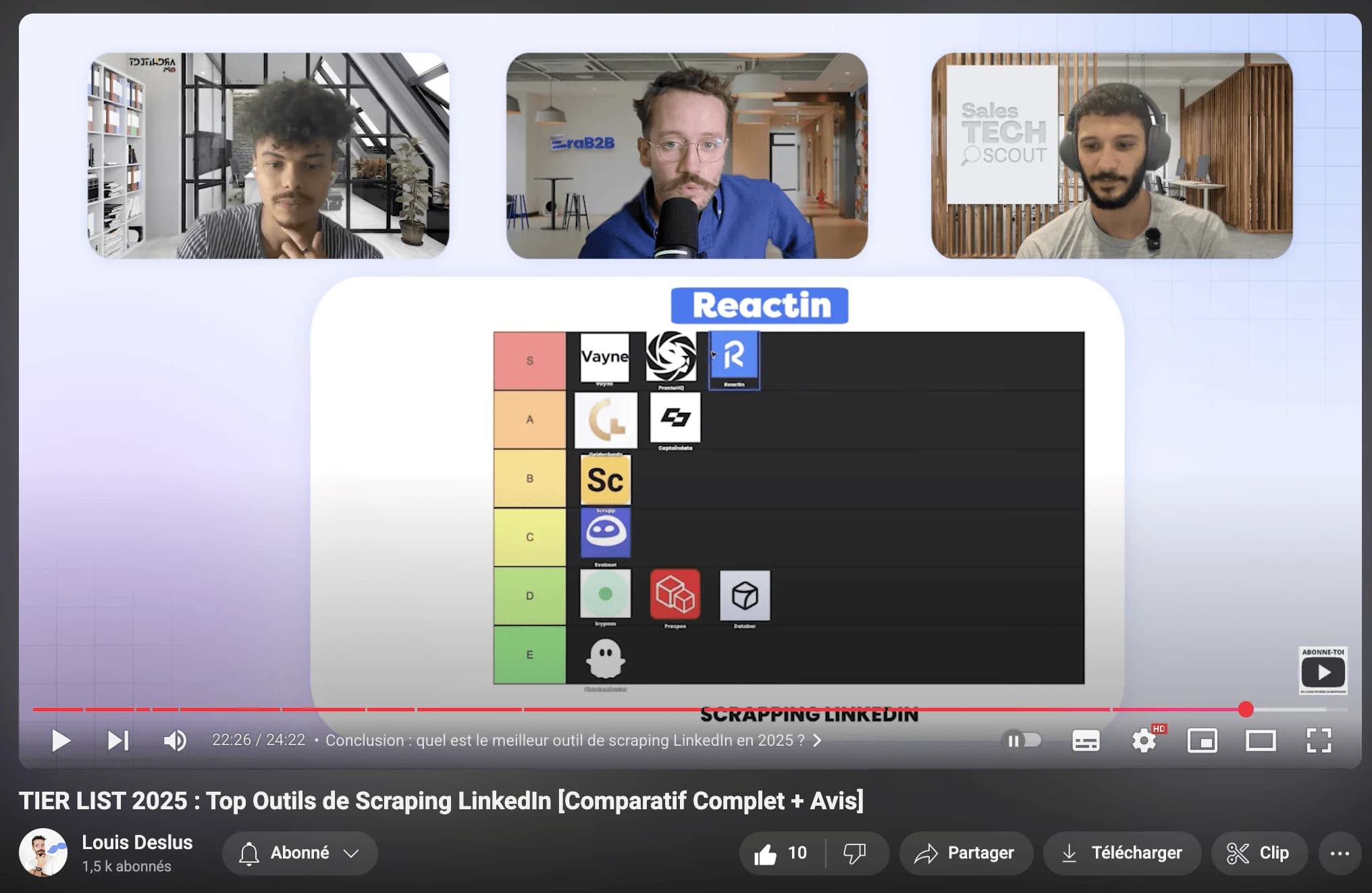
Top LinkedIn Scraping Tools for B2B Growth (2026 Review)
Honest comparison of the best LinkedIn scraping tools in 2026. ReactIn, PhantomBuster, Captain Data, Evaboot, and Prospeo ranked by features, safety, and pricing.
LinkedIn Automation Guide: The Complete 2026 Playbook
The definitive guide to LinkedIn automation in 2026. 5 intent-based workflows, 10 messaging rules, safety limits, and tool comparisons. 27% average reply rate across 5,000+ campaigns.

The 7 Best AI Sales Tools to Close More Deals in 2026
Discover the best AI sales tools in 2026. Top AI-powered tools for closing deals: ReactIn for LinkedIn outreach, Allo as the best AI phone agent, Clay for prospecting, Attio for CRM, and more.
Intent-Based Marketing Automations in 2026: The Complete Guide to 3x Reply Rates
Stop blasting the same message to every lead. Intent-based marketing automations use buyer signals to reach the right person at the right moment — delivering 3x higher reply rates. 5 workflows, benchmarks, and step-by-step setup inside.
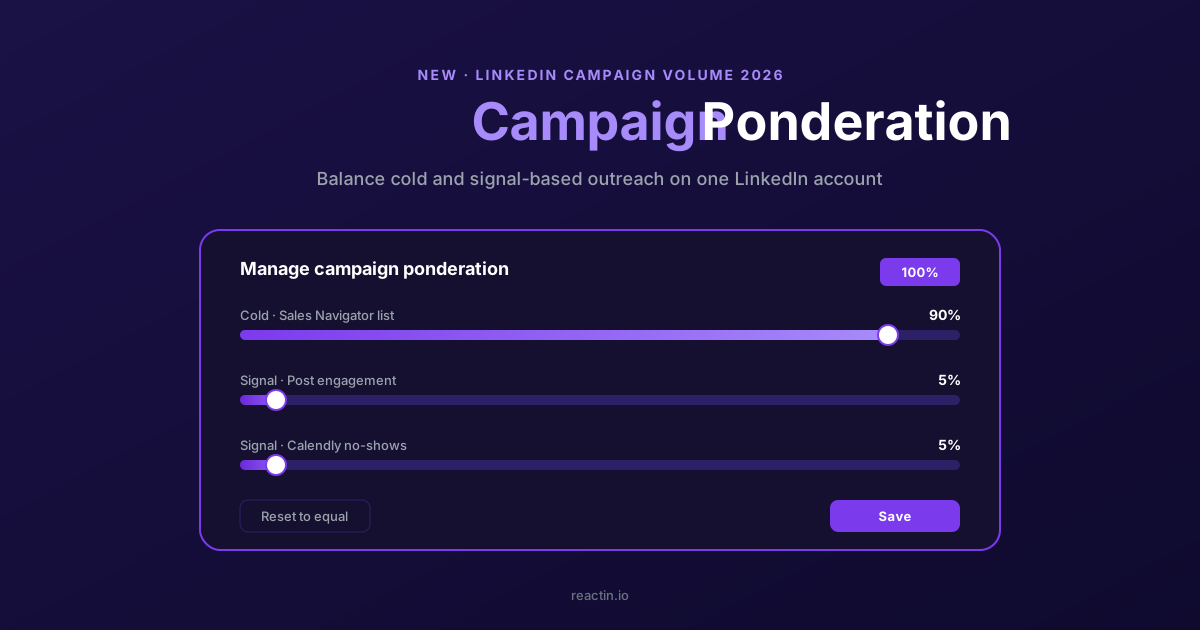
How to Balance LinkedIn Campaign Volume Across Tools (Waalaxy, HeyReach, Expandi, Dripify, LGM, PhantomBuster, Gojiberry vs ReactIn)
Most LinkedIn automation tools force you to pick: one big cold campaign, or none. Here is how Waalaxy, HeyReach, Expandi, Dripify, LGM, PhantomBuster and Gojiberry actually let you split daily volume between campaigns — and how ReactIn’s new Campaign Ponderation finally lets you run a 90/5/5 mix of cold + signal-based outreach.
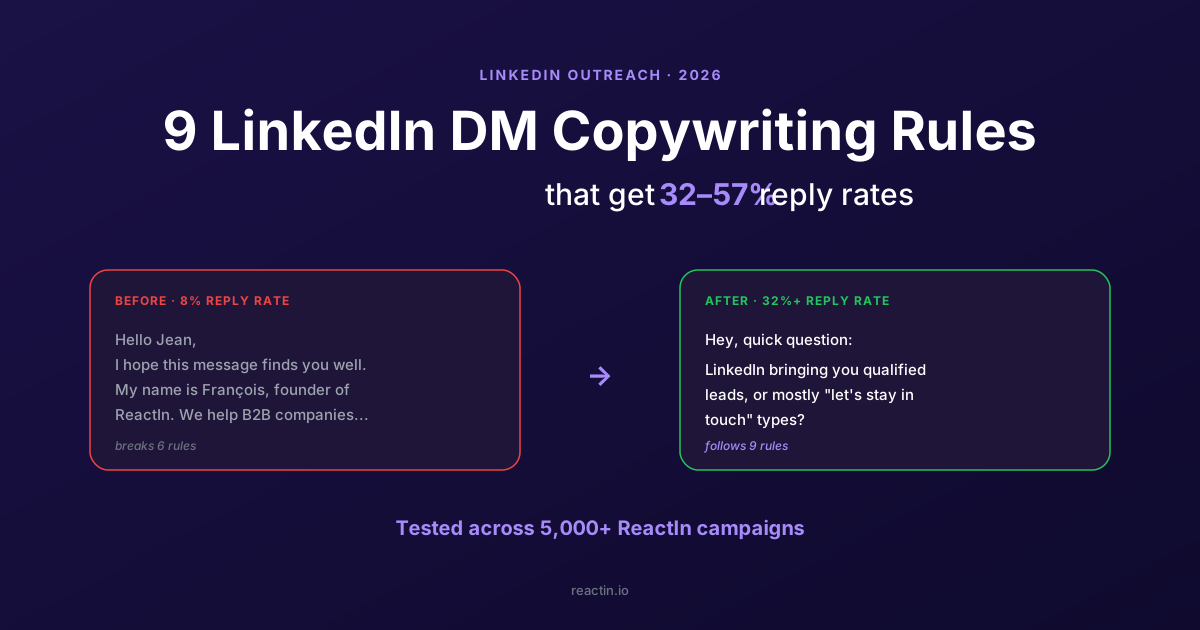
9 LinkedIn DM Copywriting Rules That Get 32-57% Reply Rates (2026)
The average LinkedIn direct message response rate is 8-12%. Our campaigns hit 32-57%. 9 tested copywriting rules, the 5-3-2 rule explained, and how to turn replies into meetings.
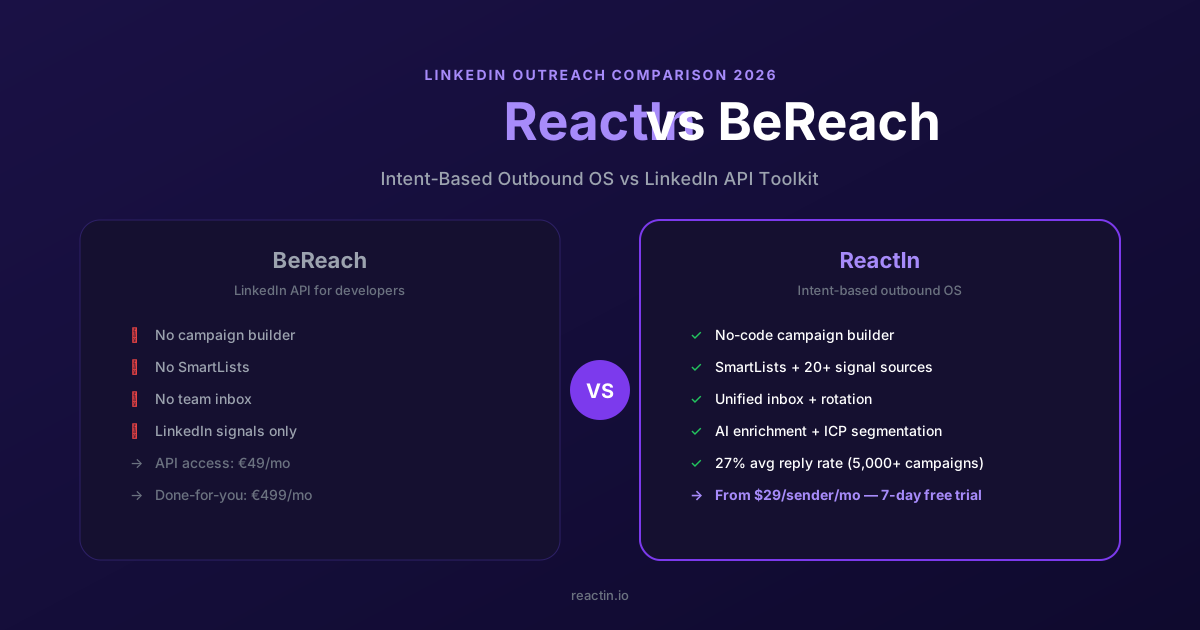
ReactIn vs BeReach (2026): Intent-Based Outbound OS or LinkedIn API Toolkit?
BeReach is a LinkedIn API for developers. ReactIn is an intent-based outbound OS for sales teams — 20+ signal sources, SmartLists, AI enrichment, and 27% reply rates out of the box. Full feature-by-feature comparison.